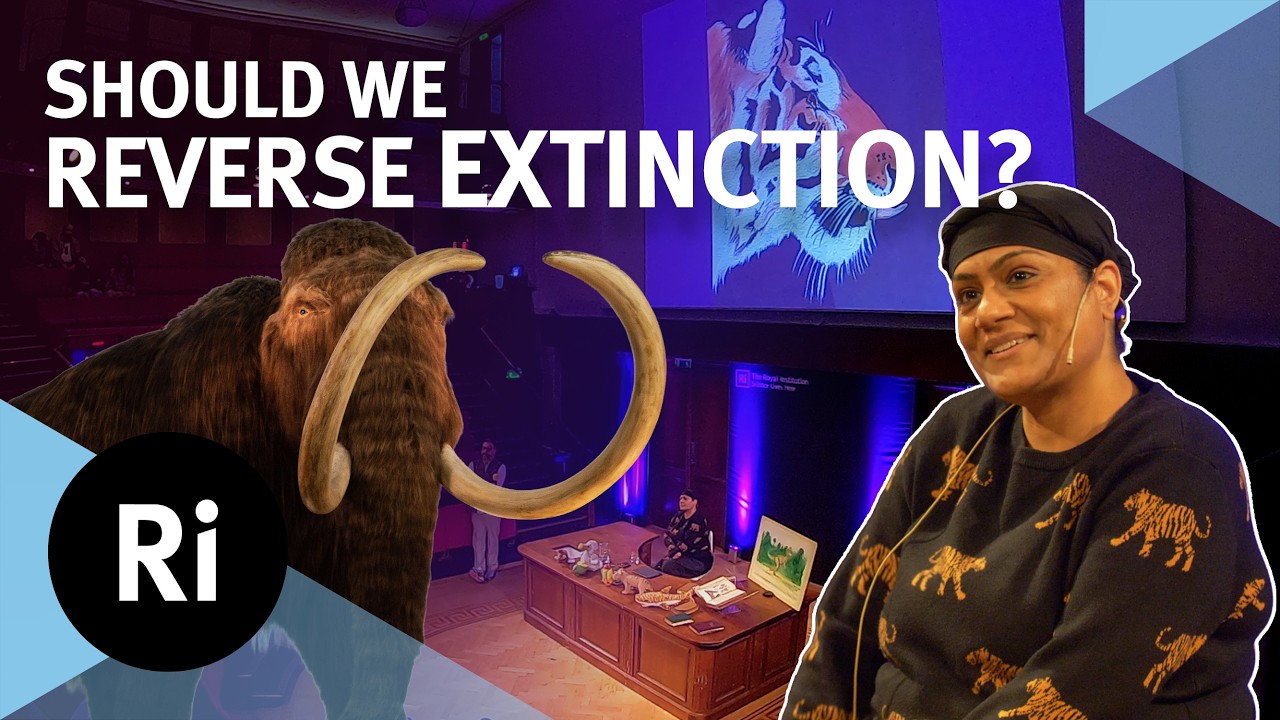
Should we bring extinct species back? | with Sadiah Qureshi
Keywords
Summary
178 words
Critical Evaluation
Value of the Information & Strength of the Argument
The value lies in connecting historical perspectives to modern biotechnology debates, offering a nuanced view rarely found in popular science. Qureshi argues convincingly that the meaning of extinction has evolved and is not fixed, and that de-extinction technologies are not neutral but reshape our relationship with life and death. The argumentation is solid, based on documented historical cases and scientific reports, though the speaker’s advocacy for conservation is clear. She effectively uses specific examples (pyrenean ibex, passenger pigeon) to ground abstract ideas.
Scientific Rigor, Source Quality, Title Accuracy
The lecture is rigorous in its historical methodology, drawing on primary sources like Cuvier’s writings and Newton’s efforts. Although explicit source citations are absent from the talk, the narrative aligns with established scholarship. The title matches content; however, the emphasis is more on the history than on a balanced technological assessment. The description provides links to the speaker’s book and institutional resources, which serve as further reading but are not scientifically verified within the video.
172 words
Title / Content Match
The title accurately reflects the main theme: exploring the history of extinction and the ethical and practical implications of de-extinction.
Quality & Reliability
8/10
The talk is based on extensive historical research by a historian of science, presented at the Royal Institution. It relies on archival evidence and published research, though explicit citations are sparse. The content is well-structured and evidence-based.
Chapters
- Introduction: A World of Extinctions
- When Nobody Believed in Extinction
- Cuvier, Mammoths and the First Extinct Species
- Neanderthals and the Discovery of Deep Human Time
- How Extinction Shaped Colonial Prejudice
- The Great Auk: Hunted for Its Rarity
- Alfred Newton and the Birth of Wildlife Protection
- Bison: The First Species Pulled Back From the Brink
- The Passenger Pigeon and the Death of Martha
- Would You Bring a Species Back?
- Frozen Zoos and the Invention of Cryopreservation
- The Cloned Ibex: A Double Extinction?
- Are Frozen Cells Really Dead?
- The Case Against De-Extinction
- Mammoths, Dire Wolves and Colossal Biosciences
- De-Extinction Becomes Policy
- What Kind of Future Are We Building?
- Birdsong, Trees and Tigers
Cited Sources
- Vanished: An Unnatural History of Extinction (book) — Speaker's latest book, available for purchase, likely summarizes the lecture content.
- Ri Science Podcast — Royal Institution podcast for related content.
- Editorial Policy for Ri Talks — Policy regarding comments and editing of Ri talks.
- Donate to the Royal Institution — Support the institution.
- Q&A session for this talk — Separate video with audience questions.
Contribution & Novelties
The talk provides a unique historical lens on extinction, showing that the concept is recent and mutable. It challenges the de-extinction narrative by questioning the scientific and ethical basis of declaring frozen cells as ’not truly dead’. The speaker introduces the term ’evolutionarily torpid’ and critiques the redefinition of extinction. This adds depth to current debates, emphasizing that de-extinction is about building futures, not just restoring pasts.
Pour aller plus loin :
- De-extinction — Overview of current techniques and ethical debates.
- Cryopreservation — Technical basis for frozen zoos.
- Passenger pigeon — History of the species and potential revival efforts.
- Pyrenean ibex — The cloned ibex case study.
107 words
Radar Profile
The profile shows high scores in information quantity and quality, with moderate technical level. The fiabilité is strong, reflecting the speaker's expertise. The talk is balanced but slightly better on historical depth than on technical detail, as it focuses on conceptual and ethical aspects.