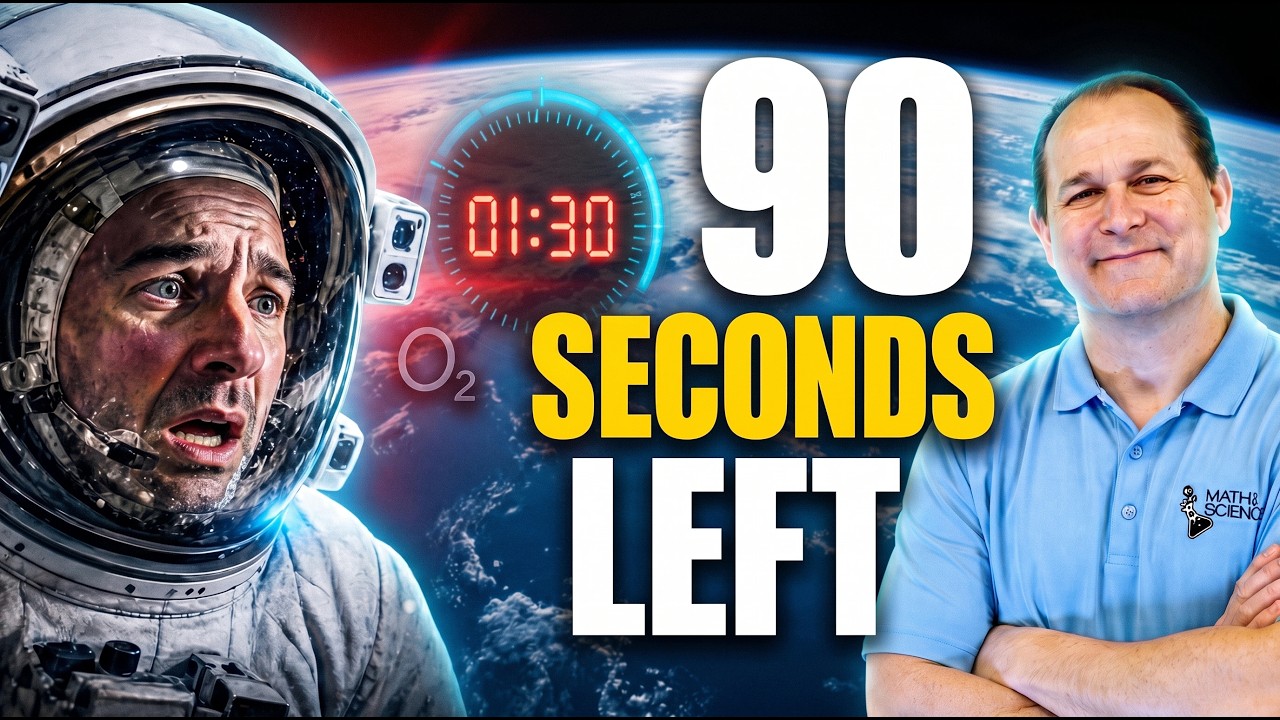
Freeze or Explode: What Happens if Your Spacesuit Leaks?
Keywords
Summary
170 words
Critical Evaluation
Value of the Information & Strength of the Argument
The video provides valuable educational content by accurately explaining the physics and physiology of vacuum exposure, correcting common misconceptions. The argumentation is solid, using real incidents and established scientific principles. It logically builds from a historical case to the technical details of spacesuit design and then to specific leak scenarios, making the science accessible and engaging.
Scientific Rigor, Source Quality, Title Accuracy
Scientific rigor is high: the video references real events (LeBlanc, Parmitano, Kittinger) and explains concepts like ebullism and hypoxia correctly. However, it does not cite specific studies or papers, relying on general knowledge. The title accurately reflects the content, as the video directly addresses whether freezing or explosion occurs and answers with debunking. The adequacy is good, though the title could be seen as slightly sensationalist, the content is accurate.
141 words
Title / Content Match
The title directly addresses the question of what happens in a spacesuit leak, and the video accurately answers it, covering both the myths (freezing/explosion) and the real effects (swelling, ebullism, hypoxia).
Quality & Reliability
8/10
The video presents scientifically accurate explanations based on real incidents (LeBlanc, Parmitano, Kittinger) and correct physics/physiology, debunking common myths without sensationalism.
Key Moments
Markers derived by PSI from the transcript: the creator did not define chapters.
- Introduction: scenario of spacesuit leak and Hollywood myths.
- Jim LeBlanc vacuum chamber incident and bubbling saliva.
- Explanation of why liquids boil in vacuum, not heat.
- Luca Parmitano water leak incident in 2013.
- Spacesuit design: 4.3 psi pure oxygen and small leak handling.
- Moderate leak: hypoxia symptoms and cognitive impairment.
- Big leak: swelling, ebullism, no explosion, no instant freezing.
- Survival time: 60-90 seconds for repressurization, don't hold breath.
- Conclusion and summary of key points.
Cited Sources
- Jim LeBlanc vacuum chamber incident — Mentioned as a real case of brief vacuum exposure.
- Luca Parmitano EVA water leak incident — Described as the most severe EVA incident in US spaceflight history.
- Joe Kittinger high-altitude jump glove failure — Used as an example of swelling due to pressure loss.
Contribution & Novelties
The video’s original contribution is its clear, myth-busting explanation of spacesuit leak consequences, combining physics and physiology in an engaging manner. It synthesizes real incidents into a coherent narrative, providing specific survival times and practical advice (e.g., not holding breath).
Pour aller plus loin :
- Ebullism — Directly relevant to the formation of gas bubbles in body fluids at low pressure.
- Hypoxia — Explains the oxygen deprivation leading to unconsciousness.
- Space suit — Overview of the technology and pressure systems mentioned.
- Extravehicular activity — Context for spacewalks and EVA procedures.
90 words
Radar Profile
The profile shows high quality and reliability scores, moderate quantity of information, and a technical level that is accessible to laypeople. The video excels in accuracy and clarity, with a slightly lower quantity due to its focused scope.