Biome 28-9-26
Keywords
Summary
111 words
Critical Evaluation
Value of the Information & Strength of the Argument
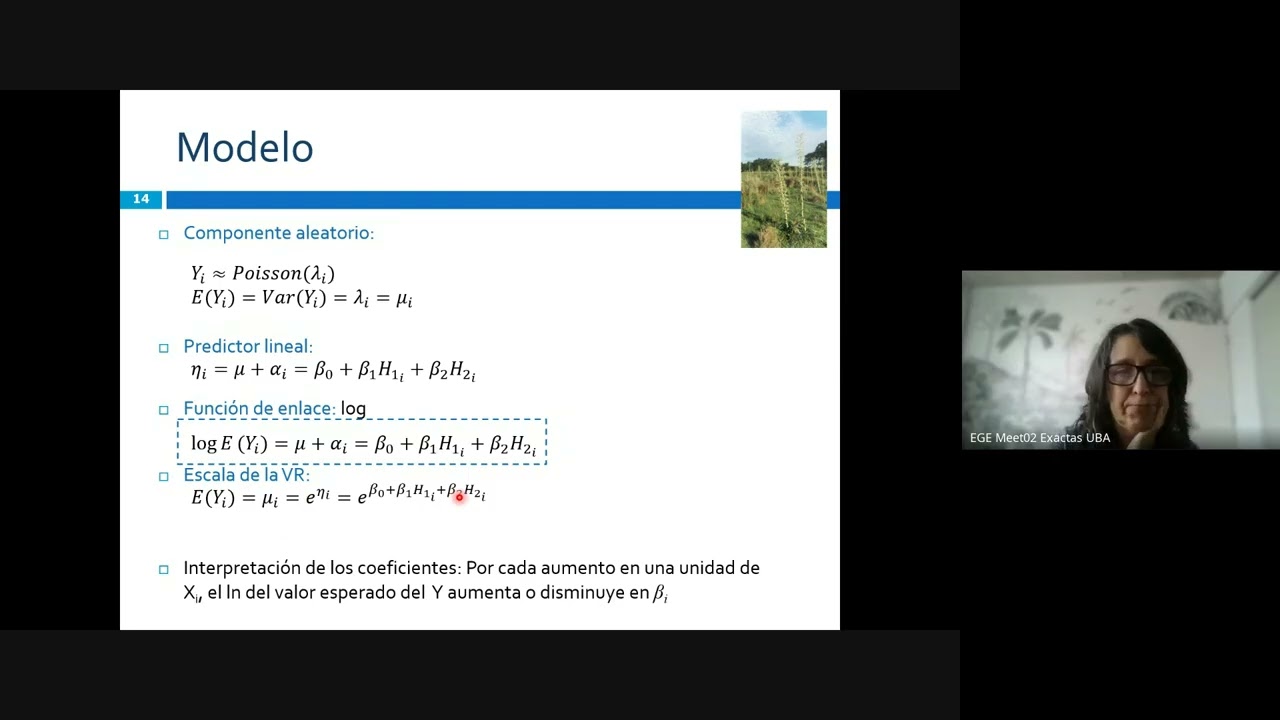
The lecture provides a thorough and didactic explanation of GLM concepts, with strong pedagogical value. The argumentation is clear, building from fundamental ideas (Poisson distribution) to practical application (herbicide example) and theoretical diagnostics (deviance). The instructor effectively contrasts linear model logic with GLM logic, particularly the change from additive to multiplicative effects and from identity to log link. The use of two scales is well-illustrated. However, the lecture is heavily theoretical and may lack concrete demonstrations with R output, but the conceptual clarity is high.
Scientific Rigor, Source Quality, Title Accuracy
The scientific rigour appears high: the content follows standard statistical theory and is presented by a university instructor. No external sources are explicitly cited in the transcript or description, so the basis is pedagogical rather than referencing original research. The title ‘Biome 28-9-26’ is a class code unrelated to the content, which reduces discoverability but does not affect the scientific substance. There are no comments provided, so public reception is unknown.
171 words
Title / Content Match
The title is an internal class code and does not indicate the topic. It is thus not informative about the content.
Quality & Reliability
8/10
The lecture is from a university course, presented by an instructor, with detailed mathematical explanations. However, no external sources are cited and the content is not independently verified.
Key Moments
Markers derived by PSI from the transcript: the creator did not define chapters.
- Introduction to GLM and review of Poisson distribution, variance-mean relationship.
- Explanation of link function and the two scales (linear predictor and response).
- Discussion on multiplicative effects and percentage change interpretation.
- Worked example with weed control, herbicide comparison, and contrast selection.
- Introduction to residuals (Pearson) and overdispersion diagnostics.
- Concept of deviance and model comparison between null and saturated models.
Contribution & Novelties
The lecture synthesizes standard GLM concepts for ecology students, with a strong focus on interpretation. It does not present novel research but offers a pedagogical contribution. For further learning:
Pour aller plus loin :
- Generalized linear model — Overview of GLM framework.
- Poisson regression — Specific model for count data.
- Deviance (statistics) — Measure of goodness of fit.
- DHARMa residual diagnostics package (R) — For checking overdispersion and model assumptions.
70 words
Radar Profile
The profile shows high technical depth and information quantity, with slightly lower quality and reliability due to lack of external validation.