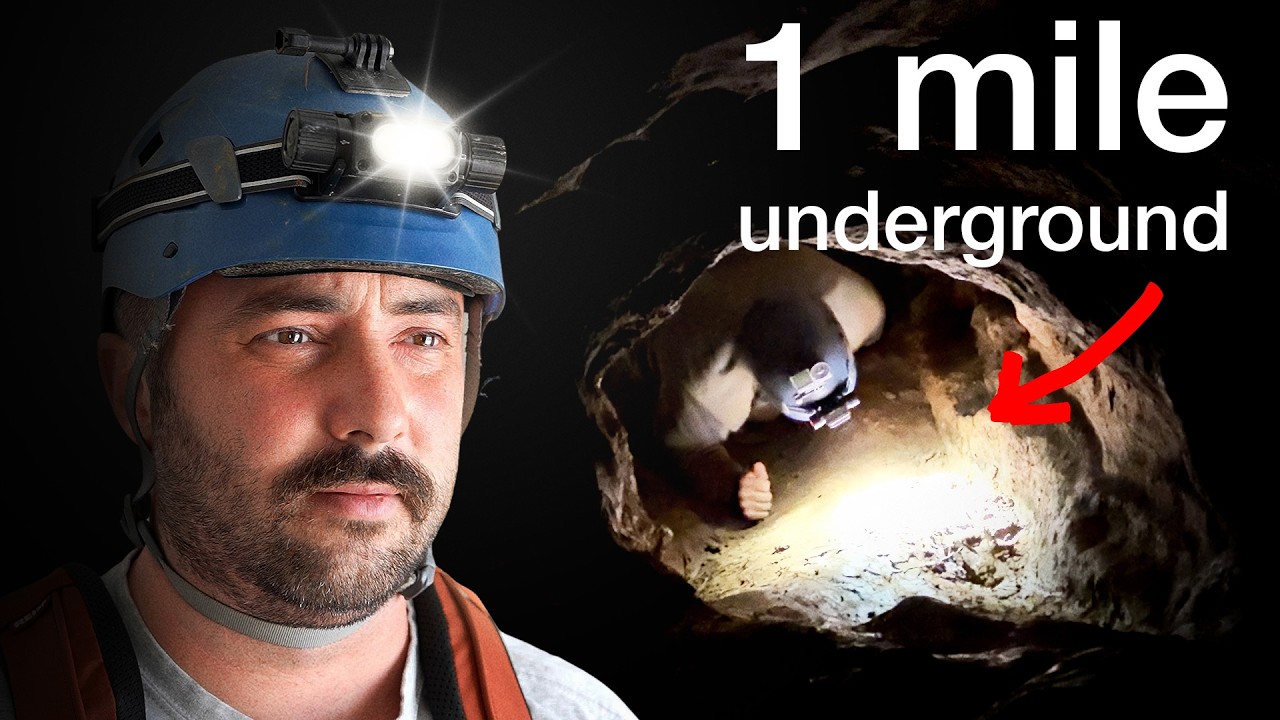
How can these caves solve the Bronze Age collapse?
Keywords
Summary
198 words
Critical Evaluation
Value of the Information & Strength of the Argument
The video’s informational value lies in its clear, accessible explanation of how speleothems serve as paleoclimate archives. Bendle’s explanation of oxygen isotope fractionation — heavier water molecules falling out more readily in cold air masses, lighter ones remaining in vapor when warmer — is accurate and well illustrated with a simple cloud analogy. The drip-monitoring data shown (40 drips per hour at driest, spikes to 260 per hour, roughly one-month lag between rainfall and drip response) provides concrete evidence of how the team calibrates the cave-to-surface relationship. The earthquake-dating method is presented with appropriate epistemic caution: the team explains that multiple uranium-series dates from stalactite tips and from the base of post-collapse stalagmites can bracket an event in time, and they explicitly acknowledge that a single date carries significant uncertainty. The argumentation is therefore sound but incomplete: the video never presents actual isotope records or dates, and the link to the Minoan collapse remains a stated research goal rather than a demonstrated result. The narrative is structured as a documentary of the expedition, with the scientific reasoning embedded in on-site conversations rather than in a formal argument.
Scientific Rigor, Source Quality, Title Accuracy
Scientifically, the video is rigorous in its methods and cautious in its claims. The researchers are identified by name and institution, the techniques described (oxygen and hydrogen isotope analysis, uranium-series dating, drip-rate monitoring) are standard and correctly explained, and the limitations of the approach are acknowledged. However, no primary literature, published datasets, or specific chronological results are cited, and the video does not reference the broader debate on the Bronze Age collapse (e.g., the Santorini eruption, climate change, or societal factors) beyond a brief mention by Iliopoulos. The title’s question is only partially answered: the video shows how caves could contribute to solving the puzzle, but does not present findings that resolve it. The description provides links to Bendle’s personal website and Instagram, and to a related GEOGIRL video on isotope climate reconstruction, which are relevant but not peer-reviewed sources. The public comments show strong appreciation for the scientific communication and the humanization of fieldwork, with several viewers noting the value of seeing how science is actually done; a few commenters add contextual details about Minoan civilization and caving, but these are not part of the video’s own sourcing.
391 words
Title / Content Match
The title's question is addressed only partially: the video shows how cave climate archives could inform the debate on the Minoan collapse, but no results are yet available, so the title slightly overpromises relative to what is delivered.
Quality & Reliability
7/10
The video documents real fieldwork by named researchers (Dr. James Bendle, University of Birmingham; Prof. George Iliopoulos, University of Patras) using established methods (speleothem isotope analysis, uranium-series dating, drip monitoring). Methods are explained accurately and caveats are acknowledged (multiple variables affecting isotope ratios, dating uncertainty). However, no primary publications, datasets, or specific numerical results are cited, and the central question about the Minoan collapse remains explicitly unresolved.
Key Moments
Markers derived by PSI from the transcript: the creator did not define chapters.
- Stefan arrives at the airport, nervous and jetlagged, before the expedition begins.
- Hiking up the mountain in Crete with a view of the Mediterranean Sea.
- Prof. George Iliopoulos introduces the question of why the Minoan civilization ended.
- Inside the cave, the team retrieves glass discs collecting annual calcite growth.
- Bendle explains oxygen isotope fractionation and how it records temperature and rainfall.
- Bendle descends by rope to collect a stalagmite from an out-of-the-way location to minimize damage.
- Drip-monitor data shown: 40 drips/hour at driest, spikes to 260 drips/hour, ~1-month lag.
- Discovery of fresh earthquake damage; discussion of uranium-series dating of ancient earthquakes.
- Rainwater sampling at a local taverna to trace the isotopic pathway from surface to cave.
- The team inspects a large stalagmite collected after being toppled by an earthquake; a 3D-printed replica is mentioned.
Cited Sources
- Dr. James Bendle's website — Personal website of the lead climate scientist, referenced in the description for more information on his work.
- GEOGIRL video on isotope climate reconstruction — Recommended video explaining how isotopes can reconstruct climates, linked in the description.
Concurring Sources
- Speleothem-based paleoclimate reconstruction — General scientific consensus that speleothems provide high-resolution continental climate records via isotope analysis.
- Uranium-thorium dating of speleothems — Established method for dating calcium carbonate deposits, consistent with the video's description.
External References
Contribution & Novelties
The video’s original contribution is its behind-the-scenes documentation of speleothem-based paleoclimate fieldwork in Crete, including the practical challenges of cave access, the calibration of drip monitors, and the emerging application of uranium-series dating to ancient earthquakes. It provides a rare visual record of how climate archives are collected and interpreted, and it highlights the involvement of local collaborators in rainwater sampling. However, it does not present new scientific results; the link to the Minoan collapse remains a research goal.
Pour aller plus loin :
- Speleothem — Wikipedia article on cave mineral deposits and their use in paleoclimate reconstruction.
- Minoan civilization — Wikipedia article on Europe’s first great civilization and the debate over its collapse.
- Uranium–thorium dating — Wikipedia article on the radiometric dating method used to date speleothems and ancient earthquakes.
- Minoan eruption — Wikipedia article on the Santorini eruption and its possible role in the Bronze Age collapse.
149 words
Radar Profile
The profile shows high information quality and reliability, moderate technical depth, and good quantity of information. The video balances accessible explanation with accurate methodological detail, though it lacks published results and primary sources, which slightly lowers the technical and reliability scores.
💬 Overwhelmingly positive and enthusiastic. On the 30 comments analyzed, viewers express admiration for Stefan Milo, appreciation for the human side of science, and fascination with the cave environment, with many noting the value of seeing real fieldwork and the scientists' communication skills.