The Coolest Physics Nobel Prize in History (Literally)

The Coolest Physics Nobel Prize in History (Literally)

🎙 Animated Physics 👥 35K 📅 October 9, 2026 ⏱ 19 min 👁 1K 📄 documentary 🧭 2026-10-09
Available in: English (current) Français

Keywords

neutrinoIceCubeNobel PrizeCherenkov radiationcosmic rays

Summary

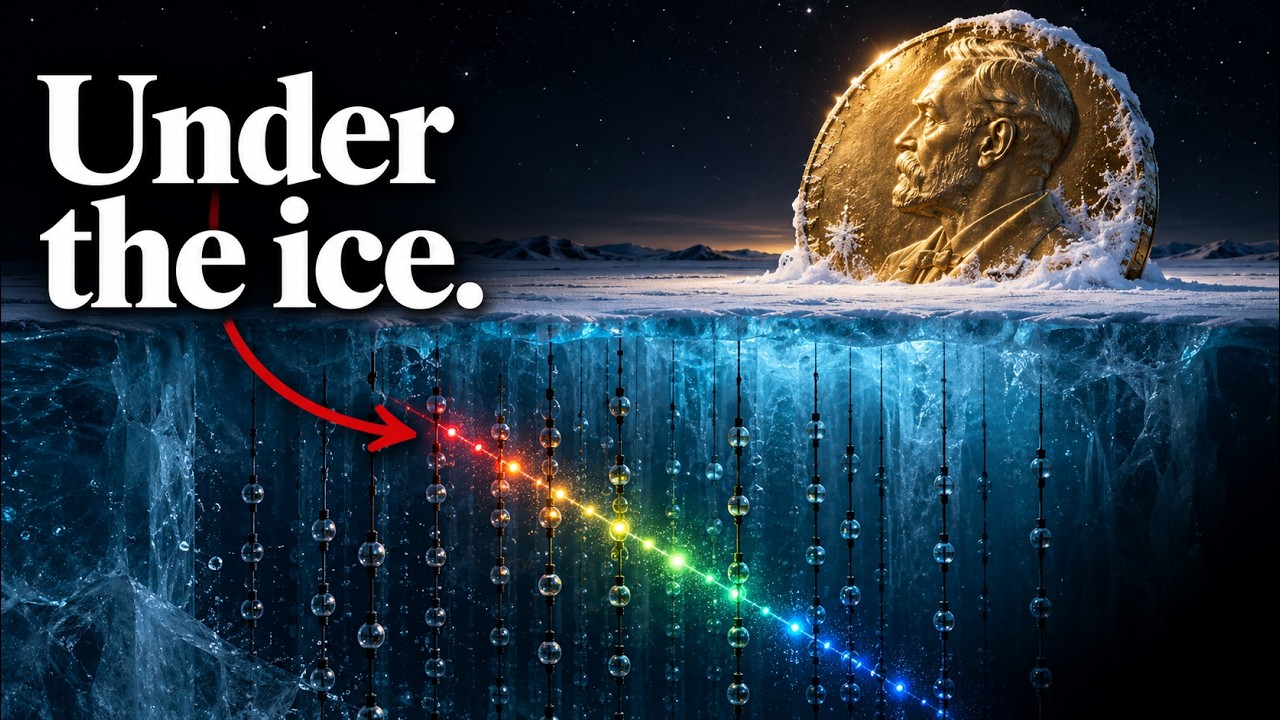
The video tells the story of Francis Halzen and the development of the IceCube Neutrino Observatory, which earned him the 2026 Nobel Prize in Physics. It begins with the historical context of neutrino discovery, from Pauli’s 1930 hypothesis to the first detection by Cowan and Reines in 1956. The narrative then focuses on Halzen’s idea to use the Antarctic ice as a detector, built with 5,160 optical sensors on 86 strings lowered into melted holes, forming a cubic kilometer of ice. The physics is explained through the Cherenkov effect, where a particle traveling faster than light in ice produces a visible blue cone. The video details the construction challenges, the 2013 detection of 28 high-energy neutrinos from beyond the solar system, and notable milestones such as the links to the blazar TXS 0506+056 and the galaxy NGC 1068, as well as the observation of the Milky Way in neutrinos. It concludes with the announcement of the Nobel Prize on October 6, 2026, the project’s next steps including an upgrade, and a reflection on the uniqueness of a prize awarded for a telescope that does not directly observe its target.

189 words

Critical Evaluation

Value of the Information & Strength of the Argument

The video excels in making a complex topic accessible through clear analogies (e.g., speedboat wake for Cherenkov radiation) and a compelling narrative arc. It effectively conveys the extraordinary scale and ambition of the IceCube project, balancing technical details with human interest. The argumentation is logical and progressive, building from the basic properties of neutrinos to the design of the detector and its scientific payoff. The reasoning is sound, and the logical connections between experimental difficulties and design choices are well articulated. The video also emphasizes the collaborative nature of the endeavor, countering the perception of a solo Nobel win with the reality of over 450 contributors.

115 words

Title / Content Match

The title playfully refers to the literal coldness of the IceCube telescope. The content directly addresses the Nobel Prize and the ice-based detector, so the title matches well.

Quality & Reliability

9/10

The video provides a scientifically accurate account of neutrino detection and the IceCube project, supported by references to official sources and historical facts. The explanations are consistent with established physics and the timeline matches public records, though some simplifications are made for accessibility.

Chapters

External References

Radar Profile

Reliability 9/10