2026 09 24 Noninvasive Ventilation in Palliative Medicine
Keywords
Summary
192 words
Critical Evaluation
Value of the Information & Strength of the Argument
The video delivers substantial practical value for clinicians, particularly those involved in palliative care or neuromuscular disease management. The speaker systematically explains the physiological rationale behind different NIV modes, supported by clear diagrams and real-world examples. Argumentation is generally solid, grounded in clinical experience and reference to standard practices. The distinction between CPAP (splinting) and BiPAP (active ventilation) is well articulated, and the explanation of AVAPS as a dynamic adjustment mechanism is particularly instructive. The emphasis on comfort-based titration over arterial blood gases in palliative settings is a nuanced point that aligns with the goal of symptom relief. However, the lecture’s argumentation occasionally relies on anecdotal statements (e.g., personal patient experiences) without citing specific studies, reducing its evidence-based rigor. The recommendation that patients need two to three months to adapt is presented as clinical wisdom rather than from a cited source. Overall, the content is valuable and internally consistent, but the lack of direct references weakens the strength of certain claims.
Scientific Rigor, Source Quality, Title Accuracy
The lecture demonstrates good scientific rigor in its technical explanations, accurately describing ventilator mechanics and clinical indicators. However, it does not cite specific scientific literature during the talk, instead relying on the speaker’s experience and common knowledge in the field. The description mentions a lecture series but provides no external links to sources. The title ‘Noninvasive Ventilation in Palliative Medicine’ accurately matches the content, which focuses on NIV applications in palliative care contexts. There is no discrepancy between the title and the presented material. The speaker also mentions that he has received no third-party compensation, and he notes that a former ventilator brand (Phillips) was recalled, showing transparency. The adequacy is perfect; the talk stays on topic and covers all relevant aspects of NIV in palliative medicine. While the lack of explicit citations is a minor weakness, the clinical familiarity and practical advice suggest a solid grounding in medical knowledge.
326 words
Title / Content Match
The title accurately describes the content, which focuses on the use of noninvasive ventilation in palliative care settings.
Quality & Reliability
7/10
The lecture is based on extensive clinical experience and covers both theoretical and practical aspects of NIV in palliative care. While it includes personal anecdotes and advice, it aligns with standard medical practices and offers practical insights.
Key Moments
Markers derived by PSI from the transcript: the creator did not define chapters.
- Introduction to the lecture and its objectives, emphasizing comfort over survival in palliative NIV.
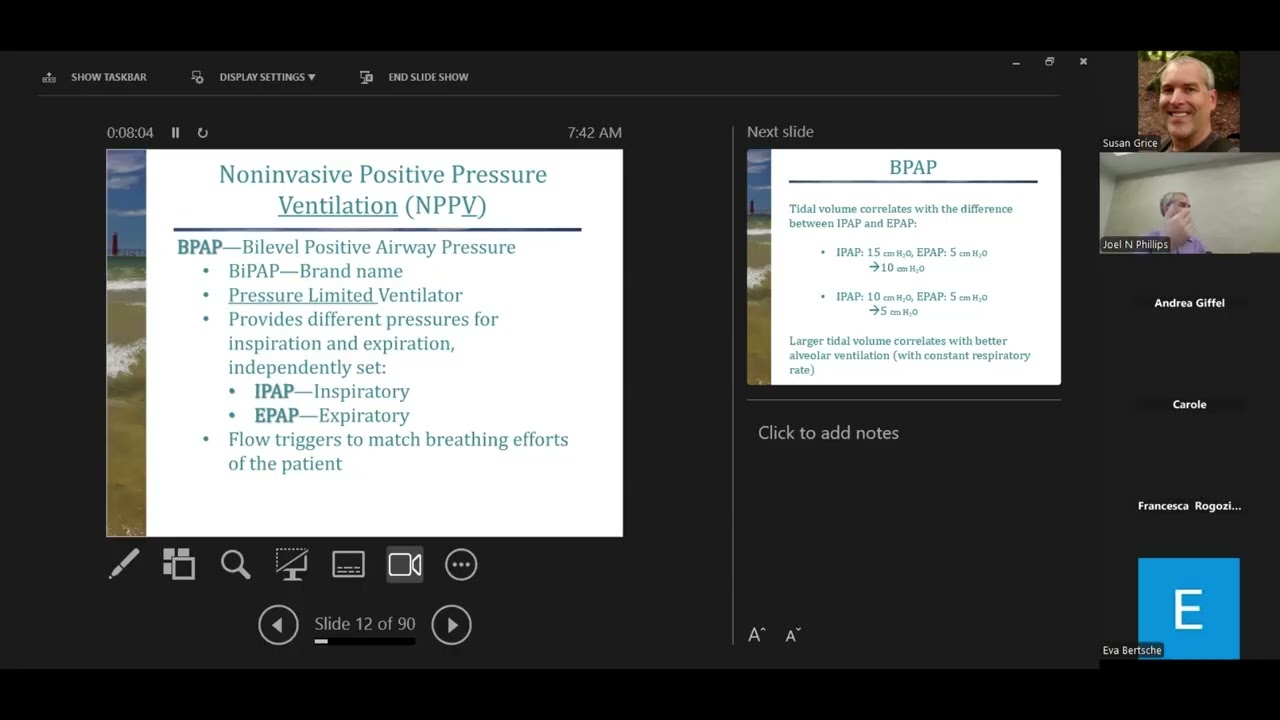
- Explanation of CPAP and BiPAP: differences in pressure delivery and ventilatory support.
- Introduction of AVAPS (Average Volume Assured Pressure Support) and its dynamic pressure adjustment.
- Discussion of various interfaces: nasal masks, pillows, oral-nasal masks, and mouthpieces, with pros and cons of each.
- Management approach: initial settings, titration, and the importance of patient adaptation over weeks.
- Troubleshooting common issues: mask fit, trigger sensitivity, and adaptation strategies.
- Monitoring tips and caution about oxygen supplementation, especially in ALS patients.
Contribution & Novelties
This lecture contributes a practical, clinician-oriented perspective on using noninvasive ventilation in palliative care, a niche often underrepresented in training. It bridges theoretical understanding with hands-on advice, such as specific starting pressures and adaptation timelines. The focus on comfort titration over strict blood gas targets is a valuable nuance for palliative practitioners. It also synthesizes device know-how, from mask options to the role of cough assist, and provides guidance for troubleshooting. The lecture’s approach to chronic NIV in neuromuscular diseases, particularly ALS, adds to its novelty.
Pour aller plus loin :
- Non-invasive ventilation (Wikipedia) — Broad overview of NIV applications, techniques, and evidence.
- Positive airway pressure (Wikipedia) — Detailed explanation of CPAP, BiPAP, and modes like AVAPS.
- Mechanical insufflation-exsufflation (Wikipedia) — Covers the cough assist device, its mechanism, and clinical utility.
- Amyotrophic lateral sclerosis (ALS) and NIV — Discusses the role of NIV in ALS respiratory management, including ALS-specific considerations.
150 words
Radar Profile
The profile shows high scores in information quantity, quality, and technical depth, with a slightly lower reliability score due to the absence of explicit citations. This indicates a content-dense, expert-led lecture that prioritizes practical knowledge over formal evidence presentation.