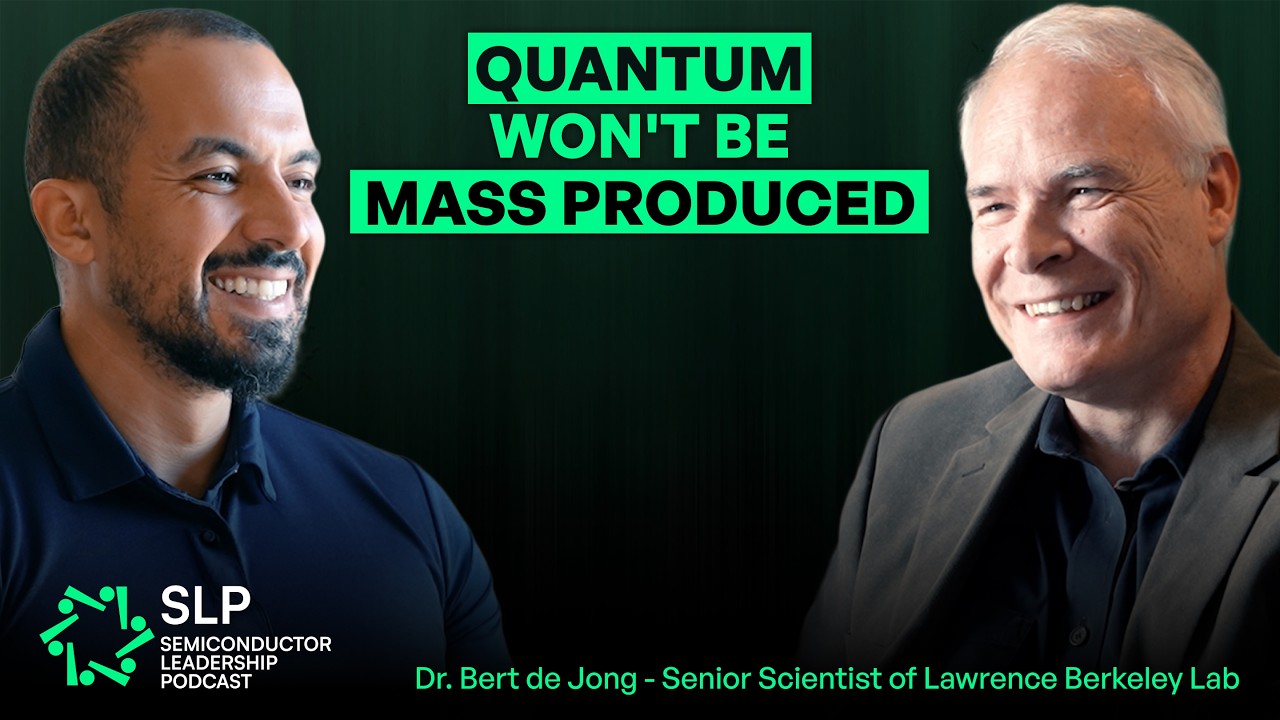
Quantum Advantage in Less Than Five Years
Keywords
Summary
183 words
Critical Evaluation
Value of the Information & Strength of the Argument
The value of this episode lies in its expert, insider perspective on the state of quantum computing, particularly the emphasis on manufacturing and fabrication challenges that are often underexplored in public discourse. de Jong’s argument is substantiated by his role leading a $15 million national center and his direct involvement in prototype development. He provides concrete examples, such as qubit lifetime variations and the probe test gap, and offers a clear, specific prediction (neutral atoms likely first to fault tolerance). The reasoning is logical and balanced, acknowledging uncertainties and the possibility of multiple winners. However, as with any expert opinion, it remains subjective and not based on formal data analysis.
Scientific Rigor, Source Quality, Title Accuracy
The scientific rigor is high for an interview format: de Jong is a credible authority, and his statements align with current knowledge in the field, but no external sources or publications are cited. The quality of sources is thus limited to the speaker’s expertise; the description provides no external links. The title ‘Quantum Advantage in Less Than Five Years’ precisely matches the content, as the interview’s central claim is that quantum advantage is achievable within that timeframe. The discussion stays on topic, covering technical and industrial aspects without digression. Overall, the content is well-structured and reliable within its scope, but a lack of verifiable citations prevents it from being a rigorous scientific reference.
238 words
Title / Content Match
The title accurately reflects the core prediction and focus of the episode, which centers on the timeline for quantum advantage and the technical challenges.
Quality & Reliability
8/10
The guest is a recognized expert leading a major national quantum initiative (QSA). His statements are grounded in direct involvement in prototype development and fabrication challenges, lending high credibility. However, the content is largely opinion and prediction, not peer-reviewed data.
Chapters
- Cold open: quantum advantage, less than five years
- Welcome to the Semiconductor Leadership Podcast
- Rapid fire round
- From the Netherlands to PNNL to Berkeley Lab
- What the Quantum Systems Accelerator is building
- Error-aware software, and where error correction stands
- Headlines versus reality
- One bet, one modality
- Superconducting's fabrication problem
- Why quantum chip volumes will never look like silicon's
- The probe test gap, and Berkeley's x-ray resources
- Allocating the budget, and why there may never be a winner
- FeMoco, and the chemistry that lands first
- Why HPC, AI, and quantum converge
- Sovereign programs, VC funding, and calibrating China
- Export controls
- Bitcoin, Shor's algorithm, and Google's call to action
- The workforce shortage, and what quantum needs from silicon
- Training people who leave, and running a 15-institution effort
- Career reflections
- The shift most people are not paying attention to
- Why he does all of this
Contribution & Novelties
This episode contributes a unique expert perspective on the intersection of quantum computing and semiconductor manufacturing, emphasizing that superconducting qubit limitations are fundamentally a fabrication problem. It also offers a specific bet on neutral atoms as the first modality to achieve fault tolerance, and highlights the need for specialized fabs and better probe testing infrastructure. The discussion of error correction advances and the workforce shortage provides current, insider insights.
Pour aller plus loin :
- Quantum computing — Overview of quantum computing principles and history.
- Quantum error correction — Technical background on error correction methods mentioned.
- Neutral atom quantum computer — Details on the modality de Jong predicts will lead.
109 words
Radar Profile
The radar profile shows high scores in reliability and information quality, with a moderate technical depth score, indicating that the content is credible and informative but accessible to a broad audience. The overall balance suggests a well-rounded expert discussion with actionable insights.