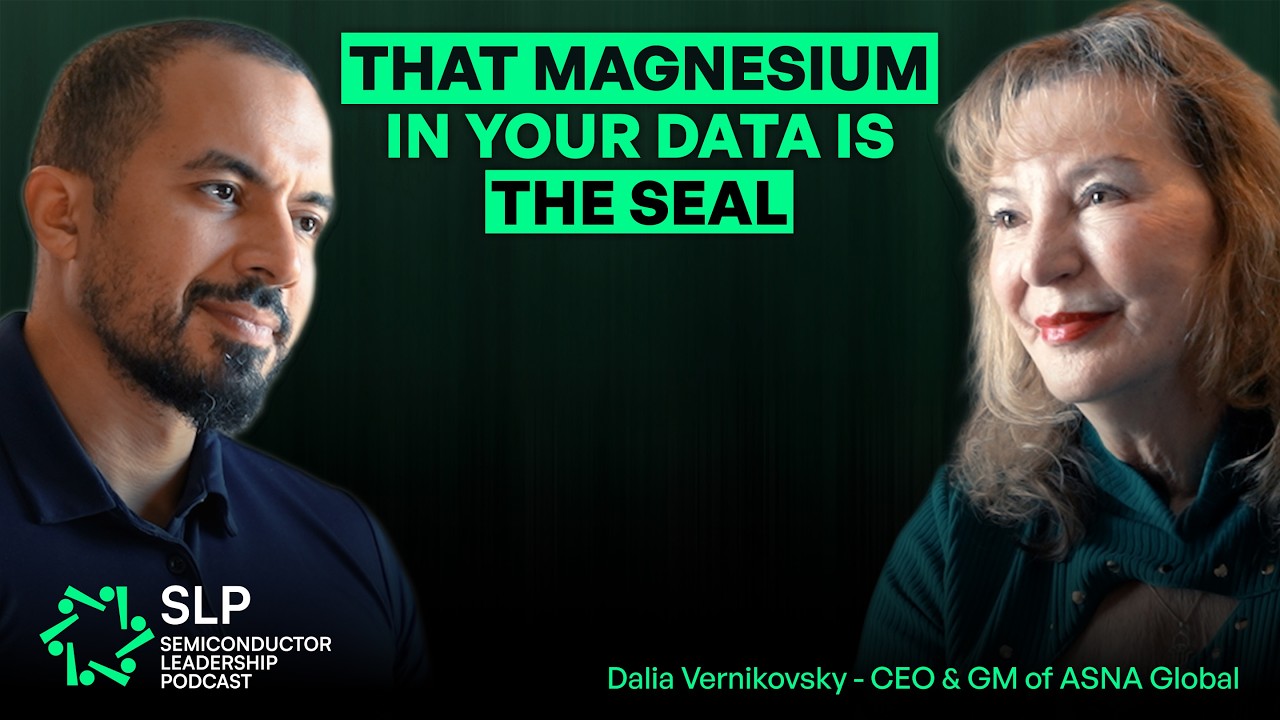
Hardware Is the Last Frontier
Keywords
Summary
169 words
Critical Evaluation
Value of the Information & Strength of the Argument
The video’s value lies in shedding light on a niche but essential aspect of semiconductor manufacturing that is rarely discussed. Vernikovsky provides concrete examples of how seal failures occur due to mismatched materials and lack of standards, and she argues for a proactive approach to creating industry-wide specifications. Her argumentation is strong, based on decades of hands-on experience and specific cases. However, the discussion is largely qualitative and anecdotal; no quantitative data or references to external research are provided, which weakens the scientific rigor. Still, the insights are credible and offer a fresh perspective on a supposedly mundane component, emphasizing that hardware is indeed a frontier for innovation and standardization.
Scientific Rigor, Source Quality, Title Accuracy
The scientific rigor is moderate: the speaker is a recognized expert, but the podcast relies on personal testimony rather than published studies or official data. No external sources are cited in the description, so claims are unverified. The title accurately captures the episode’s thesis, and the content aligns well with it, discussing the last frontier of semiconductor hardware. The interview is well-structured, and the speaker’s credibility adds weight to the statements. However, the lack of references and the conversational format limit its value as a rigorous scientific resource.
213 words
Title / Content Match
The title accurately reflects the central argument that hardware components like seals are overlooked despite being critical to semiconductor manufacturing. The video consistently reinforces this thesis.
Quality & Reliability
8/10
The content is delivered by an industry expert with 30+ years of experience, providing nuanced insights into semiconductor hardware components, standards, and business dynamics. The discussion is anecdotal but grounded in practical knowledge; no external sources are cited, which limits verifiability.
Chapters
- Game of Chips hits 20,000 orders on Amazon
- "The worst marketed industry in the world"
- Meet Dalia Vernikovsky
- The 1896 invention still inside every tool in the fab
- The component supplier's paradox
- Going after the standard itself
- Welcome to the Semiconductor Leadership Podcast
- Rapid fire round
- What belt level is running a semiconductor startup
- The biggest myth about what seals actually do
- If not semiconductors, then medicine
- What 30 years here taught her that nothing else could
- Living in a car in New Jersey, and the making of tenacity
- Was the hardship a blessing
- Why the hardware is the last frontier
- The moment she decided to build ASNA
- What it takes to earn trust at Intel, Applied Materials, Lam and TSMC
- Running a joint venture with a Taiwanese parent company
- Startup to profitability, and the phase that nearly did not work
- Turning a damaged reputation into a success story
- Where seals and subcomponents actually sit in the process
- Is it unfair that seals are treated as a commodity
- Capacity cycles, and why the downturn is when customers listen
- PFAS, regulation, and what a fab can realistically change
- Where margins hold and where they collapse
- Building differentiation in a category treated as interchangeable
- The Intel recognition, and the plaque she did not see coming
- The question customers should be asking instead
- The elastomer talent pipeline, and why application beats material
- A semiconductor standard, not a steam engine standard
- Institution building, and what business school cannot teach
- What she had to unlearn going from Brooks Automation to CEO
- What the industry has because she was in this seat
- Where ASNA goes in the next five years
- The subsystem category that does not exist yet
- The hardest decision of her career
- Her proudest moment
- The shift most people are not paying attention to
- The legacy she wants to leave behind
- The one person who pulled her out of the dark
- Closing
Cited Sources
- Game of Chips (book) — Mentioned by host during intro as a newly published book on the semiconductor ecosystem.
Contribution & Novelties
The video uniquely fills a gap in semiconductor discourse by focusing on the hardware components—particularly seals—that are often taken for granted. It challenges the industry to develop dedicated vacuum standards instead of relying on steam-era designs and highlights the technical and business challenges of component suppliers. The personal narrative of the founder adds a human dimension rarely seen in technical podcasts.
Pour aller plus loin :
- O-ring - Wikipedia — Provides background on the elastomeric gasket types discussed in the video.
- Per- and polyfluoroalkyl substances (PFAS) — Relevant to the discussion of chemical resistance and environmental regulations.
- Semiconductor device fabrication — Contextualizes where seals are used in the overall manufacturing process.
111 words
Radar Profile
The radar likely shows high scores in quantity and quality of information, moderate technical level, and moderate reliability. This reflects a thorough, experience-driven discussion that lacks formal citations but offers valuable practical knowledge.