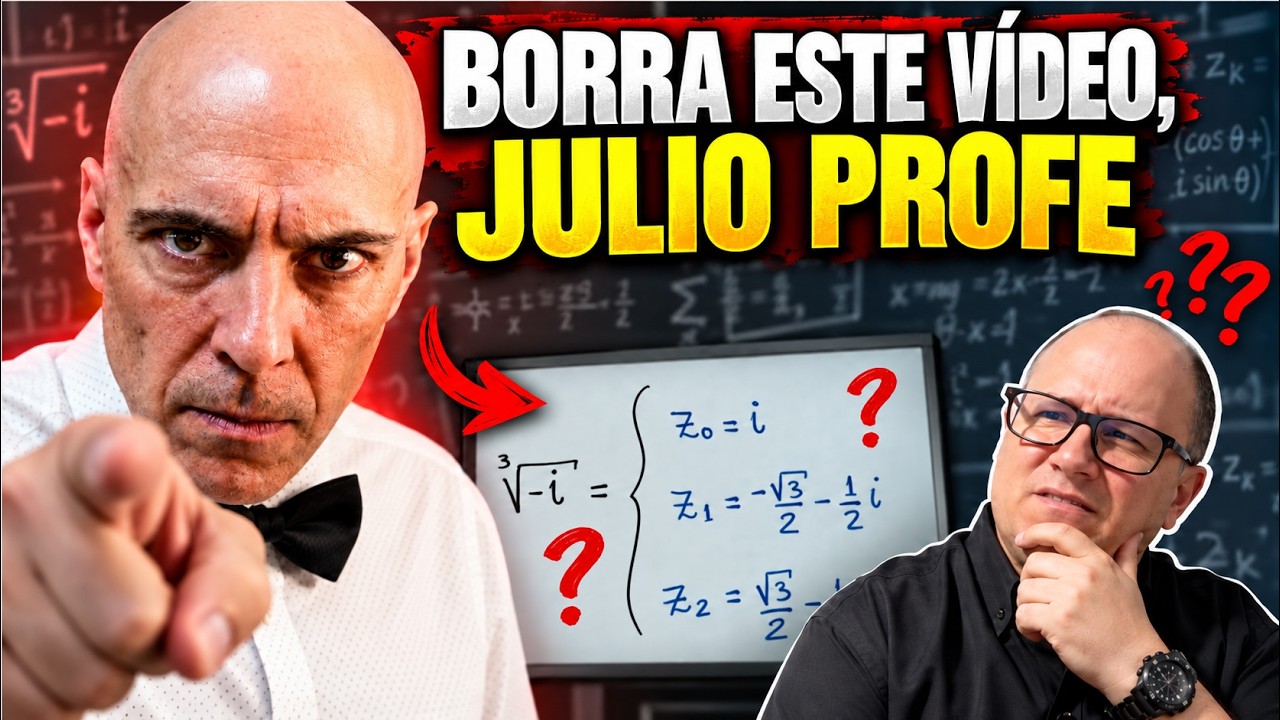
Raíces cúbicas del número i. Comento vídeo de @julioprofe
Cube roots of the number i. I comment on video by @julioprofe
Keywords
Summary
194 words
Critical Evaluation
Value of the Information & Strength of the Argument
The video provides valuable pedagogical clarification on a common misunderstanding in complex numbers. The argumentation is solid: the author distinguishes between an equation and its solutions, and between a principal value and the full solution set. He supports his point by walking through the entire derivation, ensuring viewers see exactly how the three solutions arise. The critique of Julio Profe is respectful and well-founded, though it is not a systematic review of the literature. The main value lies in prompting reflection on mathematical notation and its potential to generate confusion.
Scientific Rigor, Source Quality, Title Accuracy
The mathematical reasoning is rigorous and follows standard methods for solving polynomial equations over the complex numbers. The video cites only the referenced video by Julio Profe and a playlist of additional exercises. No external academic sources are mentioned. The title-and-content alignment is excellent. The video does not present original research but rather an expert opinion on a didactic issue, and it appropriately acknowledges the work of the referenced creator.
175 words
Title / Content Match
The title accurately reflects the content: the video discusses the cube roots of the number i and comments on a specific video by @julioprofe.
Quality & Reliability
8/10
Mathematically sound presentation with a clear derivation of the three cube roots of −i, but relies on a single reference and focuses on a notational critique rather than a comprehensive literature review.
Chapters
- El problema con las raíces
- Raíces cuadradas de 4
- Raíces cúbicas de −i
- La ecuación z³ = −i
- La solución mostrada por Julio Profe
- ¿Dónde está la confusión?
- Resolución completa de z³ = −i
- Representación de −i en el plano complejo
- Forma polar y trigonométrica
- Forma exponencial
- Todos los argumentos de −i
- Punto clave: z³ = −i
- Cálculo de las tres raíces
- Primera raíz: z₀ = i
- Segunda raíz
- Tercera raíz
- Las tres soluciones
- La cuestión de fondo
- Debate abierto en comentarios
Cited Sources
- Julio Profe's video on cube roots of -i — Video critiqued for its notation of cube roots of -i.
- Playlist of exercises on complex numbers — Additional resources for complex number practice.
Dissenting Sources
- Julio Profe's video — The author disagrees with the way the cube root expression is equated to the entire set of solutions, arguing it conflates an equation with its solutions.
Contribution & Novelties
The video’s original contribution is a clear exposition of the difference between the roots of an equation and the principal notation, applied to complex numbers. It offers a constructive critique that encourages precise mathematical wording.
Pour aller plus loin :
- Complex number — Background on complex numbers and their representations.
- De Moivre’s formula — The formula used to derive the roots.
- nth root — Discusses notations and principal roots, relevant to the notation debate.
74 words
Radar Profile
The radar profile shows high scores in information quality and reliability, reflecting the video's rigorous mathematical exposition and trustworthy reasoning. The lower quantity of information is due to its focused scope on a single notational issue, and the technical level is moderate, making it accessible to learners while still being precise.