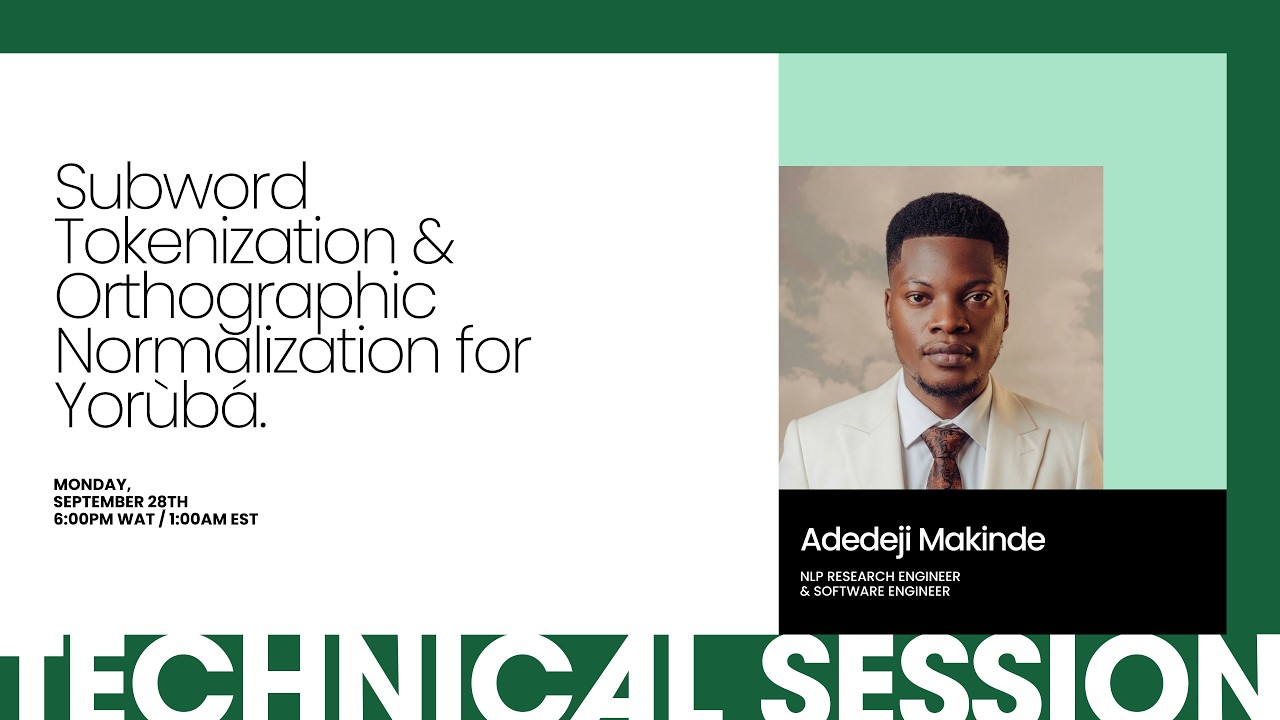
Subword Tokenization and Orthographic Normalization for Yorùbá
Keywords
Summary
179 words
Critical Evaluation
Value of the Information & Strength of the Argument
The informational value is moderate: the talk provides a practical introduction to a real problem in low-resource NLP and showcases a concrete tool (yotext) that can be used by practitioners. It explains key concepts such as subword tokenization, Unicode normalization, and diacritic handling in an accessible way, which is useful for newcomers to Yorùbá NLP. However, the depth is limited: the sentiment experiment is mentioned but not detailed, and no quantitative results, datasets, or evaluation metrics are provided beyond the library’s accuracy. The argumentation is largely descriptive and relies on the speaker’s personal experience rather than on systematic evidence. The reasoning is sometimes circular or imprecise, and the speaker acknowledges time constraints, which leads to rushed explanations. The value lies mainly in raising awareness and pointing to a practical resource, not in advancing a rigorous scientific argument.
Scientific Rigor, Source Quality, Title Accuracy
Scientific rigor is low: no references, papers, or datasets are cited, and the technical explanations contain inaccuracies (e.g., conflating NFKC with sparse autoencoders, vague descriptions of BPE and SentencePiece). The source quality is essentially the speaker’s own work and community context, with no external validation. The title/content adequacy is good: the talk does address subword tokenization and orthographic normalization for Yorùbá, though the treatment is superficial and disorganized. No comments were provided, so no audience analysis is included.
230 words
Title / Content Match
The title matches the content: the talk covers subword tokenization, orthographic normalization, diacritics, and a Yorùbá sentiment experiment. However, the delivery is disorganized and the promised depth is only partially delivered.
Quality & Reliability
5/10
The talk is a practitioner walkthrough of a real open-source library (yotext) and a sentiment-analysis experiment, but it contains no citations, no quantitative results beyond a single accuracy figure, and several imprecise or incorrect technical statements (e.g. confusing NFKC with 'sparse autoencoders', describing BPE loosely). The speaker is transparent about limitations, which supports credibility, but the absence of verifiable sources and data keeps the reliability score moderate.
Key Moments
Markers derived by PSI from the transcript: the creator did not define chapters.
- Introduction of the speaker and the session topic.
- Definition of tokenization and subword tokenization.
- Explanation of orthographic normalization and NLP basics.
- Why Yorùbá text breaks pipelines: underdots and tone marks.
- Unicode normalization forms NFC and NFD.
- Tokenization algorithms: BPE, WordPiece, SentencePiece, AfroXLMR.
- Introduction to yotext library and its functions.
- Experiment: zero-shot vs fine-tuned sentiment analysis for Yorùbá.
- Demonstration of yotext in a Colab notebook.
- Current accuracy of yotext (87%) and future work.
Contribution & Novelties
The talk’s main contribution is the presentation of yotext, an open-source Python library specifically designed for Yorùbá text preprocessing, including normalization, syllabification, and diacritic restoration. It also shares practical insights from a sentiment analysis experiment comparing zero-shot and fine-tuned models for Yorùbá, highlighting the importance of orthographic normalization. The session is valuable for practitioners working on low-resource African languages, offering a concrete tool and a case study.
Pour aller plus loin :
- Yorùbá language — Background on the language and its orthography.
- Unicode normalization — Explanation of NFC, NFD, and related forms.
- Byte pair encoding — Overview of the tokenization algorithm discussed.
- AfroXLMR — Model for African languages mentioned in the talk.
112 words
Radar Profile
The radar profile shows moderate information quantity and technical level, with lower quality and reliability due to the lack of citations and rigorous methodology. The talk is practical but not scientifically deep.