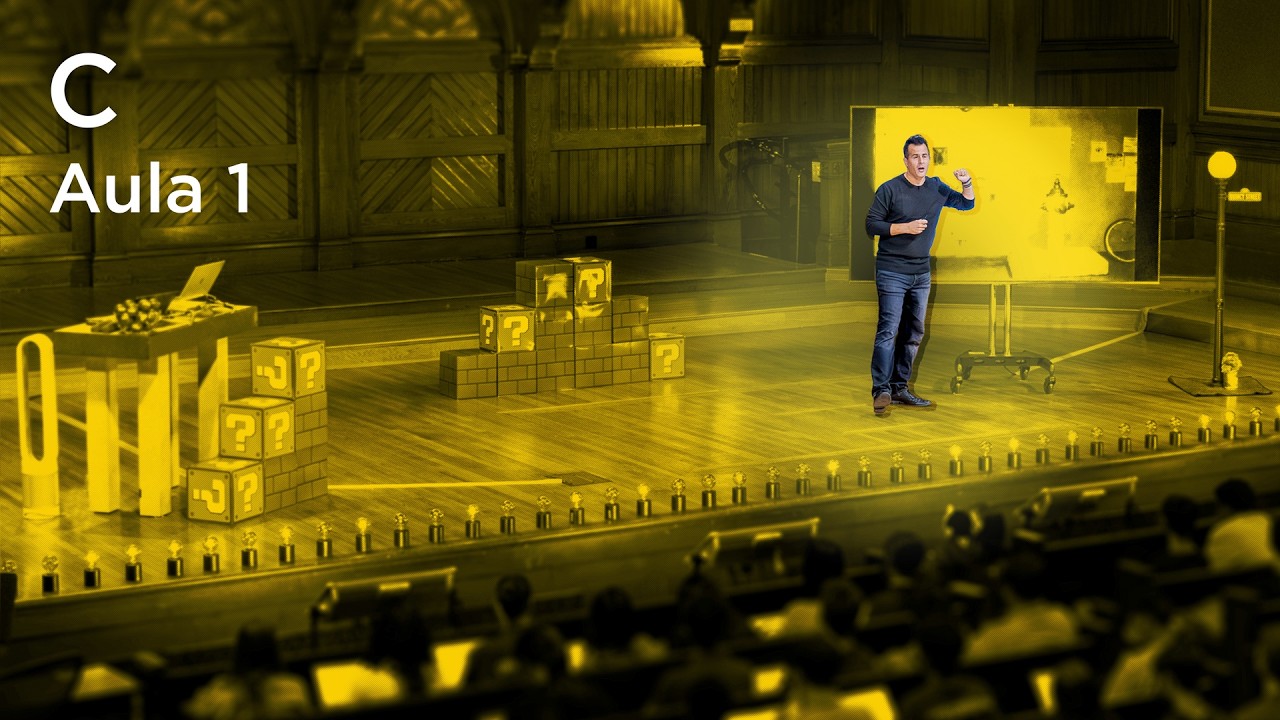
CS50x em Português - Aula 1 - C
CS50x en portugais - Leçon 1 - C
Keywords
Summary
154 words
Critical Evaluation
Value of the Information & Strength of the Argument
The informational value is high for an introductory audience: the lecture systematically builds a mental model of programming by mapping Scratch blocks to C syntax, which reduces cognitive load. Each concept is introduced with a concrete example and immediate demonstration in the IDE, reinforcing the link between theory and practice. The argumentation is solid and incremental: the instructor explains why certain syntax elements exist (e.g., escape sequences, semicolons) and what happens when they are omitted, using live errors to illustrate compiler feedback. The progression from simple output to conditionals, loops, functions, and finally to numerical precision issues is logically coherent. The treatment of integer overflow and floating-point imprecision is particularly valuable because it connects abstract data representation to real-world consequences (e.g., the Boeing 787 bug), making the argument both technically rigorous and memorable. The use of analogies (fire hose, black box) helps convey the intensity and the input-output nature of compilation without oversimplifying.
Scientific Rigor, Source Quality, Title Accuracy
Scientific rigor is high: the lecture is part of a well-established academic course, and the instructor explicitly references official CS50 resources (course website, manual pages, CS50-specific documentation). The live coding format allows viewers to see the actual behavior of the compiler and runtime, which is a form of direct evidence. Sources cited in the description include the official CS50 website, edX platform, Harvard Extension School, and the course’s GitHub repository, all of which are authoritative for the course material. The title accurately reflects the content: it is the first lecture of CS50x in Portuguese, focused on C. No misleading claims or exaggerated promises are made. The only caveat is that the video is a dubbed version, which could introduce minor translation artifacts, but the technical content remains faithful to the original. Comments were not provided, so no audience trend analysis is included.
310 words
Title / Content Match
The title accurately reflects the content: it is the first lecture of CS50x in Portuguese, focused on the C language. The match is direct and unambiguous.
Quality & Reliability
9/10
The content is a university-level introductory programming lecture delivered by a Harvard professor, with a clear pedagogical structure, live coding, and explicit references to official course materials. No factual errors were detected in the covered concepts (compilation, source vs. machine code, escape sequences, data types, integer overflow, floating-point imprecision). The only limitation is that the lecture is a translated dub, which may introduce minor inaccuracies, but the technical substance remains sound.
Chapters
- Introdução
- Código-Fonte
- Visual Studio Code para o CS50
- Olá, Mundo
- Do Scratch ao C
- Arquivos de Cabeçalho
- Páginas de Manual do CS50
- Olá, Você
- Comandos do Terminal
- Condicionais
- Tipos
- compare.c
- agree.c
- Loops
- cat.c
- Funções
- Correção, Design, Estilo
- Mario
- calculator.c
- Overflow de Inteiro
- Boeing
- Pacman
- Truncamento
- Conversão de Tipo (Type Casting)
- Imprecisão de Ponto Flutuante
Cited Sources
- CS50 Official Website — Main course website with all materials, problem sets, and lecture notes.
- CS50 on edX — Platform where the course can be taken for free or for a verified certificate.
- CS50 GitHub Repository — Source code and examples used in the course.
- David J. Malan's Harvard Page — Instructor's academic profile and contact information.
- Creative Commons BY-NC-SA 4.0 License — License under which the course materials are released.
Concurring Sources
- CS50x Course Materials — Official course website provides lecture notes, slides, and problem sets that align with the video content.
- C Programming Language Standard (ISO/IEC 9899) — Defines the behavior of C constructs discussed, such as integer overflow and type casting.
External References
Contribution & Novelties
This lecture does not present original research; its novelty lies in the pedagogical method: it translates the visual, block-based logic of Scratch into the textual syntax of C, using color-coded slides and live coding to bridge the gap for beginners. It also contextualizes abstract concepts like integer overflow and floating-point imprecision with real-world incidents (e.g., the Boeing 787 bug), making them tangible. The course’s emphasis on correctness, design, and style as separate evaluation criteria is a distinctive framework for teaching programming.
Pour aller plus loin :
- C (programming language) — Overview of the language’s history, syntax, and influence.
- Integer overflow — Explanation of the phenomenon demonstrated in the lecture.
- Floating-point arithmetic — Technical background on imprecision and IEEE 754.
- Compiler — General concept of compilation from source to machine code.
- Boeing 787 Dreamliner — Context for the software bug mentioned (power cycle issue).
143 words
Radar Profile
The radar profile shows very high scores in information quantity, quality, and reliability, reflecting the authoritative and comprehensive nature of the lecture. The technical level is moderate (4/10), appropriate for an introductory course. The overall profile is that of a high-quality educational resource with a strong balance between breadth and depth.