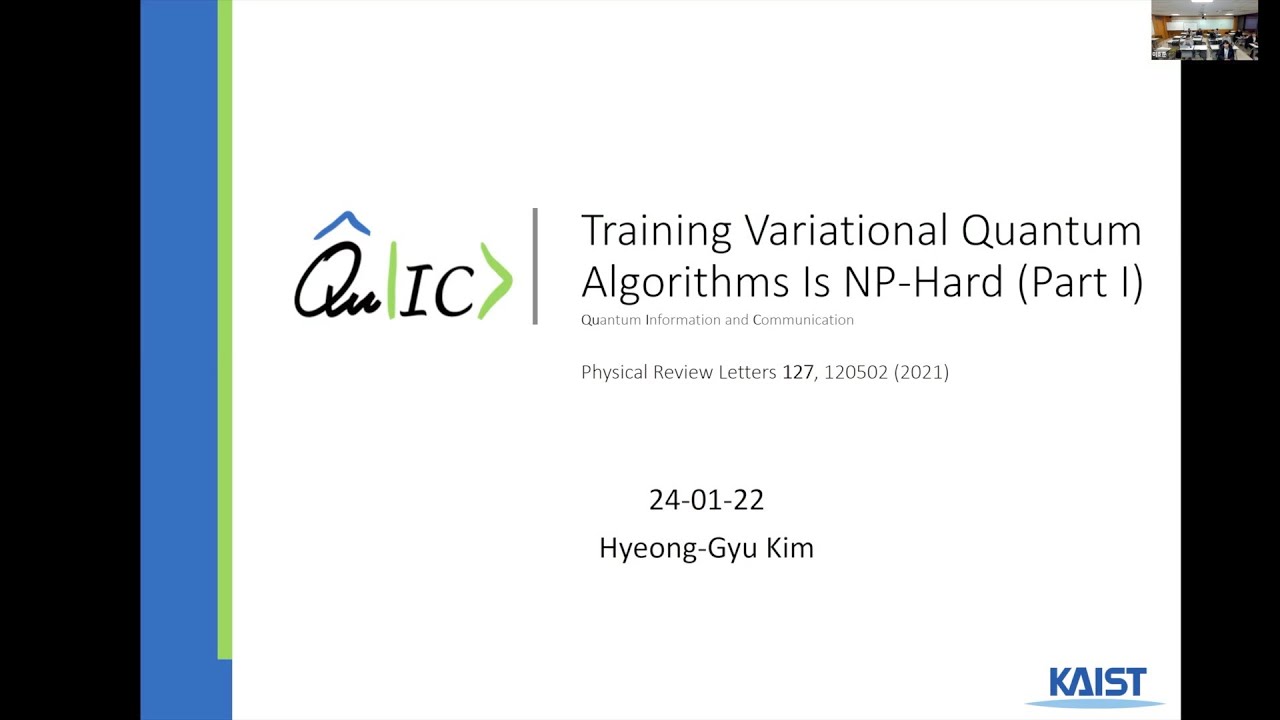
Training variational quantum algorithms is NP-hard
Keywords
Summary
189 words
Critical Evaluation
Value of the Information & Strength of the Argument
The value of the information lies in its rigorous presentation of a significant complexity-theoretic result. The presenter builds a careful chain of reductions, from a known NP-hard problem (MaxCut) to the training of VQAs. He clearly explains each step, including the continuous relaxation of MaxCut, the construction of Hamiltonians and observables, and the reduction to smaller system sizes. The argumentation follows standard NP-hardness proof techniques: starting with a hard problem, reducing it to the target problem in polynomial time, and showing that any solution to the target would solve the original. The presenter also clarifies the distinction between exact and approximate solvability, hinting at APX-hardness as a follow-up. The logical flow is coherent, and each reduction is justified with mathematical definitions and intuitions. While the presentation is concise, it effectively communicates the core ideas, making it valuable for researchers and advanced students in quantum computing and complexity theory.
Scientific Rigor, Source Quality, Title Accuracy
The scientific rigor is high, as the presentation is based on a known paper (likely Bittel & Kliesch, 2021). The presenter cites no external sources explicitly but refers to ’this paper’ and uses standard complexity theory terms. The title perfectly aligns with the content, as the talk focuses on proving NP-hardness of training VQAs. The proof is presented with care, and the presenter acknowledges the difficulty of certain steps, e.g., the fermionic representation, which adds credibility. No sources are directly listed in the description, so the presentation relies on the speaker’s expertise. The content is consistent with published results in quantum information science. The adequacy between title and content is excellent: the talk provably demonstrates the NP-hardness for exact solutions, and the title matches. The video does not contain any sponsored segments or placement. The description provides minimal context (speaker name, affiliation), which is appropriate for a seminar. Overall, the rigor is solid, though the lack of direct citations within the presentation could be improved for a broader audience, but for a specialized seminar it is acceptable.
340 words
Title / Content Match
The title exactly matches the content, which focuses on proving that training variational quantum algorithms is NP-hard.
Quality & Reliability
8/10
The presentation provides a rigorous proof sketch of NP-hardness for variational quantum algorithm training, consistent with the known scientific literature. The speaker demonstrates deep understanding of the material and explains the reduction steps clearly despite some language hesitations.
Key Moments
Markers derived by PSI from the transcript: the creator did not define chapters.
- Introduction to variational quantum circuits and the optimization problem.
- Discussion of complexity classes and the statement that the training is NP-hard.
- Reduction from continuous MaxCut to a quantum circuit problem.
- Scaling down to logarithmic qubits while preserving NP-hardness.
- Conclusion and Q&A; mention of APX-hardness for approximate solutions.
Contribution & Novelties
The video presents a proof that training variational quantum algorithms (VQAs) is NP-hard, an important complexity-theoretic result. It does so through a series of polynomial-time reductions from the MaxCut problem, illustrating that even with a logarithmic number of qubits, the optimization remains hard. This contributes to the understanding of the fundamental limitations of VQAs in practical settings. The presentation also hints at APX-hardness for approximate training, which further characterizes the difficulty. This is original in its presentation of the proof steps in a seminar format, making a dense mathematical argument more accessible to a focused audience.
Pour aller plus loin :
- NP-hardness — Provides the formal definition and examples of NP-hard problems, essential for understanding the result.
- Variational quantum eigensolver — A specific VQA algorithm relevant to the training problem discussed.
- Quantum approximate optimization algorithm — Another VQA used for combinatorial optimization, directly related to the MaxCut example.
148 words
Radar Profile
The radar profile shows a highly technical presentation with excellent quantitative and qualitative content, but moderate accessibility due to the advanced level. The high score in technical level reflects the deep mathematical reasoning, while the equally high fiabilite indicates the reliance on established scientific proofs. The lower scores in quantity of information (still high) indicate that the video covers a focused topic rather than a broad overview, which is appropriate for a seminar.