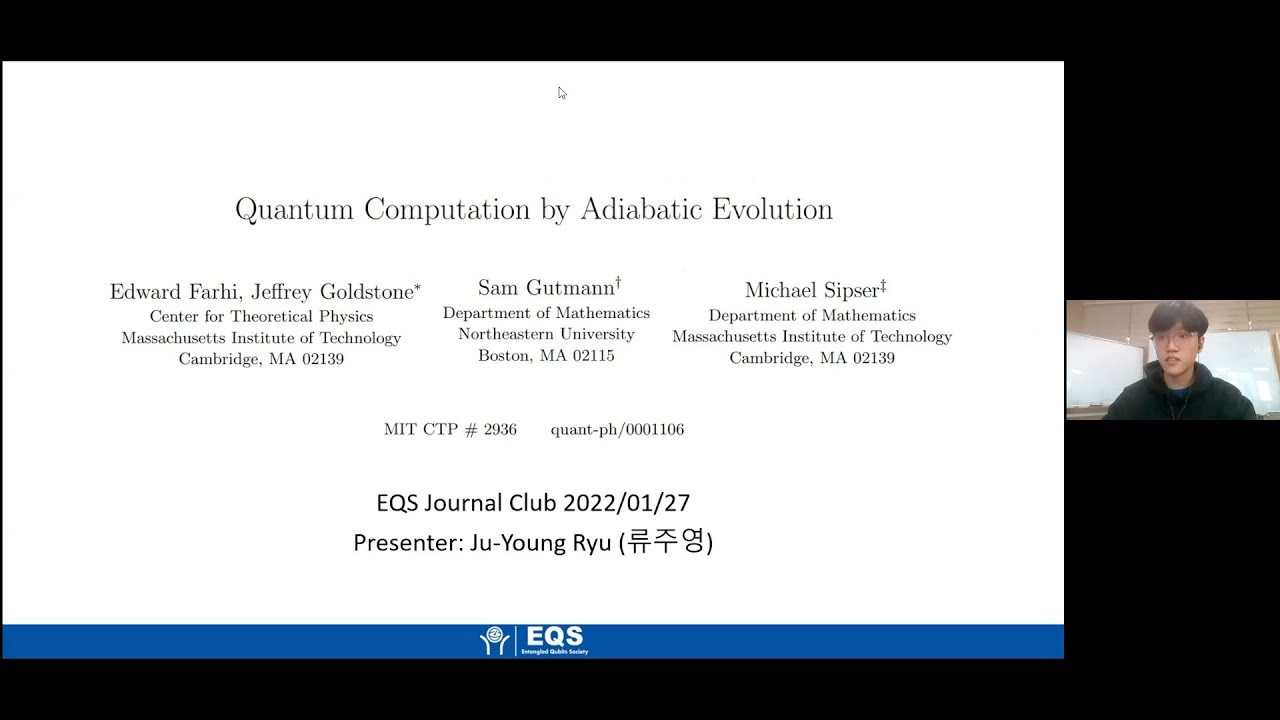
Quantum Computation by Adiabatic Evolution
Keywords
Summary
150 words
Critical Evaluation
Value of the Information & Strength of the Argument
The video provides a valuable pedagogical insight into adiabatic quantum computation. It clearly explains the construction of Hamiltonians for satisfiability problems and demonstrates the importance of the minimum gap. The argumentation is sound, using specific examples to illustrate the principles. The discussion on local adiabatic evolution highlights an important improvement. The logical flow is coherent, moving from theory to examples and then to broader connections.
Scientific Rigor, Source Quality, Title Accuracy
The video is based on a well-known paper and cites it explicitly. The title matches the content precisely. The presenter does not cite many external sources during the talk but mentions additional papers for local adiabatic evolution and a review. The technical accuracy appears high, with appropriate use of quantum mechanics terminology.
132 words
Title / Content Match
The title exactly matches the content, which is a detailed explanation of the adiabatic quantum computation paper.
Quality & Reliability
7/10
The lecture is based on a seminal paper and presents accurate technical details, though it is not peer-reviewed and relies on the presenter's interpretation.
Key Moments
Markers derived by PSI from the transcript: the creator did not define chapters.
- Introduction and outline of the talk
- Explanation of the adiabatic theorem and conditions for efficient evolution
- Construction of the problem Hamiltonian for satisfiability problems
- One-qubit toy problem illustrating gmin and failure conditions
- Grover search problem and discussion of no quantum advantage
- Local adiabatic evolution for achieving quadratic speedup
- Equivalence to gate-based quantum computing via Trotterization
- Summary and Q&A session
Cited Sources
- Quantum Computation by Adiabatic Evolution — The main paper being presented
- Quantum adiabatic evolution algorithms versus simulated annealing — Mentioned as the 2002 paper on local adiabatic evolution
- Review of Adiabatic Quantum Computing (2018) — Suggested for further reading, but no specific title given
Contribution & Novelties
The video offers a clear and accessible explanation of a foundational paper in adiabatic quantum computation, emphasizing the minimum gap’s role and showcasing local adiabatic evolution as a improvement. It also bridges the gap to gate-based models, making the topic more approachable for learners.
Pour aller plus loin :
- Adiabatic quantum computation — Overview of the field and its history.
- Quantum annealing — Related method for optimization, often compared to adiabatic QC.
- Boolean satisfiability problem — The SAT problem discussed in the video.
- Grover’s algorithm — Quantum search algorithm providing quadratic speedup, relevant to the Grover example.
97 words
Radar Profile
The radar profile shows high scores in technical depth and quantity of information, with slightly lower but still solid quality and reliability, reflecting a detailed academic lecture.