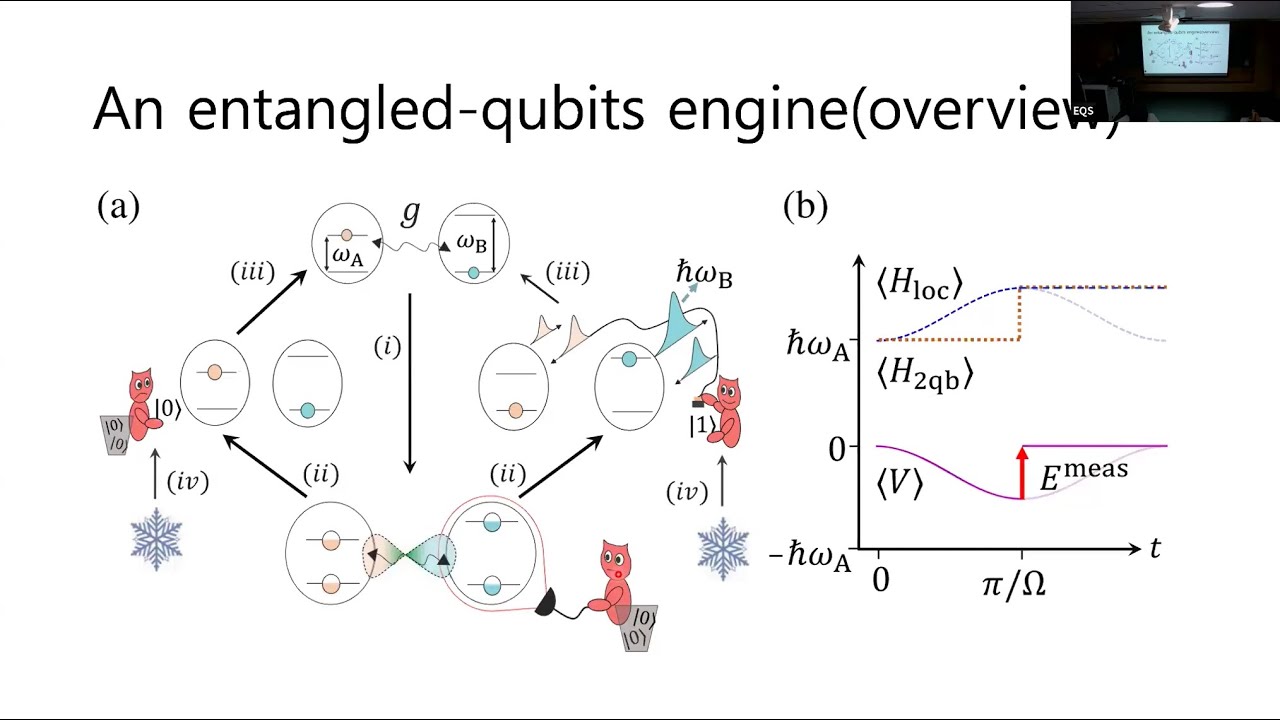
QISCA Joint Seminar 2024 Winter - Two-Qubit Engine Fueled by Entanglement and Local Measurements
Keywords
Summary
253 words
Critical Evaluation
Value of the Information & Strength of the Argument
The value of the information lies in the clarity with which a non-trivial quantum-thermodynamic cycle is decomposed into elementary steps: state preparation, entangling Hamiltonian, local measurement, feedback, and reset. The speaker explicitly connects each mathematical step to a physical interpretation (the demon’s ‘happiness’ when B is excited, the energy cost of the entangling pulse being zero, the role of the measurement time t0). The argumentation is mostly deductive and follows the paper’s logic, with the speaker deriving the average work and the information cost and then pointing out the apparent contradiction with the Carnot bound. The resolution of this paradox is sketched through the effective temperature and the observation that the process is not isothermal. The argument is strengthened by the speaker’s honesty about what he does not cover (error model, work extraction ratio) and by his invitation to check a possible typo in the supplementary material. However, the argumentation remains largely qualitative: no numerical plots, no experimental proposals, and no discussion of the limits of the model (e.g., ideal measurement, no decoherence) are provided. The Q&A is brief and does not fully address the comparison with classical information engines, leaving the practical advantage of the scheme underexplored.
Scientific Rigor, Source Quality, Title Accuracy
The talk is explicitly based on a single peer-reviewed source: Bresque, L., et al., ‘Two-qubit engine fueled by entanglement and local measurements’, Physical Review Letters 126.12 (2021): 120605. This reference is given in the description and repeated in the presentation. The speaker also mentions a companion video on the Korea Quantum Clubs channel, which is listed in the description. The scientific rigor is generally good for a seminar: the Hamiltonian, the measurement time, the feedback protocol, and the energy balance are presented in a consistent way, and the speaker distinguishes between the ideal and non-ideal cases. The main weakness is the lack of quantitative results and the absence of a critical discussion of the assumptions (e.g., the demon’s memory, the role of the ancilla M, the thermodynamic limit). The title is perfectly adequate: the content is exactly a two-qubit engine fueled by entanglement and local measurements. No advertising sequence is present in the video.
367 words
Title / Content Match
The title matches the content exactly: the presentation is a step-by-step explanation of the two-qubit engine driven by entanglement and local measurements, with the Q&A focused on the same mechanism.
Quality & Reliability
7/10
The talk is a faithful walkthrough of a peer-reviewed PRL paper (Bresque et al., PRL 126, 120605, 2021), with the main reference explicitly given and the derivation steps (entangling Hamiltonian, local measurement at t0 = pi/(2 Omega), feedback via pi-pulses, energy balance, effective temperature, pre-measurement model with an ancilla M) presented in a coherent order. The speaker is transparent about what he skips (error model, work extraction ratio) and even flags a possible typo in the supplementary material, which is a sign of honesty rather than overreach. Reliability is limited by the informal whiteboard-style delivery, the absence of quantitative results beyond the schematic formulas, and the fact that no independent verification or comparison with experiments is offered.
Chapters
Cited Sources
- Bresque, L., et al. 'Two-qubit engine fueled by entanglement and local measurements.' Physical Review Letters 126.12 (2021): 120605. — Main reference of the presentation, cited in the description and throughout the talk.
- Korea Quantum Clubs video on the same paper — Alternative presentation of the same paper, mentioned in the description.
Concurring Sources
- Bresque, L., et al. 'Two-qubit engine fueled by entanglement and local measurements.' Physical Review Letters 126.12 (2021): 120605. — The primary source, which the talk follows closely.
Contribution & Novelties
The talk does not present original research; it is a pedagogical review of a published PRL paper. Its main contribution is to make accessible the counter-intuitive idea that a two-qubit engine can extract work from entanglement and local measurements, and to clarify the role of the pre-measurement interaction with an ancilla as the physical origin of the extracted energy. The speaker also highlights the apparent violation of the Carnot bound and its resolution through an effective temperature, which is a useful conceptual takeaway.
Pour aller plus loin :
- Quantum thermodynamics — General framework for thermodynamics at the quantum scale, directly relevant to the engine discussed.
- Maxwell’s demon — The information-to-work conversion principle underlying the demon in the paper.
- Entanglement — The resource that fuels the engine.
- Physical Review Letters 126, 120605 (2021) — The original paper by Bresque et al.
140 words
Radar Profile
The radar profile shows a strong technical level and good information quantity, with reliability and quality slightly lower due to the informal seminar format and the absence of quantitative results. The overall shape is that of a solid pedagogical exposition of a specialized topic, rather than a critical or original contribution.