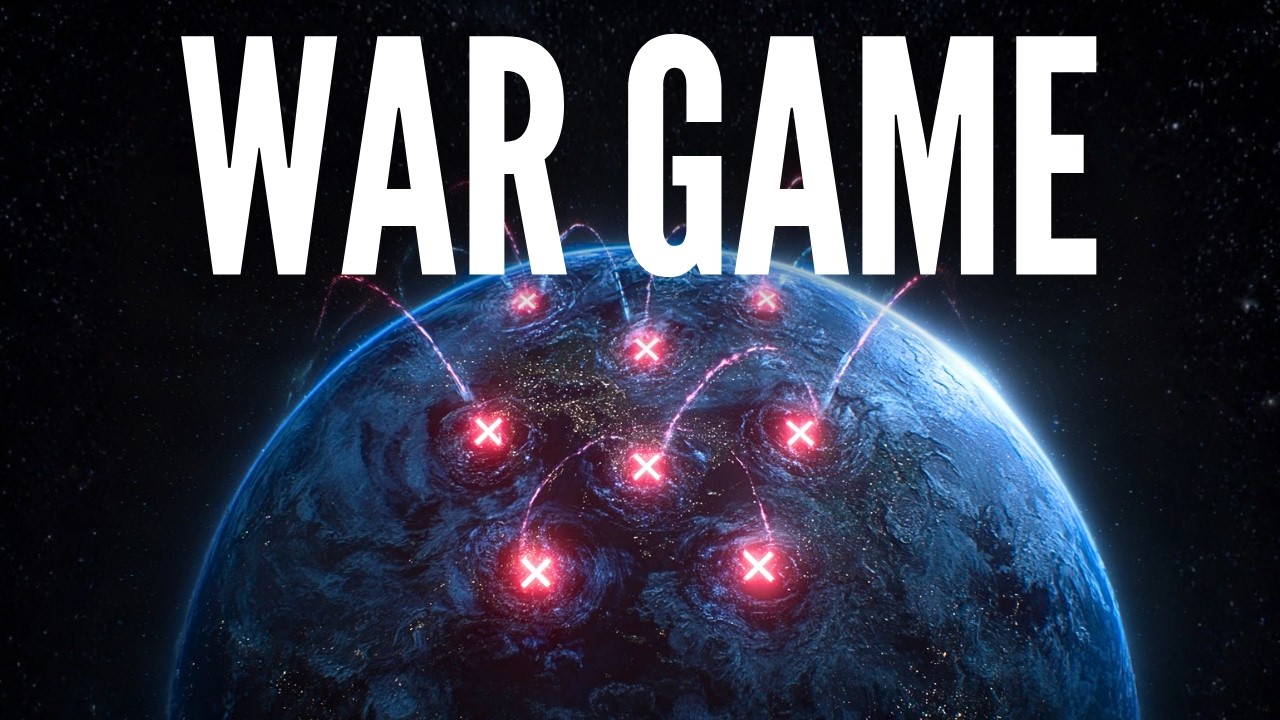
On s’est trompés sur le PARADOXE de FERMI (le JEU caché)
We were wrong about the FERMI PARADOX (the hidden GAME)
Keywords
Summary
215 words
Critical Evaluation
Value of the Information & Strength of the Argument
The video provides a compelling and original synthesis, connecting abstract game theory to concrete existential risk. It adds value by framing the Fermi paradox not as a question of cosmic silence but as a consequence of behavioural traps that could affect any technologically advanced civilization. The argument progresses logically from the tic-tac-toe metaphor to the paradoxes of nuclear deterrence, integrating psychological and informational constraints. While it simplifies some technical concepts, it does not oversimplify the core strategic dilemmas. The historical examples are well-chosen and effectively illustrate the fragility of the system. The reasoning is solid, though it leans on analogies that, by the creator’s own admission, have limits. Overall, the video’s narrative is engaging and intellectually stimulating, offering a fresh perspective on a classic puzzle.
Scientific Rigor, Source Quality, Title Accuracy
The video demonstrates scientific rigour by referencing a peer-reviewed article (Reid Pauly & Rose McDermott’s ‘The Psychology of Nuclear Brinkmanship’) and a scholarly book on nuclear deterrence (Bruno Tertrais’ ‘Pax atomica?’). It also draws on official reports of historical incidents, such as those from the National Security Archive. However, it does not always distinguish between established facts and interpretation, but this is typical of science communication. The title accurately reflects the content: the video reinterprets the Fermi paradox through the lens of game theory and suggests that the Great Filter might be a self-inflicted geopolitical game. The title’s emphasis on being ‘wrong’ is justified, as the video challenges simplistic explanations of the paradox. No significant discrepancies between title and content are observed.
262 words
Title / Content Match
The title suggests a fresh angle on the Fermi paradox, linking it to game theory and nuclear deterrence. The content delivers on this by proposing a novel 'game-theoretic' explanation for the Great Filter.
Quality & Reliability
8/10
The video grounds its argument in game theory and historical near-miss incidents, referencing a peer-reviewed article on nuclear brinkmanship. It clearly distinguishes speculation from established knowledge, though it simplifies complex strategic concepts for a general audience.
Chapters
- Le paradoxe de Fermi et le Grand Filtre
- L’impasse du morpion
- La leçon de WarGames
- Pourquoi la dissuasion nucléaire fonctionne
- Quand se protéger devient dangereux
- Trois fois où nous avons frôlé la catastrophe
- Jusqu’où peut-on pousser la menace nucléaire ?
- Le jeu qu’on ne peut pas quitter
- Et si c’était ça, le Grand Filtre ?
Cited Sources
- The Psychology of Nuclear Brinkmanship — Peer-reviewed article by Reid B.C. Pauly & Rose McDermott, referenced as key research for the video's arguments on brinkmanship and psychological factors.
- Pax atomica ? Théorie, pratique et limites de la dissuasion — Book by Bruno Tertrais, recommended for further reading on nuclear deterrence theory and practice.
- L’IA va-t-elle nous dépasser ? Un chercheur démêle le vrai du faux — avec Nicolas Sabouret | Science & Vie — Interview with a scientist, recommended for exploring AI risks and related topics.
- Christophe Pauly's website — Creator's personal site, offering additional content and context.
Contribution & Novelties
The video’s main novelty lies in proposing that the Great Filter of the Fermi paradox might be a civilisation-level game-theoretic trap, analogous to a never-ending game of tic-tac-toe. By using this metaphor, it reframes existential risk not as an external event but as a failure of coordination among rational actors. It concretely applies this to nuclear brinkmanship, showing how deterrence stability depends on perception, communication, and the ability to maintain second-strike capabilities—concepts that could apply to any advanced civilisation. The video enriches ongoing discussions by integrating insights from political psychology and game theory into the SETI discourse.
Pour aller plus loin :
- Mutual Assured Destruction — Core doctrine underpinning nuclear deterrence, relevant to the video’s discussion of stable equilibria.
- Security Dilemma — Key concept explaining how defensive actions can provoke escalation, central to the video’s argument.
- Stanislav Petrov — The officer whose decision during a false alarm averted potential catastrophe, illustrated in the video.
- Game Theory — Formal framework for analysing strategic interactions, foundational to the video’s analogy.
168 words
Radar Profile
The radar profile shows a well-rounded video with high scores across quantity, quality, and reliability, but a slightly lower technical level, reflecting its accessible approach to complex topics. The balanced profile indicates a video that is both informative and trustworthy, suitable for a general audience interested in existential risk.