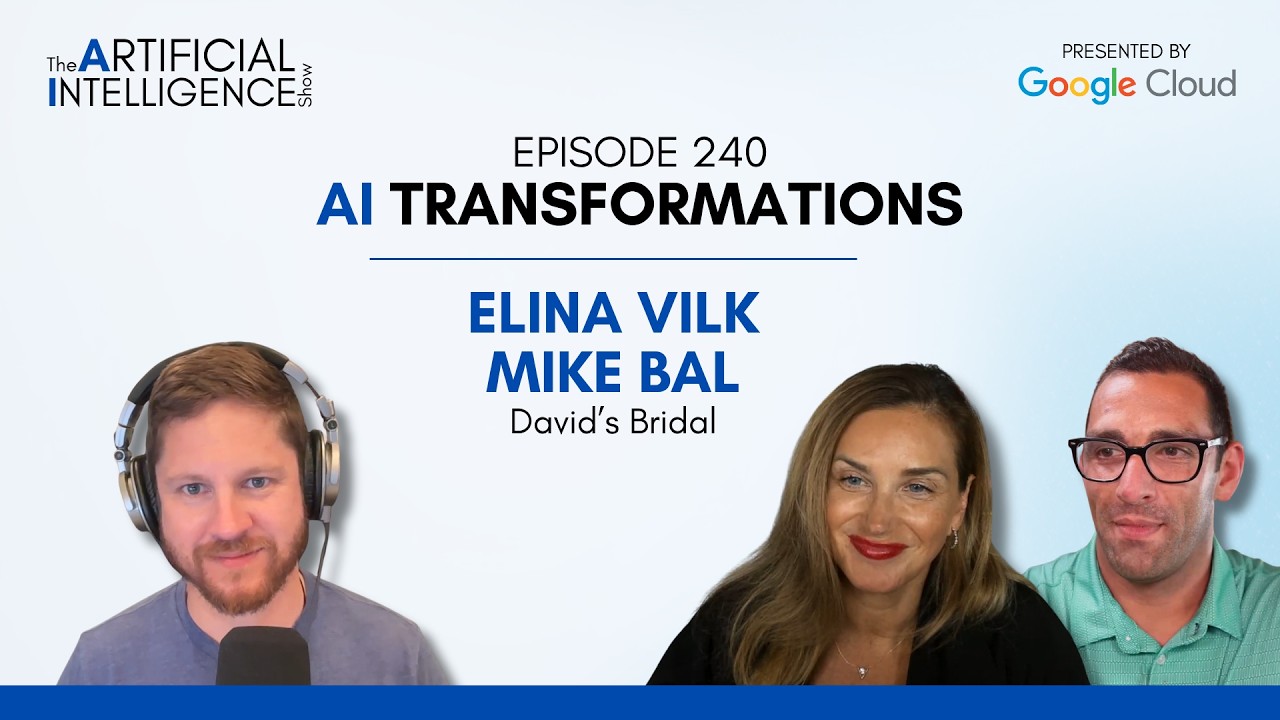
Ep. 240: How David’s Bridal Is Rebuilding a 76-Year-Old Business Around AI
Keywords
Summary
180 words
Critical Evaluation
Value of the Information & Strength of the Argument
The information is highly valuable for business leaders and technologists, as it presents a detailed, real-world case study of AI transformation. The guests articulate a clear problem statement (customer stress) and demonstrate how AI can solve it, moving beyond generic productivity gains to reinvent a core business process. The argumentation is logical and grounded in customer research and hands-on product development. They validate their approach with specific examples, such as the vision quiz and budget red-zone alerts, and explain the reasoning behind design choices like memory and personalization. However, the discussion is promotional to some extent, given the sponsorship, but the technical and strategic insights remain substantive and actionable.
Scientific Rigor, Source Quality, Title Accuracy
The episode exhibits strong scientific rigor in its methodology: the guests reference early customer interviews, iterative design, and the use of evals for model selection. Sources are primarily internal expertise and user feedback, which is appropriate for this type of case study. The title is accurate, and the content thoroughly addresses the theme. The episode relies on the credibility of the speakers and their hands-on experience; while not peer-reviewed, the transparency about challenges and decision-making enhances reliability. The presence of Google Cloud sponsorship is disclosed and does not undermine the authenticity of the narrative. Overall, the rigor and source quality are commendable for a practitioner-focused conversation.
230 words
Title / Content Match
The title accurately captures the episode's focus on David's Bridal's AI-driven business transformation, and the content aligns with this promise.
Quality & Reliability
8/10
First-hand accounts from company leaders provide concrete examples and technical details, but the episode is sponsored by Google Cloud, which may introduce bias.
Chapters
- Intro
- How the AI transformation at David's Bridal began
- The early phases and turning points
- Inside Pearl Planner, the customer-facing assistant
- Using AI for timelines, budget, and vendors
- The models, tools, and platforms behind it
- Pearl Connect and the Google Cloud stack
- Early results from Pearl Planner and Pearl Connect
- How internal teams at David's Bridal use AI
- What's next for David's Bridal
Cited Sources
- Show Notes Episode 240 — Detailed show notes with additional context and links discussed in the episode.
- Google Cloud — The technology platform used for Pearl Connect and other AI infrastructure.
- Marketing AI Institute Newsletter — Newsletter for regular updates on AI in marketing.
- AI Academy — Educational resources on AI.
- MAICON — AI marketing conference.
- SmarterX Community — Community for AI enthusiasts.
- SmarterX Webinars — Free webinars on AI.
- SmarterX LinkedIn — LinkedIn page for SmarterX.
Contribution & Novelties
This episode provides a unique, in-depth look at how a 76-year-old traditional business completely reimagines its core offering using AI, specifically addressing the emotional and logistical pain points of wedding planning. The guests detail their journey from identifying the customer problem to implementing AI solutions, including design principles like personalization, memory, and task sequencing. The discussion also covers the technical architecture (custom orchestration, model rotation) and the expansion to a B2B platform, offering a holistic view of AI transformation beyond simple automation.
Pour aller plus loin :
- Google Cloud AI — Relevant for understanding the cloud infrastructure and AI services mentioned in the episode.
- Marketing AI Institute — Provides ongoing insights into AI applications in marketing and business.
- Show Notes for Episode 240 — Contains additional resources and references discussed by the guests.
133 words
Radar Profile
The radar profile shows high scores in quantity and quality of information, reflecting the rich detail and first-hand accounts. The technical level is moderate, as the discussion balances strategic and technical aspects without delving into deep algorithmic specifics. Overall reliability is good, with a slight deduction for inherent promotional bias.