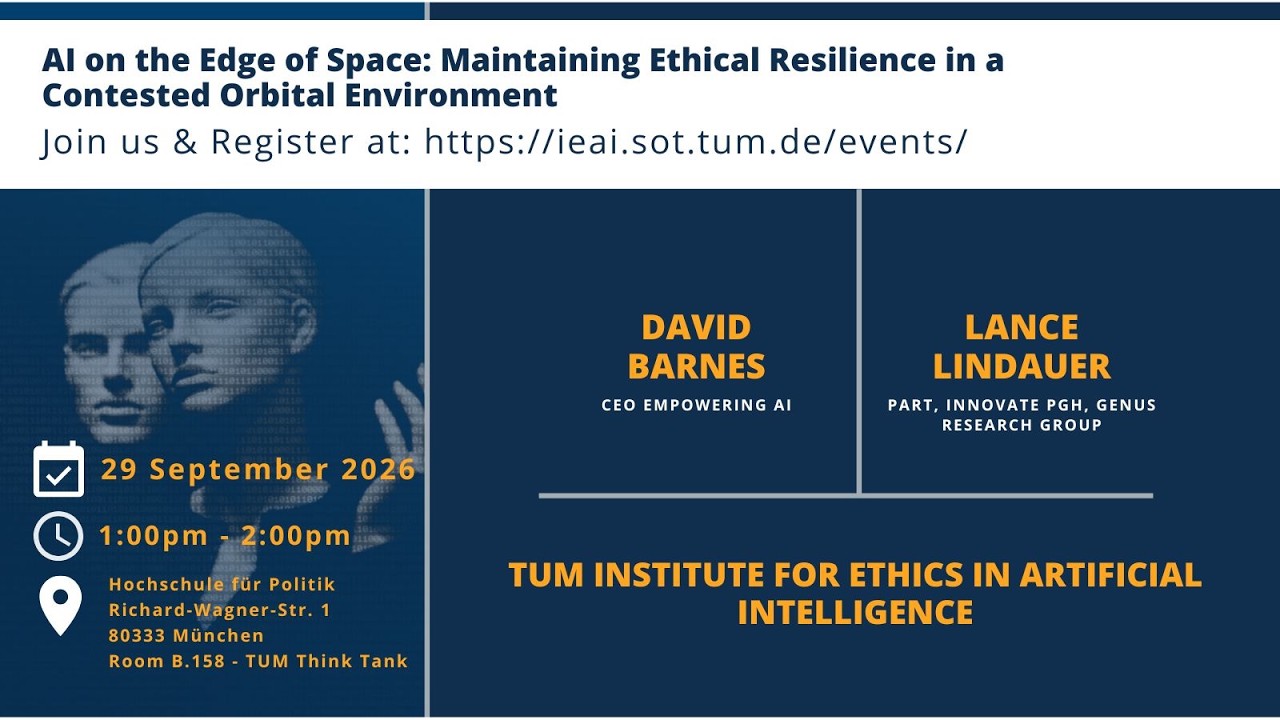
IEAI Event - AI on the Edge of Space
Keywords
Summary
196 words
Critical Evaluation
Value of the Information & Strength of the Argument
The presentation offers a broad historical and conceptual overview rather than deep technical analysis. Its value lies in framing the ethical and security questions surrounding AI in space, particularly the challenge of maintaining human oversight as systems become more autonomous. The argument is structured around the ’three Ps’—people, physical infrastructure, and principles/governance—which provides a useful analytical framework. However, the speakers acknowledge that this is a work-in-progress, and many points remain at the level of general observations rather than evidence-based conclusions. The historical timeline is informative but not exhaustive, and the discussion of AI’s role is somewhat superficial, focusing on applications like satellite swarms and automatic decision-making without delving into technical details or ethical trade-offs. The argument for ethical resilience is compelling but lacks concrete policy recommendations or case studies. Overall, the talk is a valuable conversation starter but does not present original research findings or rigorous analysis.
Scientific Rigor, Source Quality, Title Accuracy
The speakers do not cite specific sources during the presentation; they reference historical events and technologies without providing references. The description includes only institutional links (IEAI website, newsletter, events page), which are not direct sources for the content. The title accurately reflects the topic, and the content stays on theme. The lack of citations and the preliminary nature of the research reduce the scientific rigor. The presentation is more of an expert opinion piece than a literature review or original study. The adéquation between title and content is strong, as the discussion consistently addresses AI, space, and ethical resilience.
261 words
Title / Content Match
The title accurately reflects the content: the discussion covers AI in space, ethical resilience, and the contested orbital environment. The presentation aligns well with the announced topic.
Quality & Reliability
6/10
The speakers are credible experts (a retired brigadier general and a co-founder of an NGO focused on responsible technology), and the content is presented as a work-in-progress research brief. However, the talk is largely a historical overview and conceptual framing, with few primary sources cited during the presentation. The description provides only institutional links, not direct references to the works mentioned. The lack of specific citations and the preliminary nature of the research lower the reliability score.
Key Moments
Markers derived by PSI from the transcript: the creator did not define chapters.
- Introduction by the host, outlining the event's topic and speakers.
- Lance Lindauer explains the origin of the research and the three themes: orbital history, technological evolution, and global security.
- Historical overview begins: 1944 V-2 rocket crossing the Kármán line, first photos from space in 1946, first life in space (fruit flies), first mammal (Albert II).
- Discussion of the space race: Sputnik 1 (1957), Vanguard 1 (1958), Yuri Gagarin (1961), Telstar 1 (1962), and the moon landing.
- Technological evolution: boundaries of space (LEO, MEO, HEO), solar power, measurement instrumentation, GPS, reusable spacecraft, Hubble telescope, ISS, robotic arms, automatic decision-making, satellite swarms.
- Mention of PRITV, NASA's first AI geospatial foundational model in orbit, as a recent development.
- Transition to national security implications, with David Barnes taking over.
Cited Sources
- IEAI - Institute for Ethics in Artificial Intelligence — Institutional website of the hosting organization.
- IEAI Events — Page listing events, including this one.
- IEAI Newsletter — Subscription page for updates.
Contribution & Novelties
The presentation does not introduce new scientific findings; it synthesizes existing knowledge and frames upcoming research. Its originality lies in applying the ’three Ps’ framework (people, physical infrastructure, principles/governance) to the intersection of AI and space, and in highlighting the need for ethical resilience in autonomous space systems. The speakers announce a forthcoming research brief that will expand on these themes.
Pour aller plus loin :
- Kármán line — Definition and significance of the boundary of space.
- Space debris — Overview of the growing problem of orbital debris.
- Ethics of artificial intelligence — General background on AI ethics, relevant to the discussion of ethical resilience.
105 words
Radar Profile
The radar shows moderate information quantity and quality, with lower technical depth and reliability. The content is accessible but not highly specialized, reflecting its nature as an expert discussion rather than a technical deep dive.