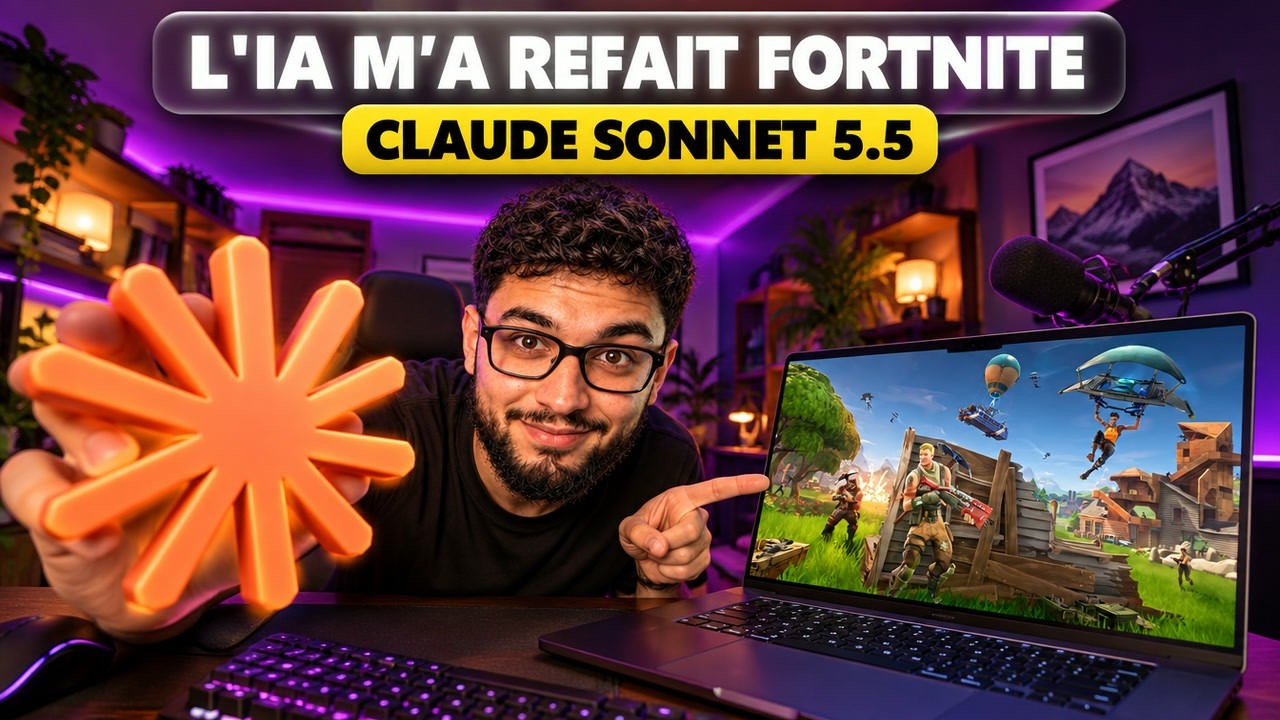
Claude Sonnet 5.5 : MEILLEUR rapport qualité/prix ?!
Claude Sonnet 5.5: BEST value for money?!
Keywords
Summary
183 words
Critical Evaluation
Value of the Information & Strength of the Argument
The video offers practical, hands-on comparisons with reproducible prompts and a clear methodology, giving viewers actionable insights into model selection based on cost and performance. The argumentation is persuasive, backed by concrete examples and a blinded voting system that reduces bias. However, the sample size is small (12 duels), and the evaluation is subjective, relying on personal preferences rather than quantitative metrics. The creator acknowledges this by presenting both sides fairly, and the inclusion of cost considerations adds practical value.
Scientific Rigor, Source Quality, Title Accuracy
The video references official benchmarks and provides links to all prompts and skills used, including GitHub repositories. Sources are technical but not formally cited beyond the description links. The title is accurate and aligns with the content, though the exclamation mark hints at a promotional tone. The methodology is transparent, but rigor could be improved with more structured testing and statistical analysis. The description contains relevant resources, but some claims (e.g., Pokémon Red completion) are not independently verified.
173 words
Title / Content Match
The title accurately reflects the content: a cost-performance comparison between Claude Sonnet 5.5 and Opus 5.
Quality & Reliability
7/10
Personal hands-on comparison with transparent methodology and reproducible prompts, but limited by subjective evaluation, small sample size, and non-controlled conditions.
Chapters
- Intro : Sonnet 5.5 est sorti
- Les benchmarks
- Prix et avancées face à Sonnet 5
- Ce qu'on va construire
- Mettre à jour Claude Code
- Use case 1 : motion design (même prompt pour les deux)
- Motion design d'un navigateur web IA
- Use case 2 : Fortnite recréé en 3D
- Use case 3 : ma vidéo recréée avec hypit
- Use case 4 : le duel à l'aveugle Opus vs Sonnet
- Duel site Mars
- Duel motion design Postiz
- Duel short face caméra
- Bonus : les sites brouillard
- Verdict : Opus gagne 8 duels sur 12
- Use case 5 : prospection LinkedIn + n8n
- Les mails préparés
- Conclusion
Cited Sources
- Visual Studio Code — IDE used for running Claude Code and the projects.
- motion-web skill — GitHub repository for motion design skill used in one use case.
- hypit skill — GitHub repository for video regeneration skill.
- Scout skill — GitHub repository for a skill used in the video.
- brag skill — GitHub repository for another skill.
- scroll-craft skill — GitHub repository for a skill.
- claude-watch skill — GitHub repository for a skill used to watch videos.
- crawl4AI — GitHub repository for web crawling library.
- opus-vs-sonnet form — Form to get the free pack of prompts.
Concurring Sources
- Anthropic Research Papers — Official research that often discusses model capabilities and benchmarks.
- OpenRouter Model Comparisons — The video mentions OpenRouter pricing; this platform aggregates model performance and costs.
Dissenting Sources
- Independent benchmark leaderboards (e.g., Artificial Analysis) — External benchmarks may show different rankings depending on the test set and methodology, not discussed in the video.
Contribution & Novelties
This video provides a timely, hands-on evaluation of a newly released AI model, focusing on practical performance and cost-efficiency rather than just benchmark numbers. The blind duel system offers a creative way to gather comparative feedback. The inclusion of multiple diverse use cases (motion design, game development, web design, prospecting) makes the assessment broad and applicable to real-world tasks. The creator also shares all prompts and skills, enabling viewers to reproduce the tests.
Pour aller plus loin :
- Claude (language model) - Wikipedia — Overview of Anthropic’s AI model family.
- SWE-bench - GitHub — Benchmark for AI coding performance, relevant to the Terminal Bench metrics discussed.
- n8n - official site — Workflow automation platform used in the LinkedIn prospecting use case.
- Anthropic official site — Official page for Claude models, for latest updates.
133 words
Radar Profile
The radar profile shows high scores in information quantity and technical level, reflecting the detailed use cases and benchmarks. Quality and reliability are moderate, as the evaluation is subjective and lacks statistical rigor. The overall balanced profile suggests a well-rounded but not exhaustive analysis.