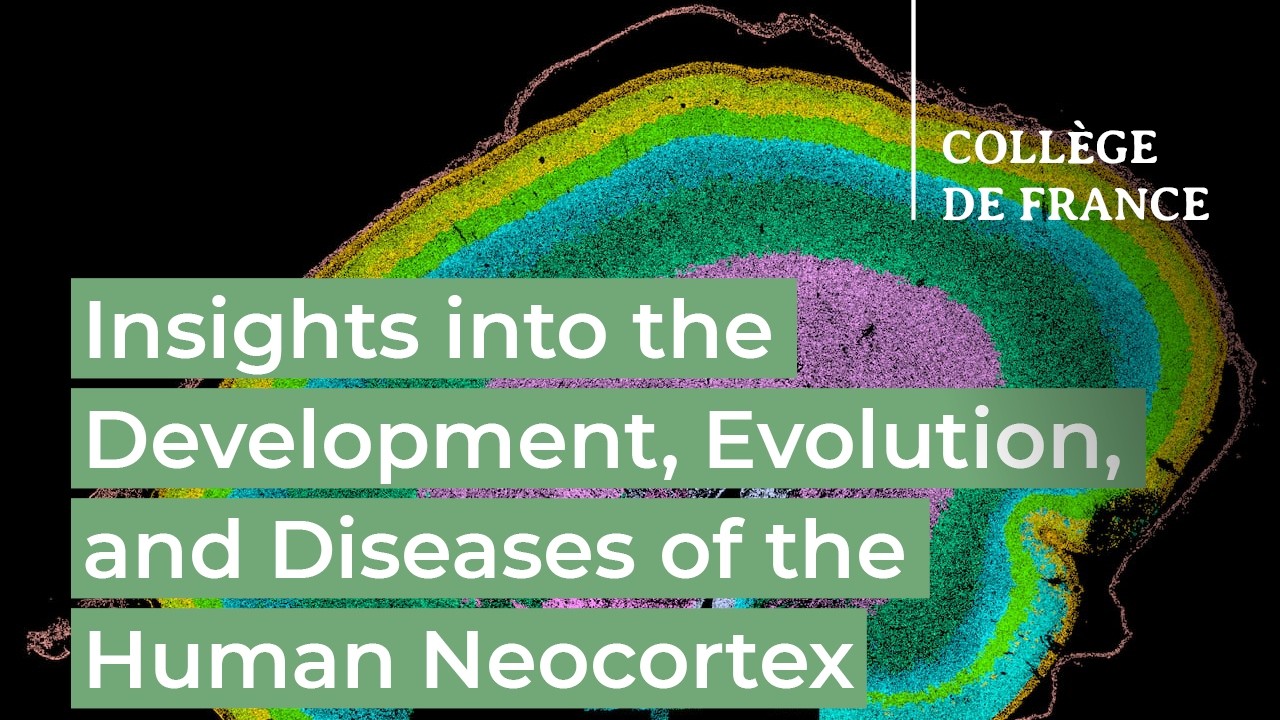
Genomic Insights into Human Brain Development, Evolution, and Disease - 2026-27 (1)
Keywords
Summary
176 words
Critical Evaluation
Value of the Information & Strength of the Argument
The value of the information is exceptionally high, as the lecture presents unpublished (at the time of the talk) findings from a massive single-cell atlas of the developing human brain. The argumentation is rigorous: experimental observations are supported by multiple independent methods (immunohistochemistry, live imaging, organoid models, spatial transcriptomics). The reasoning is logical and transparent, with clear caveats, such as the artificial nature of organoids and the distinction between gene expression timing and cell birthdate. The presenter directly tests hypotheses (e.g., LIF receptor function) and acknowledges unexpected results (e.g., the non-microtubule mechanism of somal translocation). The translational promises are well-grounded in the data, making the argumentation both solid and compelling.
Scientific Rigor, Source Quality, Title Accuracy
The scientific rigor is high: the talk references the group’s own peer-reviewed publications (e.g., the 2015 single-cell study) and leverages publicly available resources like the Allen Institute data. The described multi-omic study appears methodologically sound with careful validation of predictions. The title accurately represents the content, which indeed covers genomic insights into development, evolution, and disease. The sources cited in the description consist mainly of institutional pages (Collège de France, chaires, playlists) that provide context rather than direct data references. No external peer-reviewed sources are explicitly named beyond the presenter’s own work, which is standard for a seminar. Overall, the lecture is trustworthy and well-structured.
230 words
Title / Content Match
The title accurately reflects the content, which focuses on genomic approaches to understanding human brain development, evolution, and disease.
Quality & Reliability
8/10
The lecture presents original research from a leading expert in the field, based on extensive single-cell genomics data. The content is detailed and references multiple published studies, though the talk itself is not peer-reviewed. The methodological rigor is high, and the data appear robust.
Key Moments
Markers derived by PSI from the transcript: the creator did not define chapters.
- Introduction and award ceremony; Arnold Kriegstein is welcomed as invited professor.
- Overview of human cortical development; contrast with mouse: prolonged development and more progenitor types.
- Discovery of outer radial glia (oRG) in the outer subventricular zone; mitotic somal translocation described.
- First single-cell sequencing study (2015, 250 cells); new markers for oRG and ventricular radial glia identified.
- LIF receptor specific to oRG; organoid experiments show LIF expands oRG numbers.
- Large multi-omic atlas (1M+ cells) from 9-12 weeks to adolescence; integration of ATAC-seq, RNA-seq, spatial transcriptomics.
- Lineage reconstruction shows upper-layer neurons from oRG/truncated radial glia; discovery of V1-specific layer 4 neuron.
- Spatial transcriptomics reveals neuron-neuron signaling; somatostatin from interneurons accelerates excitatory neuron maturation.
- Conclusions: roadmap for deriving specific neural cells; implications for disease and therapy.
Cited Sources
- Collège de France - Insights into the Development, Evolution, and Diseases of the Human Neocortex — Official agenda page for the lecture series, providing details about the talk and speaker.
- Chaire Paléoanthropologie - Jean-Jacques Hublin — Page of the chair that hosted the lecture, relevant to context.
- Chaire Processus morphogénétiques - Alain Prochiantz — Page of the co-host chair.
- Playlist - Jean-Jacques Hublin's courses — YouTube playlist of related lectures.
- Playlist - Alain Prochiantz's courses — YouTube playlist of related lectures.
- Collège de France — General institutional resource.
External References
Contribution & Novelties
The lecture provides a major contribution to our understanding of human cortical development by presenting a comprehensive single-cell multi-omic atlas that characterizes over a million cells across developmental stages. It identifies novel progenitor lineages, including the distinct roles of outer radial glia and truncated radial glia, and reveals that upper-layer neurons arise exclusively from oRG, differing from the rodent model. A particularly novel finding is the postnatal emergence of a V1-specific layer 4 excitatory neuron, which is absent in mice and likely linked to visual experience. Additionally, the spatial transcriptomics uncovers specific neuron-to-neuron signaling, such as somatostatin from interneurons accelerating excitatory neuron maturation, and maps disease risk genes to discrete cell populations.
Pour aller plus loin :
- Radial glial cells — Overview of the scaffold cells central to the talk.
- Single-cell sequencing — Technique used to generate the atlas.
- Neocortex — Structure at the focus of the research.
- ATAC-seq — Method for chromatin accessibility used in the study.
158 words
Radar Profile
The radar profile shows a very high score for technical level (10) and strong scores for information quantity and quality (9 each), while reliability is slightly lower (8), reflecting the advanced, data-dense presentation and the inherent uncertainty of unpublished results.