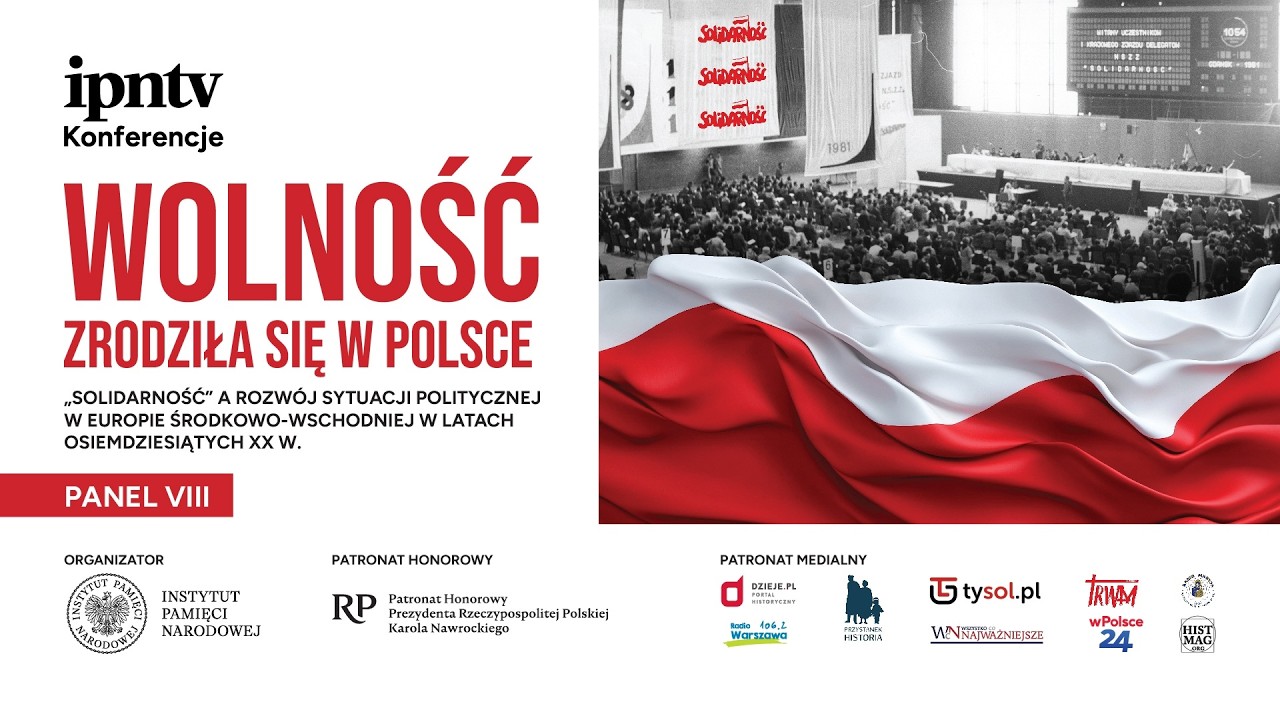
PANEL VIII
Keywords
Summary
201 words
Critical Evaluation
Value of the Information & Strength of the Argument
The panel provides substantial informational value through four detailed case studies that collectively illuminate the multifaceted role of Solidarity in the 1989–1990 transitions. Filip Gańczak’s presentation is particularly rich, drawing on diplomatic reports and internal East German documents to trace the evolution of the GDR’s stance toward Solidarity—from outright ignoring to desperate, belated outreach. He convincingly argues that the GDR’s strategy failed because it invested exclusively in the Communist Party and lacked a real offer, unlike West Germany. Artur Brożyniak’s comparison between Poland and Kazakhstan is thought-provoking, though the argument relies heavily on cultural and mental differences (e.g., clan structures, the role of the Catholic Church) rather than a systematic comparative framework. His account of the 1986 Alma-Ata protests and their brutal suppression is detailed and well-supported by figures. Adam Chmielecki’s contribution, as summarized in the transcript, focuses on the participation of Solidarity activists in democratization, but the excerpt is truncated, limiting assessment. Krzysztof Brzechczyn’s talk on Fighting Solidarity is not detailed in the provided transcript. Overall, the arguments are coherent and grounded in historical evidence, but the oral format means some claims are asserted rather than fully demonstrated. The discussion segment is not transcribed, so its value cannot be evaluated.
Scientific Rigor, Source Quality, Title Accuracy
The speakers are established historians affiliated with the IPN and academic institutions, and their presentations reference specific archival sources, such as reports from Polish ambassadors (e.g., Janusz Obodowski) and East German officials (e.g., Jürgen Vanfall). However, the video does not provide a bibliography or footnotes, and the oral nature of the conference means that sources are mentioned in passing rather than systematically cited. The title ‘PANEL VIII’ is purely descriptive and accurately reflects the content, though it offers no indication of the specific topics covered. The description provides a detailed program with timestamps and speaker affiliations, which enhances transparency. The panel is part of a larger conference, and the playlist link is provided, but no direct links to primary sources or publications are included in the description. The overall rigor is consistent with a scholarly conference, but the lack of accessible citations in the video itself slightly reduces the verifiability.
366 words
Title / Content Match
The title 'PANEL VIII' is a generic label for the eighth panel of a conference; it accurately reflects the content, which is a multi-speaker panel on the role of Solidarity in the democratic transitions of 1989–1990. It is not misleading, but it is minimally informative.
Quality & Reliability
8/10
The panel features established historians from the Institute of National Remembrance (IPN) and related academic institutions, presenting research based on archival documents and diplomatic reports. The arguments are grounded in specific sources (e.g., reports from Polish ambassadors, East German diplomatic correspondence) and are presented in a scholarly conference format. However, the video is a recording of oral presentations without full citations, and some claims rely on secondary interpretations. The overall reliability is high for a historical conference, but not equivalent to a peer-reviewed publication.
Key Moments
Markers derived by PSI from the transcript: the creator did not define chapters.
- Filip Gańczak begins his presentation on the GDR's talks with Solidarity (1989–1990).
- Artur Brożyniak starts his comparative analysis of the fall of communism in Poland and Kazakhstan.
- Adam Chmielecki discusses the role of Solidarity activists in Poland's democratization and support for other Central European countries.
- Krzysztof Brzechczyn presents on the political thought and activities of the Fighting Solidarity organization.
- Discussion and summary of the conference panel.
Cited Sources
- Conference playlist — Playlist of the conference, provided in the description.
Contribution & Novelties
The panel offers original insights by bringing together four distinct research perspectives on the role of Solidarity in the 1989–1990 transitions. Filip Gańczak’s contribution is particularly novel in its detailed reconstruction of the GDR’s hesitant and ultimately failed attempts to engage with Solidarity, using East German and Polish diplomatic archives. Artur Brożyniak’s comparison between Poland and Kazakhstan is a rare attempt to juxtapose the Central European and Central Asian experiences of communist collapse, highlighting cultural and mental factors often overlooked in political transition studies. Adam Chmielecki and Krzysztof Brzechczyn add further depth by examining the agency of Solidarity activists and the intellectual framework of Fighting Solidarity. The panel thus enriches the historiography of 1989 by moving beyond a purely Polish or Central European focus and by emphasizing the interplay of domestic and international factors.
Pour aller plus loin :
- Solidarity (Polish trade union) — Background on the movement central to the panel.
- Peaceful Revolution — Context for the East German transition discussed by Gańczak.
- Jeltoqsan — The 1986 Alma-Ata protests in Kazakhstan, a key event in Brożyniak’s presentation.
- Fighting Solidarity — The organization analyzed by Brzechczyn.
186 words
Radar Profile
The radar profile shows high scores in information quantity and quality, reflecting the dense historical detail and multiple case studies. Technical level is moderately high due to the specialized historical and political analysis. Reliability is strong, given the academic affiliations of the speakers and their use of archival sources, though the oral format slightly limits verifiability.