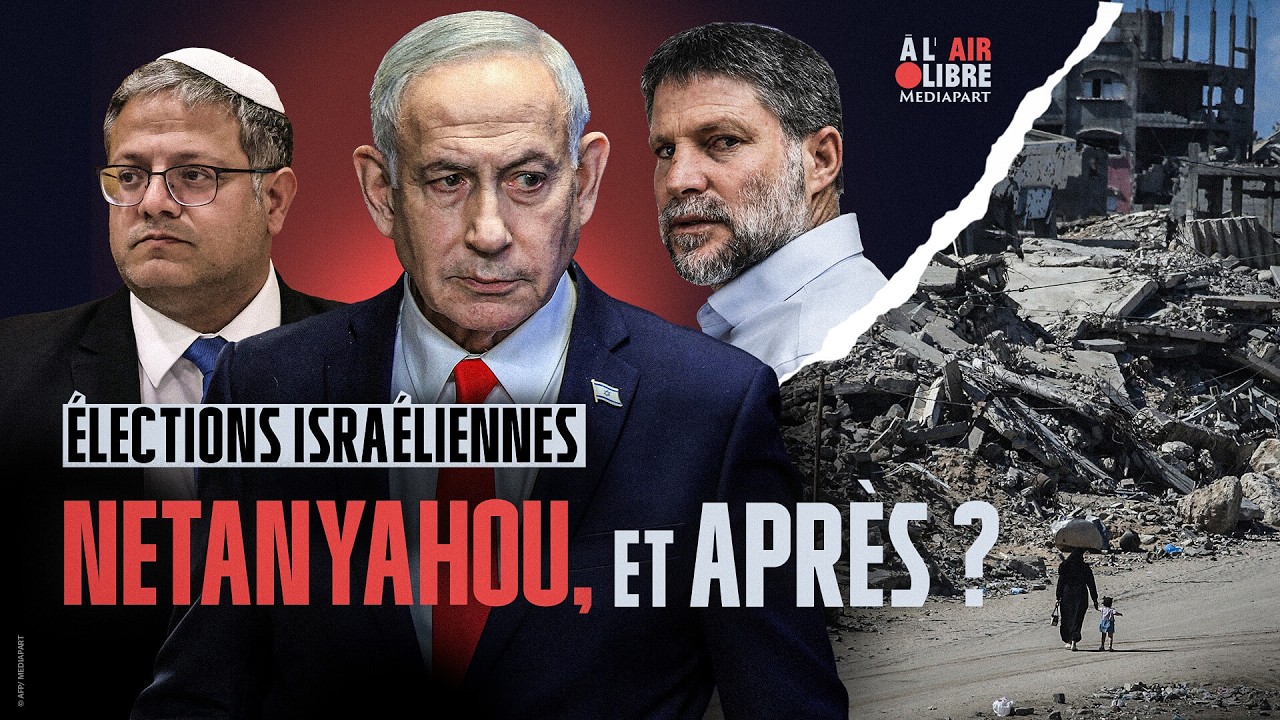
Élections en Israël : « La majorité des israéliens considère qu’il n'y a pas d’innocents à Gaza »
Elections in Israel: « The majority of Israelis considers that there are no innocents in Gaza »
Keywords
Summary
167 words
Critical Evaluation
Value of the Information & Strength of the Argument
The program offers substantial informational value by combining academic expertise with field journalism. The guests provide structural analysis of Israel’s electoral system, the fragmentation of the party landscape, and the ideological convergence of most Jewish parties on Palestinian issues. The argument is built around the idea that the opposition is united primarily by anti-Netanyahu sentiment rather than by a positive political project, and that this limits its ability to offer a real alternative. The discussion also highlights the paradox of Palestinian citizens being a significant electoral force while being largely excluded from governing coalitions. The reasoning is generally coherent and supported by examples, such as the 2021 Bennett-Lapid government and the role of Mansour Abbas. However, some claims, such as the characterization of the war as genocidal, are asserted rather than argued in detail. The value lies in the nuanced explanation of why Israeli politics remains rightward-leaning despite widespread dislike of Netanyahu.
Scientific Rigor, Source Quality, Title Accuracy
The program demonstrates scientific rigor by featuring researchers from recognized institutions (Université libre de Bruxelles, IRSEM) and a specialist journalist. It cites specific investigations: a Haaretz report on Netanyahu’s alleged prior warning, a New Yorker investigation on Qatari payments to Hamas, and a Radio France investigation. These sources are named and their content summarized, though direct links are not provided in the transcript. The title is broadly consistent with the content, as the discussion does address the Israeli public’s attitude toward Gaza, but it is somewhat reductive given the broader electoral and political analysis. The overall sourcing is credible, but the format remains a talk show rather than a peer-reviewed study, so some assertions rely on expert opinion rather than primary data.
289 words
Title / Content Match
The title accurately reflects a central theme of the debate, namely the widespread rejection among Israelis of the notion of innocent civilians in Gaza, though the discussion also covers the electoral system, coalition politics, and Arab parties.
Quality & Reliability
8/10
The discussion relies on recognized academic and journalistic experts (a post-doctoral researcher at ULB, a researcher at IRSEM, and a Mediapart international journalist), and it cites specific investigations (Haaretz, The New Yorker, Radio France) with precise details. However, the program is an opinion and analysis talk show rather than a peer-reviewed study, and some assertions are presented without direct sourcing in the transcript.
Key Moments
Markers derived by PSI from the transcript: the creator did not define chapters.
- Introduction to the Israeli legislative elections of 27 October and the program's framing.
- Explanation of Israel's parliamentary system and the 3.25% electoral threshold.
- Presentation of the opposition bloc and its heterogeneous composition.
- Discussion of Gadi Eisenkot as Netanyahu's main challenger and his military record.
- Analysis of the rightward shift in Israeli politics and the lack of alternative programs.
- Role of Palestinian citizens of Israel and Arab parties in the elections.
- Revelations about Netanyahu's alleged prior knowledge of the 7 October attack.
- Conclusion on the limited impact of recent revelations on public opinion.
Cited Sources
- Mediapart subscription page — Mediapart's subscription link, mentioned in the description as a way to support the outlet.
- Mediapart donation page — Donation link provided in the description to support Mediapart's journalism.
- Mediapart newsletters — Link to subscribe to Mediapart's newsletters, included in the description.
Concurring Sources
- Haaretz investigation on Netanyahu's prior warning — Cited in the program as revealing that Netanyahu was informed of a large-scale Hamas operation before 7 October.
- The New Yorker investigation on Qatari payments to Hamas — Mentioned as reporting that Israel allowed Qatar to transfer $30 million monthly to Hamas.
- Radio France investigation on Qatari payments — Cited as corroborating testimonies about the Qatari transfers to Hamas.
Contribution & Novelties
The program’s original contribution lies in its synthesis of structural and conjunctural factors shaping the Israeli elections, combining academic analysis with journalistic investigation. It highlights the paradox of a broad anti-Netanyahu sentiment that fails to translate into a coherent political alternative, and it underscores the role of Palestinian citizens as a demographic and electoral factor that mainstream Jewish parties refuse to integrate. It also connects recent corruption and security revelations to the broader question of why they do not destabilize Netanyahu’s base.
Pour aller plus loin :
- Israeli legislative election, 2026 — Wikipedia entry on the upcoming elections, useful for dates and electoral system details.
- Benjamin Netanyahu — Background on Netanyahu’s political career and legal cases.
- Gaza war — Overview of the conflict since 7 October 2023, relevant to the discussion.
- Palestinian citizens of Israel — Context on the 20% Palestinian minority and their political representation.
146 words
Radar Profile
The radar profile shows high scores in information quantity and quality, reflecting a dense and well-sourced discussion. The technical level is moderately high due to the structural analysis of electoral systems and coalition politics. Overall reliability is strong, though the format remains a journalistic talk show rather than a formal study.