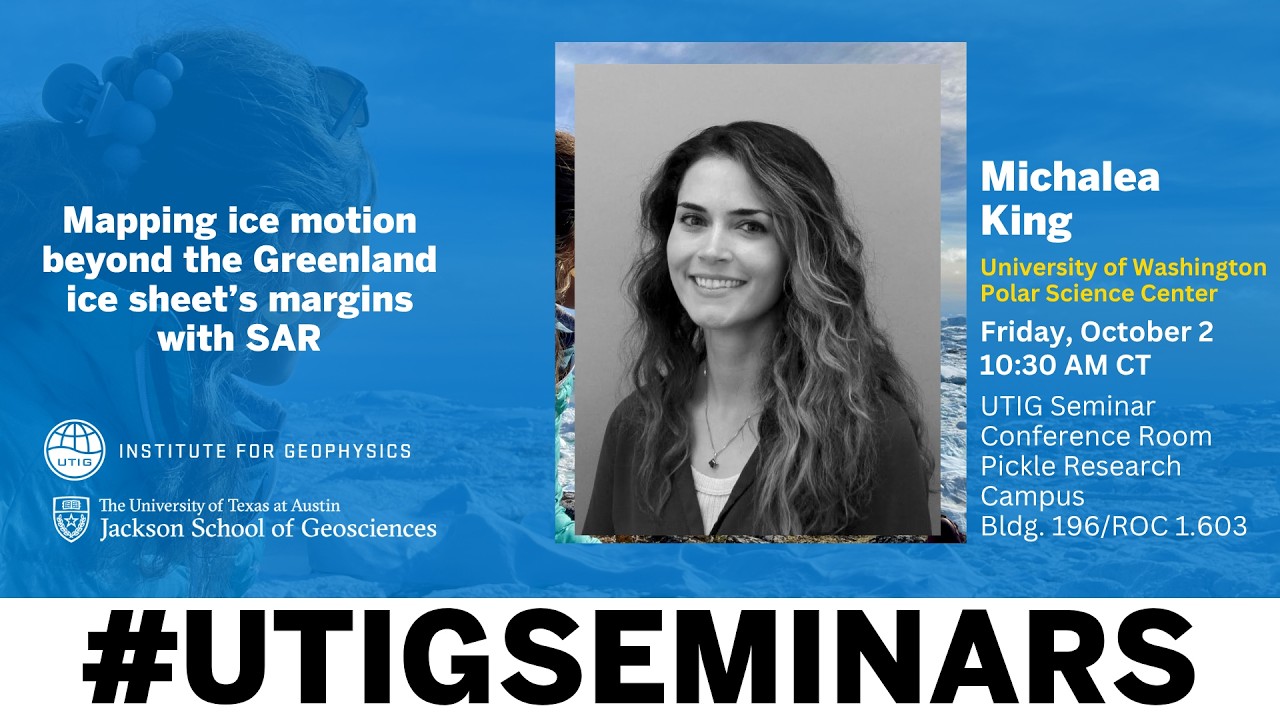
Fall 2026 UTIG Seminar Series: Michalea King
Keywords
Summary
204 words
Critical Evaluation
Value of the Information & Strength of the Argument
The presentation offers substantial informational value by detailing a novel extension of established remote-sensing techniques to a poorly mapped component of the cryosphere: fjord mélange. It clearly defines mélange, distinguishes rigid from non-rigid states, and explains why only the former can be tracked with SAR offset tracking. The argumentation is structured and logical: from method development to case studies (Rink, Helheim, Upernavik) to process interpretation. The speaker explicitly acknowledges uncertainties, such as the chicken-and-egg problem between calving and mélange flush-out, and the subjective nature of delineating rigid mélange. The use of multiple glaciers and multi-year time series strengthens the empirical basis. However, some interpretations remain preliminary and rely on visual correlation rather than statistical testing. The value lies in the methodological advance and the generation of new datasets that can be used by the broader community.
Scientific Rigor, Source Quality, Title Accuracy
The scientific rigor is high: the methods are standard in glaciology (Sentinel-1 SAR offset tracking, velocity mapping), and the speaker is transparent about limitations and ongoing work. Sources are not explicitly cited in the talk, but the description provides a link to the speaker’s personal website (michaleaking.github.io) where further work can be found. No external references or URLs are given in the description beyond that. The title accurately reflects the content, with no misleading elements. The presentation is a seminar, not a peer-reviewed publication, but it follows standard scientific communication practices. No comments were provided for analysis.
248 words
Title / Content Match
The title accurately reflects the content: the talk is precisely about mapping ice motion beyond the Greenland ice sheet margins using SAR, focusing on mélange in fjords. No discrepancy.
Quality & Reliability
8/10
The presentation is a research seminar by an established polar scientist, based on peer-reviewed-style work funded by NSF and NASA. Methods (Sentinel-1 SAR offset tracking, velocity mapping) are standard and clearly described. Limitations are acknowledged explicitly (dependence on manual terminus traces, inability to track non-rigid mélange, ambiguity in cause-effect between calving and mélange flush-out). No sensationalism, no unsupported claims. The score is not higher because the talk is a work-in-progress with preliminary results and no published paper is cited in the description.
Key Moments
Markers derived by PSI from the transcript: the creator did not define chapters.
- Introduction of speaker Michalea King by host Ginny Catania.
- Speaker's background and path to polar science.
- Definition of mélange and its presence in Greenland fjords.
- Explanation of SAR capabilities and Sentinel-1 coverage.
- Methodology for mapping mélange velocity using offset tracking.
- Distinction between rigid and non-rigid mélange and implications for tracking.
- Case study: Helheim Glacier and terminus trace updates.
- Results from Rink Glacier: rigid mélange area vs. terminus change.
- Flow line analysis to infer extension/compression in mélange.
- Future directions: NISAR and cross-disciplinary applications.
Cited Sources
- Michalea King's personal website — Provided in the video description as a resource to learn more about the speaker's work.
Contribution & Novelties
This work is novel in extending ice-velocity mapping techniques from grounded ice to the mélange within Greenland’s fjords, providing the first comprehensive attempt to map rigid mélange motion around Greenland. It introduces a method to derive flow lines through mélange to infer whether it is extending or compressing, which can help distinguish between mélange-triggered calving and glacier-driven bulldozing. The project also generates new datasets that are being integrated into ecological and biological studies, demonstrating cross-disciplinary value. The talk highlights the potential of NASA’s NISAR mission to improve temporal resolution for identifying rapid fjord flushing events.
Pour aller plus loin :
- Sentinel-1 — ESA’s radar satellite mission providing the SAR data used in this study.
- NISAR — NASA-ISRO SAR mission launched in 2025, expected to provide denser SAR coverage.
- Ice mélange — Wikipedia article on the mixture of sea ice and icebergs in fjords.
- Glacier velocity — Overview of glacier dynamics and mass balance.
153 words
Radar Profile
The radar profile shows high reliability and quality, with moderate technical level and information quantity. The content is specialized but accessible to an informed audience, and the speaker's transparency about limitations supports the high reliability score.