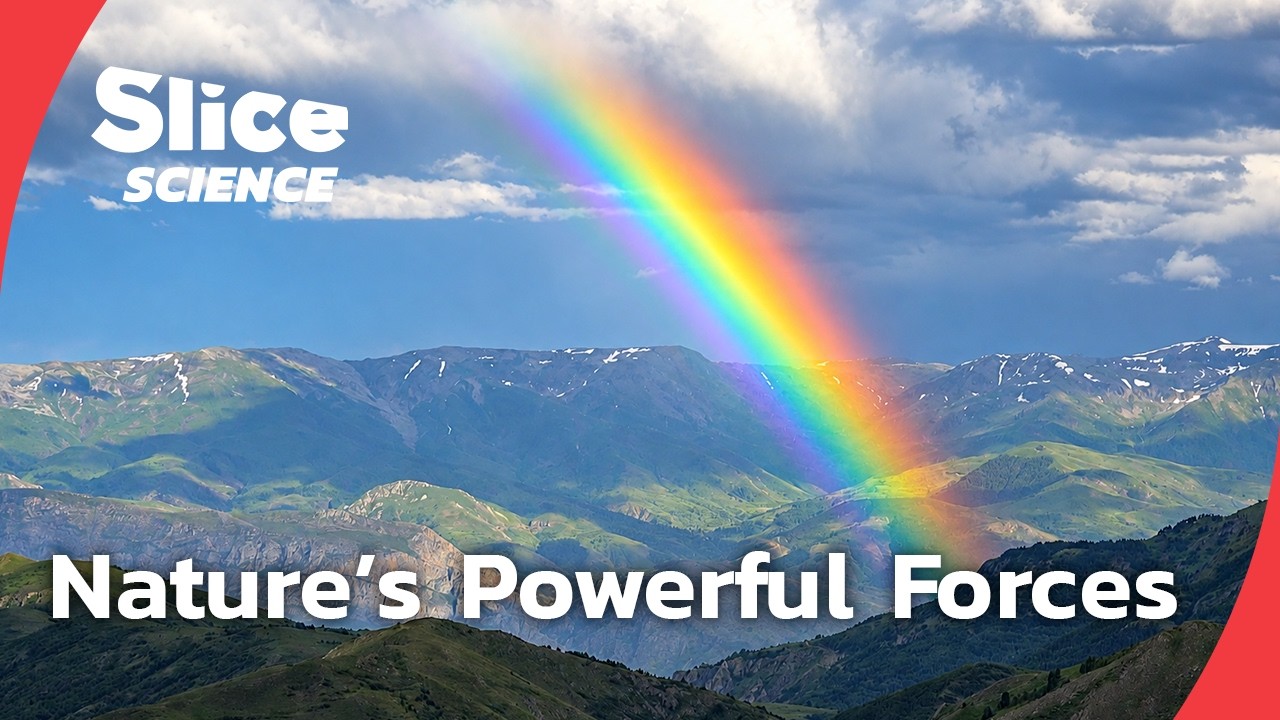
Rainbows, Hail And Typhoons: The Science Of Weather | SLICE SCIENCE | FULL DOC
Keywords
Summary
168 words
Critical Evaluation
Value of the Information & Strength of the Argument
The documentary provides clear and accessible explanations of weather topics, making complex scientific concepts understandable to a general audience. It uses effective visual aids and relatable examples, such as the ROYGBIV mnemonic and historical records of hailstones. The argumentation is straightforward but lacks critical analysis or alternative viewpoints; it presents facts as established without deep evidence. While the coverage is broad, each topic is treated superficially, and the documentary does not engage with debates or nuances, such as the distinction between climate change and global warming or the limitations of forecasting models. Overall, it serves as an educational overview rather than a rigorous scientific presentation.
Scientific Rigor, Source Quality, Title Accuracy
The documentary does not cite specific scientific sources, relying instead on established knowledge and general data. It mentions specific records (e.g., largest hailstone in South Dakota, 2010) but does not provide references. The title accurately reflects the content, which is comprehensive for a general audience. The production is from 2011, so some statistics, particularly on global warming and Typhoon Haiyan, may be outdated but remain broadly valid. The lack of explicit sourcing reduces its scientific rigor, but the information is fundamentally accurate. No comments were available for analysis; therefore, no public opinion trends are provided.
215 words
Title / Content Match
The title accurately reflects the content, which covers rainbows, hail, global warming, forecasting, and Typhoon Haiyan as examples of weather science.
Quality & Reliability
7/10
The documentary presents accurate scientific explanations of weather phenomena, consistent with mainstream meteorology and climatology. However, it lacks explicit citations and in-depth analysis, and some data (e.g., climate numbers) may be dated given the 2011 production.
Key Moments
Markers derived by PSI from the transcript: the creator did not define chapters.
- Introduction to the documentary and overview of weather topics to be covered.
- Explanation of rainbow formation through refraction and dispersion of sunlight in water droplets.
- Discussion of hail formation, sizes, and hazards, including record hailstones.
- Overview of global warming, the greenhouse effect, and environmental impacts.
- History and modern techniques of weather forecasting, including computer simulations.
- Case study of Typhoon Haiyan, detailing its path, intensity, and devastating effects.
- Recap of key points and closing remarks.
Contribution & Novelties
The documentary contributes a consolidated, accessible overview of multiple weather phenomena, making scientific concepts approachable. Its novelty lies in the compilation of topics rather than original research. For further exploration, the following resources are suggested:
Pour aller plus loin :
- Rainbow — Explore the physics of rainbow formation and optical phenomena.
- Hail — Detailed information on hail formation, sizes, and records.
- Greenhouse effect — Understand the mechanism behind global warming.
- Weather forecasting — History and methods of predicting weather.
- Typhoon Haiyan — Comprehensive account of the 2013 storm and its impacts.
91 words
Radar Profile
The radar profile shows moderate to high scores in information quantity and reliability, with lower technical depth. This indicates a video that provides solid factual content but at a basic level, suitable for general education rather than advanced study. The peak in reliability reflects the accurate scientific foundation, while the low technique suggests limited mathematical or complex explanation.