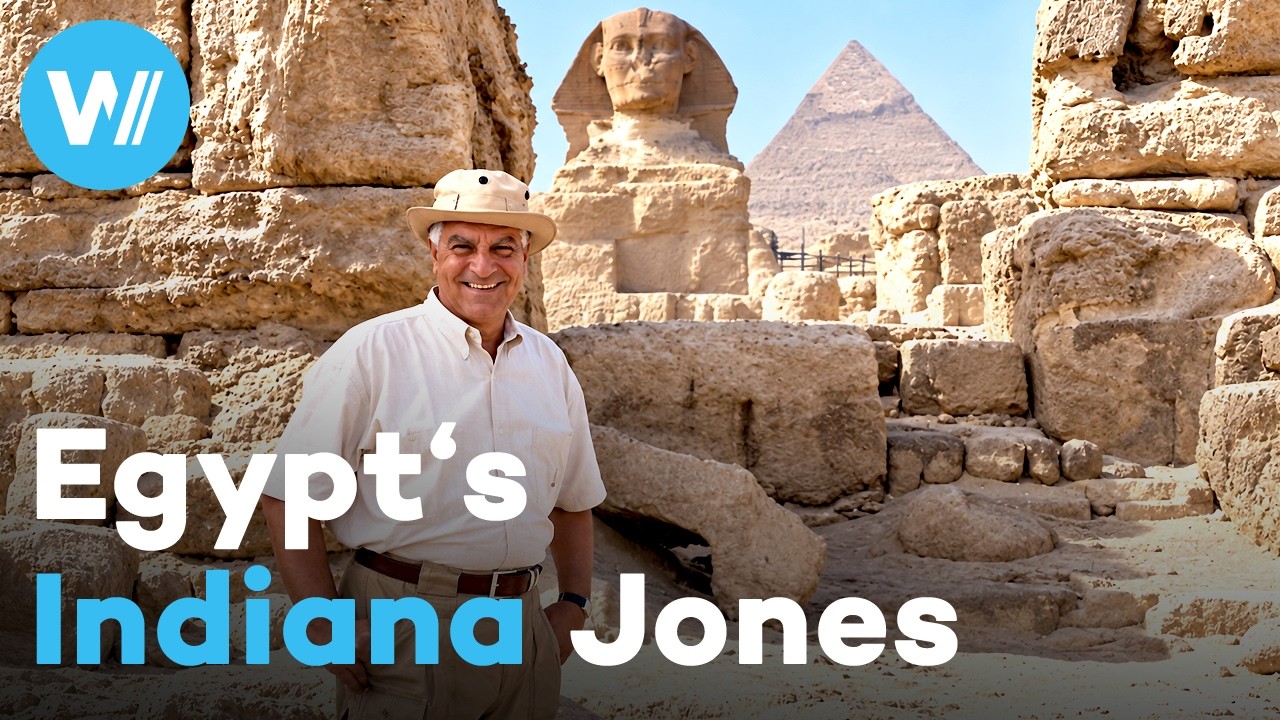
Zahi Hawass: Pyramids, Revolution and the Story of Modern Egypt | The Egyptian (Documentary, 2021)
Keywords
Summary
176 words
Critical Evaluation
Value of the Information & Strength of the Argument
The value of this documentary lies in its rare, personal testimony from Zahi Hawass, who offers insights into Egypt’s modern political and social transformations through the lens of his own life. It provides a nuanced perspective on the contrast between Egypt’s liberal past and its authoritarian turns, and it humanizes historical events by connecting them to individual experience. The argumentation is primarily narrative and testimonial, effective for evoking empathy but less rigorous for analytic depth. It presents a coherent point of view that Egypt’s identity is contested between a tolerant, cosmopolitan heritage and more rigid, foreign-influenced interpretations of Islam. While engaging, the argument relies on personal authority rather than systematic evidence, and some claims about historical causality remain suggestive rather than fully developed.
Scientific Rigor, Source Quality, Title Accuracy
Scientifically, the documentary does not adhere to a strict evidence-based framework; it offers a mixture of autobiography, oral history, and summary commentary. The interviewees include Hawass, his acquaintances, and urban planners, but specific scholarly references are absent. The quality of sources is uneven, with some statements (e.g., about pyramid builders’ average lifespan) reflecting real research, but others are presented without citation. The title accurately signals the content, which justifies its focus on Hawass and modern Egypt; however, the subtitle ‘Pyramids’ may suggest a deeper archaeological investigation than what is actually delivered. Overall, the rigor is acceptable for a mainstream documentary but not for academic reference.
243 words
Title / Content Match
The title accurately reflects the documentary's scope, covering Hawass's career, ancient Egypt, and modern Egyptian history.
Quality & Reliability
7/10
The documentary is well-produced with credible interviewees, but it presents personal viewpoints and lacks formal citations for many historical claims, relying on testimony and narrative rather than peer-reviewed sources.
Key Moments
Markers derived by PSI from the transcript: the creator did not define chapters.
- Opening: Egypt then and now, contrast between past and present Cairo.
- Discussion on who built the pyramids, with Hawass presenting workforce theories.
- Hawass describes growing up in Nasser's Egypt and the influence of the revolution.
- Revolution of 1952, Nasser's land reforms, and their effects on society.
- Cairo's transformation from a cosmopolitan city to a megacity.
- Ancient tombs, curses, and new discoveries including the pyramid builders' tombs.
- Modern Egypt: culture, women, education, and the future of the country.
Cited Sources
- wocomoCOOK — Channel link provided in the description
- wocomoHISTORY — Channel link provided in the description
- wocomoHUMANITY — Channel link provided in the description
- wocomoTRAVEL — Channel link provided in the description
- wocomoWILDLIFE — Channel link provided in the description
Contribution & Novelties
This documentary adds a personal and historical layer to the public image of Zahi Hawass, revealing his formative experiences and connecting them to Egypt’s political trajectory. Its original contribution lies in the intimate interviews and archival echoes, offering a humanized account of modern Egyptian history through the eyes of a key cultural figure. It also sheds light on the daily realities of Cairo’s urban challenges and the cultural tensions between tradition and modernity.
Pour aller plus loin :
- Zahi Hawass (Wikipedia) — Provides an academic overview of Hawass’s career and controversies, serving as a factual complement to the personal narrative.
- Great Pyramid of Giza (Wikipedia) — Offers detailed archaeological and historical context for the pyramids discussed in the film, including construction theories.
- Egyptian Revolution of 2011 (Wikipedia) — Expands on the theme of political change and the country’s recent upheavals, referenced indirectly in the documentary’s commentary on modern Egypt.
149 words
Radar Profile
The radar profile shows a balanced but moderate performance across all dimensions, with relatively high scores in information quantity and quality, and lower scores in technical depth and overall reliability. This reflects a documentary that is informative and engaging but not deeply analytical or rigorously sourced.