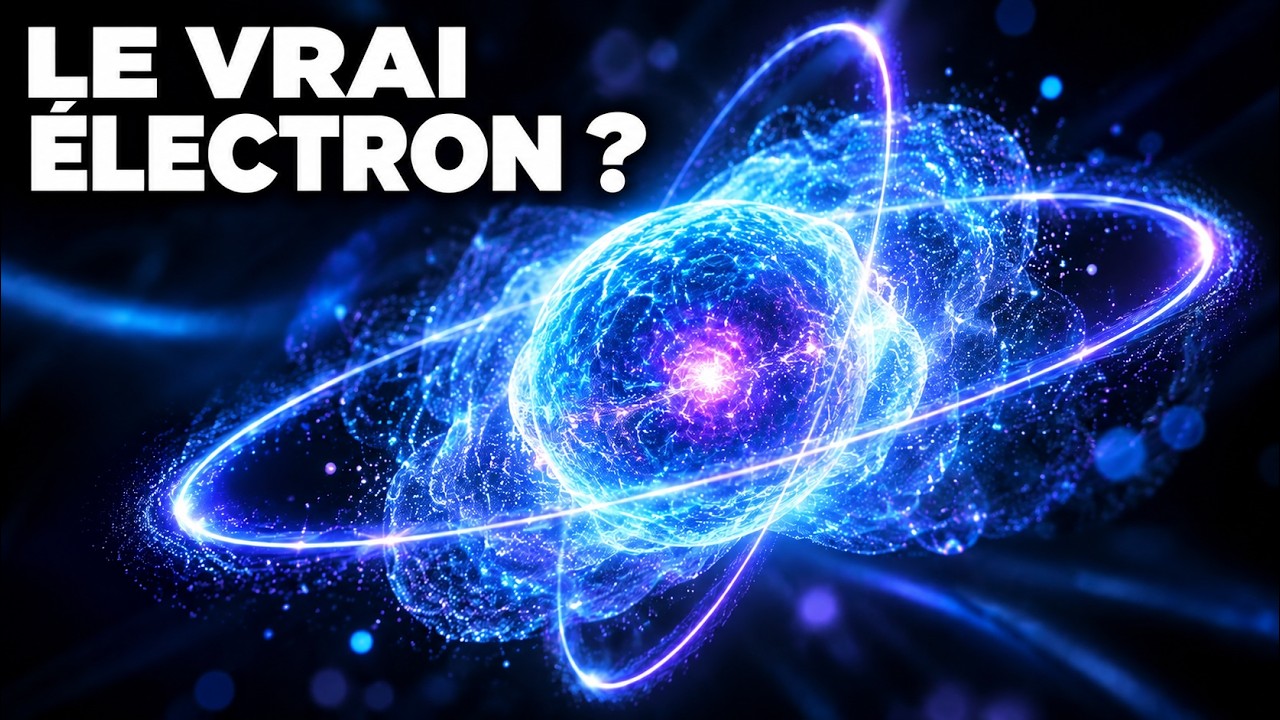
La forme de l’électron pourrait cacher une nouvelle physique
The shape of the electron could hide new physics
Keywords
Summary
198 words
Critical Evaluation
Value of the Information & Strength of the Argument
The video provides substantial value by explaining a complex topic in particle physics through intuitive analogies (balls, snow, ocean waves) and logical progression. It builds a coherent argument: starting from the classical misconception, moving to quantum field theory, then explaining the EDM and why it matters. The discussion of virtual particles and the quantum vacuum is particularly well-handled, linking theoretical predictions to experimental possibilities. The argumentation is mainly theoretical, with clear distinctions made between confirmed physics and speculative extensions like supersymmetry. The tone remains measured, though sometimes the speculative nature could be emphasized more strongly. The historical context of experiments (ACME, JILA) adds credibility, but the lack of concrete references weakens the overall evidence base.
Scientific Rigor, Source Quality, Title Accuracy
The video demonstrates strong scientific rigor in its internal logic: each concept builds on the previous one, and the presenter is careful to state when theories are unconfirmed. However, no external sources are cited; the content relies on the presenter’s expertise and well-known facts. The description contains no links to papers or articles, which limits the ability to verify claims. The title matches the content precisely, as the video directly investigates whether the electron’s shape could hide new physics. The use of chapters improves accessibility, but the lack of citations means viewers cannot easily cross-check information. The video is best suited as an introductory overview, and viewers seeking primary literature would need to search independently.
245 words
Title / Content Match
The title accurately reflects the central question explored: whether the electron's shape could reveal physics beyond the Standard Model. The content consistently addresses this theme throughout the video.
Quality & Reliability
8/10
The video offers a detailed and coherent presentation of quantum field theory, the electron's electric dipole moment, and its implications for new physics. It clearly explains key concepts (quantum vacuum, supersymmetry, CP violation) with relevant analogies. However, no external sources or references are given in the description, and the speculative nature of new physics is not always explicitly framed as hypothesis. Overall, it is reliable for a general audience but lacks verifiable citations.
Chapters
- L'illusion de la sphère parfaite
- La véritable nature quantique de l'électron
- Qu'est-ce que le moment dipolaire électrique ?
- Les mystères et le bouillonnement du vide quantique
- Supersymétrie et particules fantômes
- La brisure de symétrie et la flèche du temps
- Big Bang : le triomphe de la matière sur l'antimatière
- ACME et JILA : comment mesurer l'impossible ?
Contribution & Novelties
The video’s main contribution is its accessible synthesis of how the electron’s shape could serve as a probe for new physics. It connects abstract quantum field theory concepts to the concrete experimental search for an electron EDM, making the topic approachable to a broader audience. It highlights why the Standard Model predicts a negligible EDM, and how supersymmetric extensions would predict a measurable one, thus framing the experimental search as a decisive test for new theories. The section on the quantum vacuum and virtual particles is particularly illuminating, showing how heavy hypothetical particles could influence measurements even if they cannot be directly detected.
Pour aller plus loin :
- Electron electric dipole moment — Général overview of the EDM, its theoretical background and experimental bounds.
- Supersymmetry — A key theoretical framework mentioned in the video, predicting new particles and possible sources of EDM.
- Quantum vacuum — Explains the concept of vacuum fluctuations, essential to understanding how virtual particles could affect the electron’s shape.
162 words
Radar Profile
The scores are relatively balanced: high on quantity of information and reliability, slightly lower on technical depth, reflecting the video's aim for accessibility over exhaustive technical detail. The profile indicates solid content but moderate complexity, suitable for a general audience seeking an introduction to particle physics concepts.