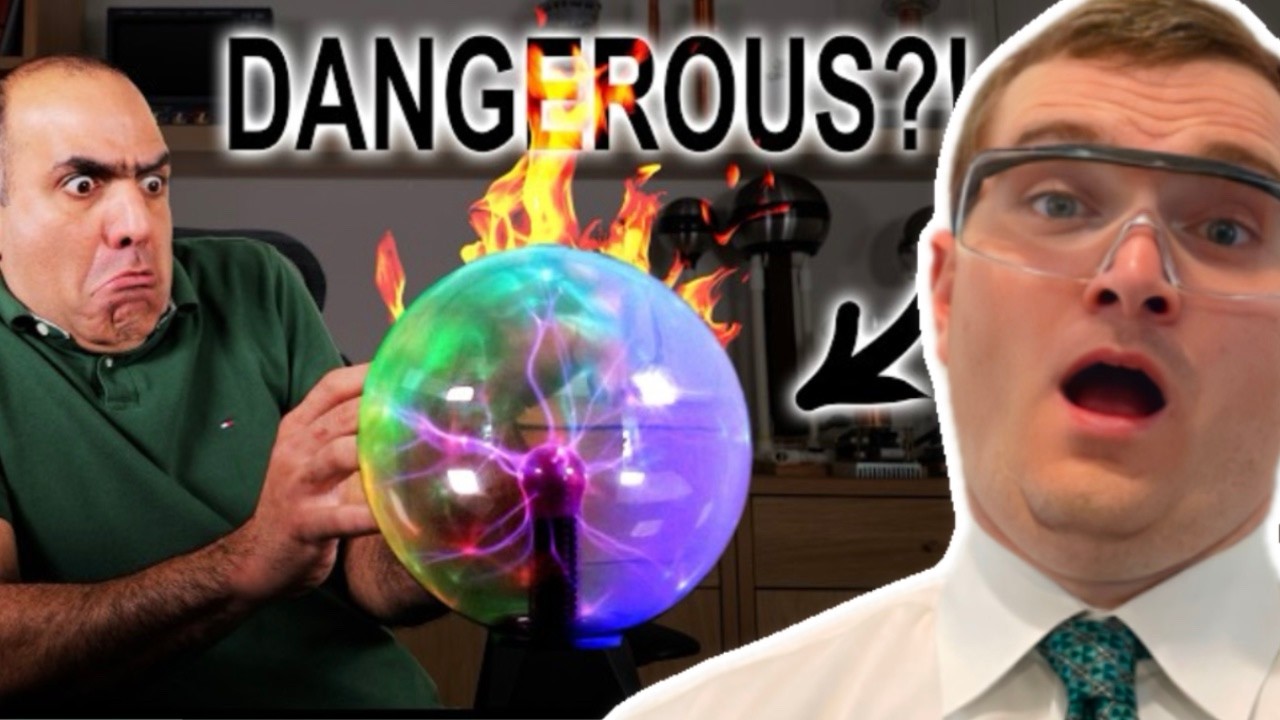
ElectroBOOM vs. Plasma Globe - Nuclear Engineer Reacts
Keywords
Summary
228 words
Critical Evaluation
Value of the Information & Strength of the Argument
The video’s value lies in its clear exposition of complex electrical safety principles, particularly the roles of current density, frequency, and energy pathway in determining physiological and fire hazards. The nuclear engineer’s analogy to reactor thermal limits effectively underscores the concept that total power is less significant than localized energy deposition. The argumentation is solid, as each demonstration is tied to a safety lesson, and the step-by-step analysis prevents oversimplification. The discussion of the hand sanitizer incident is meticulously dissected, showing how multiple unlikely conditions must align for a fire to occur. The explanation of flyback transformers and plasma glow is both accurate and accessible, bridging theoretical physics and practical engineering. The incorporation of personal experience and comparative cases strengthens the credibility of the assertions.
Scientific Rigor, Source Quality, Title Accuracy
The video maintains high scientific rigor, with the engineer consistently referencing standard safety terminology and concepts from nuclear engineering to validate his points. He openly critiques ElectroBOOM’s risky practices while acknowledging the educational value, showing balanced judgment. The primary source is the original ElectroBOOM video, which is clearly cited in the description. The title accurately reflects the content—a reaction and analysis—and the video delivers exactly that. No external scientific papers are cited, but the reasoning relies on well-established principles. The engineer’s own expertise adds authority, and his explanations are consistent with recognized electrical safety guidelines. The only minor issue is the lack of formal citations, but the analytical nature compensates for this.
252 words
Title / Content Match
The title accurately reflects the content: a nuclear engineer reacts to ElectroBOOM's plasma globe experiments, providing expert commentary. It is precise and matches the video's focus.
Quality & Reliability
9/10
The video provides a rigorous analysis of electrical safety concepts, drawing on nuclear engineering principles, with accurate scientific explanations and clear reasoning.
Key Moments
Markers derived by PSI from the transcript: the creator did not define chapters.
- Introduction and initial safety warnings about touching plasma globes.
- Finger heating demonstration with wet skin, discussing skin resistance and energy deposition.
- Copper tape experiment illustrating surface area and current density effects.
- Resistor test to measure current through the body, emphasizing proper instrumentation.
- Analysis of the Questacon incident where alcohol hand sanitizer ignited near a plasma globe.
- Rectifier and capacitor setup to change frequency and create painful discharges.
- Explanation of flyback transformer and plasma physics behind the glow.
- Final analogies to nuclear safety, emphasizing the importance of energy pathways and holistic hazard analysis.
Cited Sources
- Original Video by ElectroBOOM — The original ElectroBOOM video that the nuclear engineer reacts to, demonstrating plasma globe experiments and safety issues.
Contribution & Novelties
The video provides a unique perspective by applying nuclear engineering safety principles to an everyday electrical device, emphasizing that hazard depends on current density, frequency, and energy pathways rather than just voltage. It bridges two engineering disciplines and offers a memorable teaching on why raw numbers alone don’t determine danger. The nuclear engineer’s analogies—such as comparing localized heating to reactor thermal limits—give fresh insight into familiar electrical concepts.
Pour aller plus loin :
- Plasma globe — Overview of the device and its operation.
- Flyback transformer — Explains the high-voltage generation mechanism used in the plasma globe.
- Electric shock — Details physiological effects and frequency dependence.
105 words
Radar Profile
The radar profile shows consistently high scores across all dimensions, reflecting the video's robust technical content, clear explanation, and reliable expert commentary. The balanced scores indicate a well-rounded production with strong information density and scientific accuracy.
💬 Based on the 30 comments analyzed, the sentiment is overwhelmingly positive, with viewers expressing enthusiasm for the collaboration, praising the educational value, and enjoying the humorous interactions between the two engineers.