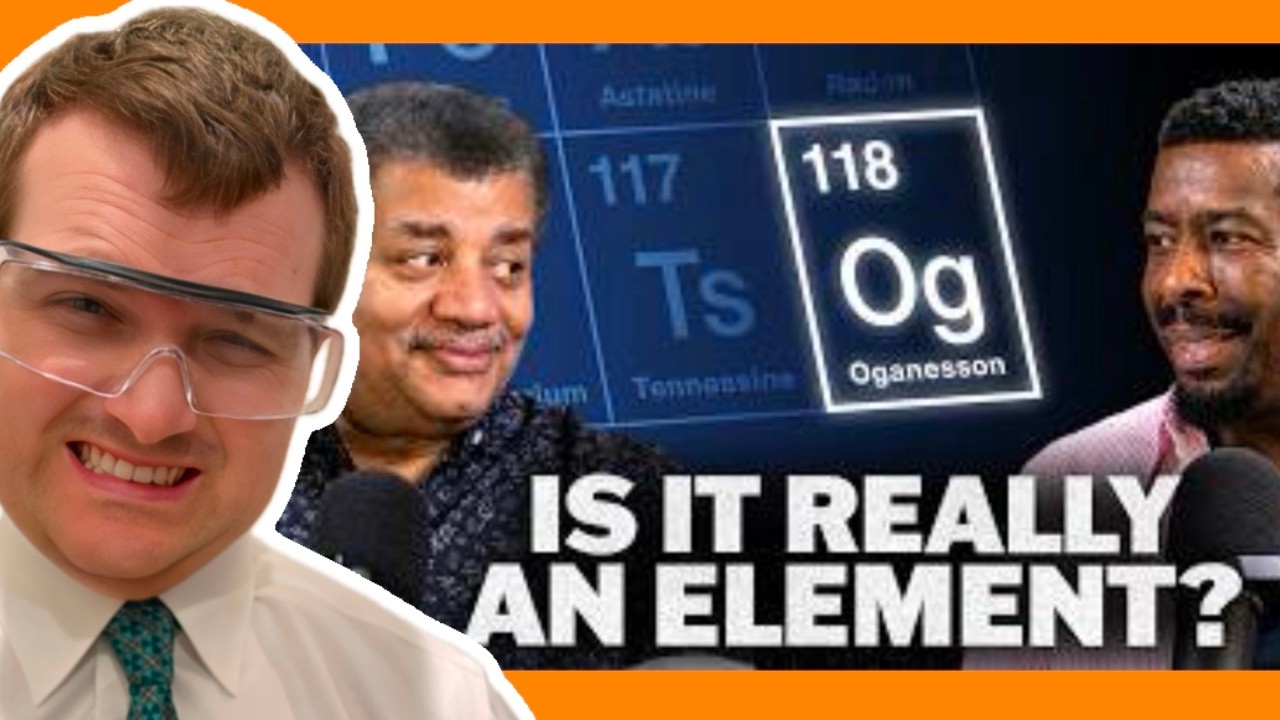
The Era of Man Made Elements - Nuclear Engineer Reacts to Startalk
Keywords
Summary
189 words
Critical Evaluation
Value of the Information & Strength of the Argument
The video provides high value by offering expert corrections and deeper explanations of nuclear physics concepts mentioned superficially in the original StarTalk clip. The engineer explains the strong nuclear force, the residual interaction, and the statistical nature of radioactive decay, making the content technically rich. His argumentation is clear and well-structured, using examples like carbon-14 dating and technetium-99m in medicine to illustrate points. He also addresses misconceptions, such as the overgeneralization that technetium has a 6-hour half-life, noting the variation among isotopes. The reasoning is solid, grounded in established nuclear physics.
Scientific Rigor, Source Quality, Title Accuracy
The engineer refers to the original StarTalk video but does not cite external academic sources within the video; he instead draws on his professional knowledge. He does mention the chart of nuclides as a key reference, which is appropriate for accuracy. The title is apt, as the content is a reaction to a video about man-made elements, and the engineer stays on topic. No comments are provided for analysis, so trends cannot be assessed.
180 words
Title / Content Match
The title accurately reflects the content: a nuclear engineer reviewing and reacting to a StarTalk video about man-made elements.
Quality & Reliability
8/10
The reactor is a nuclear engineer providing expert corrections and detailed explanations, but the format is a reaction video without peer review or citations, slightly reducing reliability.
Key Moments
Markers derived by PSI from the transcript: the creator did not define chapters.
- Definition of an element by proton number and introduction to the periodic table.
- Discussion of the strong nuclear force, neutrons, and the residual strong interaction.
- Explanation of isotopes, carbon-14 beta decay, and radiometric dating.
- Technetium as the first artificially produced element; clarification of its half-life.
- Superheavy elements and the criteria for naming even short-lived nuclides.
- Concluding thoughts on natural versus artificial elements and the chart of nuclides.
Cited Sources
- Original StarTalk video — The video being reacted to, discussing man-made elements.
Contribution & Novelties
The reactor adds substantial technical depth beyond the original clip, clarifying the physics behind the periodic table. He highlights the importance of the chart of nuclides for isotope stability, corrects misconceptions about gluons, and provides nuance on the occurrence of transuranics in nature. His original contribution lies in translating pop-science into accurate nuclear engineering terms.
Pour aller plus loin:
- Chart of nuclides — A comprehensive reference for all known nuclides and their stability.
- Strong interaction — The fundamental force governing nuclear binding.
- Technetium-99m — Widely used radioisotope for medical imaging, illustrating the practical use of man-made elements.
97 words
Radar Profile
The radar shows high scores across information quantity, quality, and technical depth, with a slightly lower reliability score due to the format being an opinion-based reaction. This indicates a technically rich but subjective analysis with high educational value.