15 SETIEMBRE
15 SEPTEMBER
Keywords
Summary
183 words
Critical Evaluation
Value of the Information & Strength of the Argument
The presentation provides a clear, structured overview of a nuanced topic. The speaker methodically builds the argument: starting with the rule (consent always required), then introducing exceptions and their criteria, and finally illustrating with specific examples (e.g., retrospective chart review, genetic samples). The logical flow is strong, and she uses concrete scenarios to make the abstract principles tangible. The strength of the argumentation lies in her consistent emphasis on individual autonomy and her caution against exaggerating social value. However, the lack of citations or references to specific ethical guidelines (e.g., Declaration of Helsinki, CIOMS) weakens the scientific depth, and some parts rely heavily on anecdotal illustrations.
Scientific Rigor, Source Quality, Title Accuracy
The presentation is scientifically rigorous in its internal logic and aligns with standard ethical principles for human research. The speaker does not cite any external sources, studies, or regulatory texts, which limits the verifiability of her assertions. She mentions Peruvian law and international requirements generically but provides no specific references. The title ‘15 September’ is completely inadequate and fails to convey the content, which is a significant weakness. No comments were available to analyze.
195 words
Title / Content Match
The title '15 September' is entirely unrelated to the content; it appears to be a date or placeholder.
Quality & Reliability
7/10
The presentation is logically structured, well-reasoned, and covers a specific niche topic (waiver of informed consent) with clear criteria. The speaker demonstrates deep knowledge and provides practical examples, though she does not cite or reference specific studies, guidelines, or regulations by name, relying instead on general principles and her professional experience.
Key Moments
Markers derived by PSI from the transcript: the creator did not define chapters.
- Introduction of the speaker and topic; disclaimer about personal opinions.
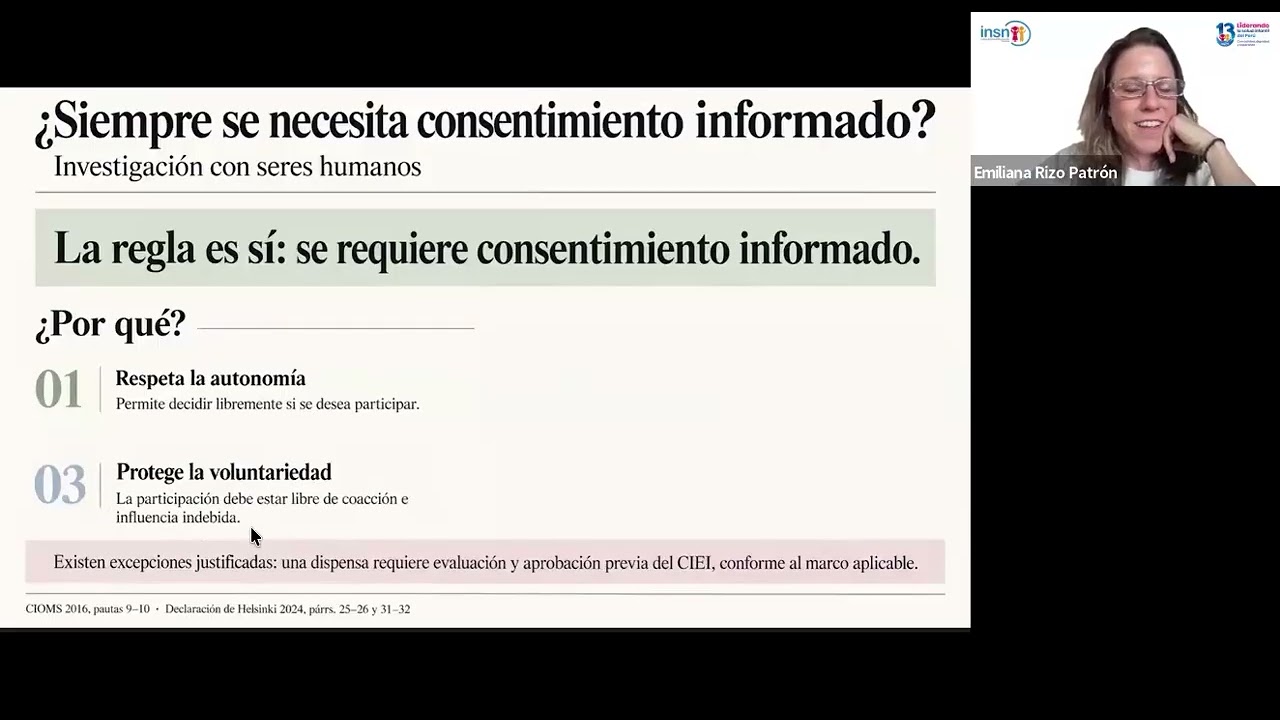
- Explanation of why informed consent is always required, including for retrospective data.
- Introduction of the waiver concept and the three criteria: impracticality, minimal risk, high social value.
- Detailed discussion of impracticality with examples; distinction between inconvenience and scientific invalidity.
- Risk assessment challenges and safeguards; discussion of potential harms like stigma and data breaches.
- Wrap-up and summary; emphasis on ethics committees as partners, not obstacles.
Contribution & Novelties
The video offers a practical, decision-oriented framework for researchers navigating the waiver of informed consent, emphasizing the need for evidence-based justifications. It clarifies common misconceptions (e.g., ’no risk’ vs. ‘minimal risk’) and underscores the importance of safeguards. While the content is not novel in academic literature, it translates complex ethical guidelines into actionable steps for clinical settings.
Pour aller plus loin :
- Informed consent (Wikipedia) — Provides foundational context on the concept and its legal and ethical dimensions.
- Declaration of Helsinki (WHO) — Outlines key ethical principles for medical research involving human subjects, including consent requirements.
- Institutional review board (Wikipedia) — Explains the role and functioning of ethics committees, central to the waiver process discussed.
115 words
Radar Profile
The radar profile shows moderate to high scores across dimensions, with the strongest on 'quantite_information' and 'qualite_information' (both 7). 'Niveau_technique' is slightly lower (6) due to the conceptual rather than technical depth. 'Fiabilite_globale' (6) reflects the lack of explicit citations, which slightly undermines verifiability.