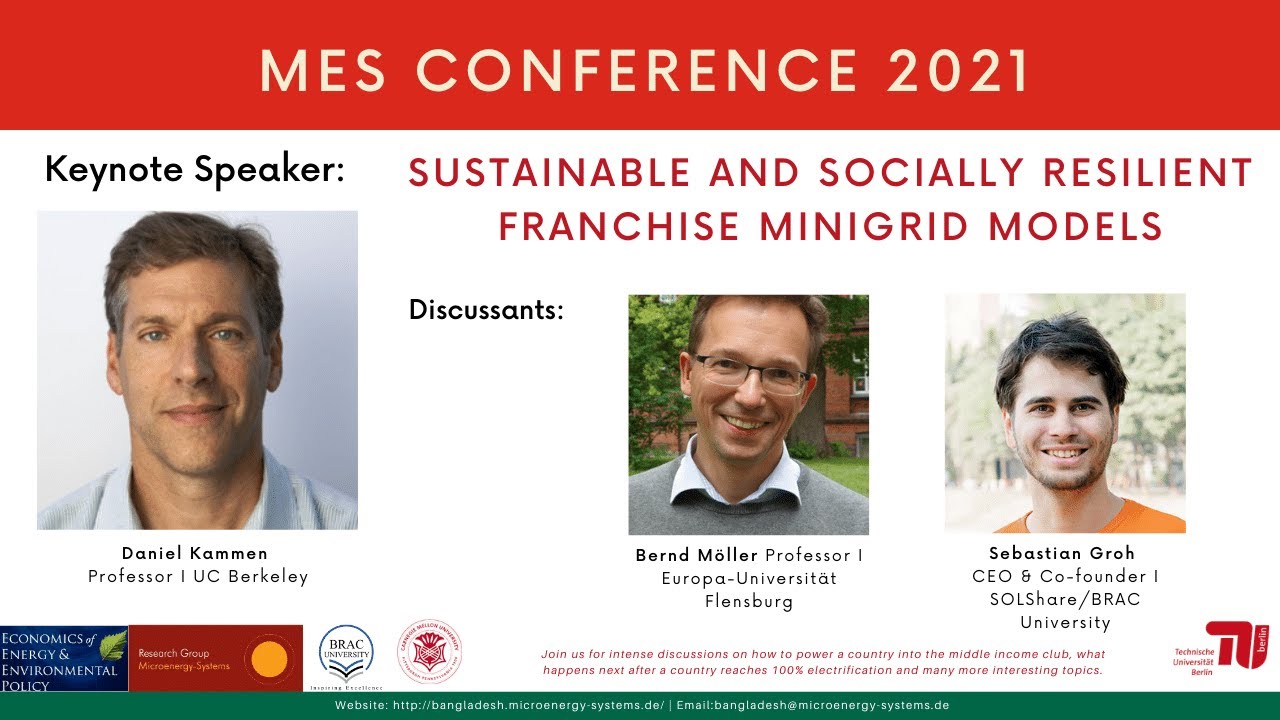
Sustainable and Socially Resilient Franchise Minigrid Models | 2021 MES Conference
Keywords
Summary
181 words
Critical Evaluation
Value of the Information & Strength of the Argument
The talk provides valuable insights into real-world mini-grid implementations, particularly the OffGridBox deployment and the P-REC financing model. Kammen’s argumentation is grounded in concrete case studies and field data, making his points persuasive and actionable. He highlights the importance of flexible technical designs and innovative financing mechanisms to address energy access in low-income regions. However, the argumentation occasionally relies on anecdotal evidence and lacks quantitative comparisons across different solutions. The discussion of franchise models is still in early stages, with limited details on scalability and sustainability. Overall, the presentation offers a compelling narrative for community-centric energy solutions, backed by practical experience.
Scientific Rigor, Source Quality, Title Accuracy
The scientific rigor is moderate; while the speaker references a peer-reviewed IEEE special issue and a Nature paper, these are not cited in detail. The quality of sources is adequate, with the primary focus on project experiences rather than systematic literature review. The title accurately reflects the content, and the session structure with keynote and discussants enhances the depth of analysis. No external sources are listed in the description beyond the MicroEnergy group website, but the talk itself mentions the Renewable and Appropriate Energy Laboratory (RAEL) and various project partnerships. The video is a conference presentation, not a formal study, so it should be viewed as an expert opinion rather than a peer-reviewed contribution.
230 words
Title / Content Match
The title accurately reflects the content, which focuses on franchise-based mini-grid models designed for sustainability and social resilience.
Quality & Reliability
8/10
High credibility of the speaker (UC Berkeley professor) and the practical basis of presented projects; however, the talk lacks formal peer review and relies on anecdotal evidence from field implementations.
Key Moments
Markers derived by PSI from the transcript: the creator did not define chapters.
- Introduction by Sebastian Groh and keynote begin on mini-grid strategies
- Kammen describes IEEE special issue on mini-grids and challenges in gaining institutional recognition
- Discussion of micro-hydro project in Laos and its community benefits
- Introduction of OffGridBox technology and deployment in Rwanda
- Details on OffGridBox costs, logistics, and community impact analysis
- Transition to P-REC (Peace Renewable Energy Credit) and first sale to Microsoft
- Case study of P-REC-funded solar array in Goma and expansion to Kenya
- Discussion of franchise model for mini-grids and potential for local entrepreneurship
- Audience questions and comments from discussants on technical and social resilience
Cited Sources
- MicroEnergy Research Group website — Official website of the organizers; provides additional resources on the conference and research
- Renewable and Appropriate Energy Laboratory (RAEL) — Daniel Kammen's laboratory website, mentioned in the talk for publications and project information
Concurring Sources
- IEEE Special Issue on Mini-grids — Mentioned in the talk as a key collection of mini-grid projects; open access papers from 2019
External References
Contribution & Novelties
124 words
Radar Profile
The radar profile shows a balanced performance with high scores on quality and reliability, moderate technical depth, and strong information richness. The content is practical and grounded in field experience, making it valuable for practitioners despite limited formal rigor.