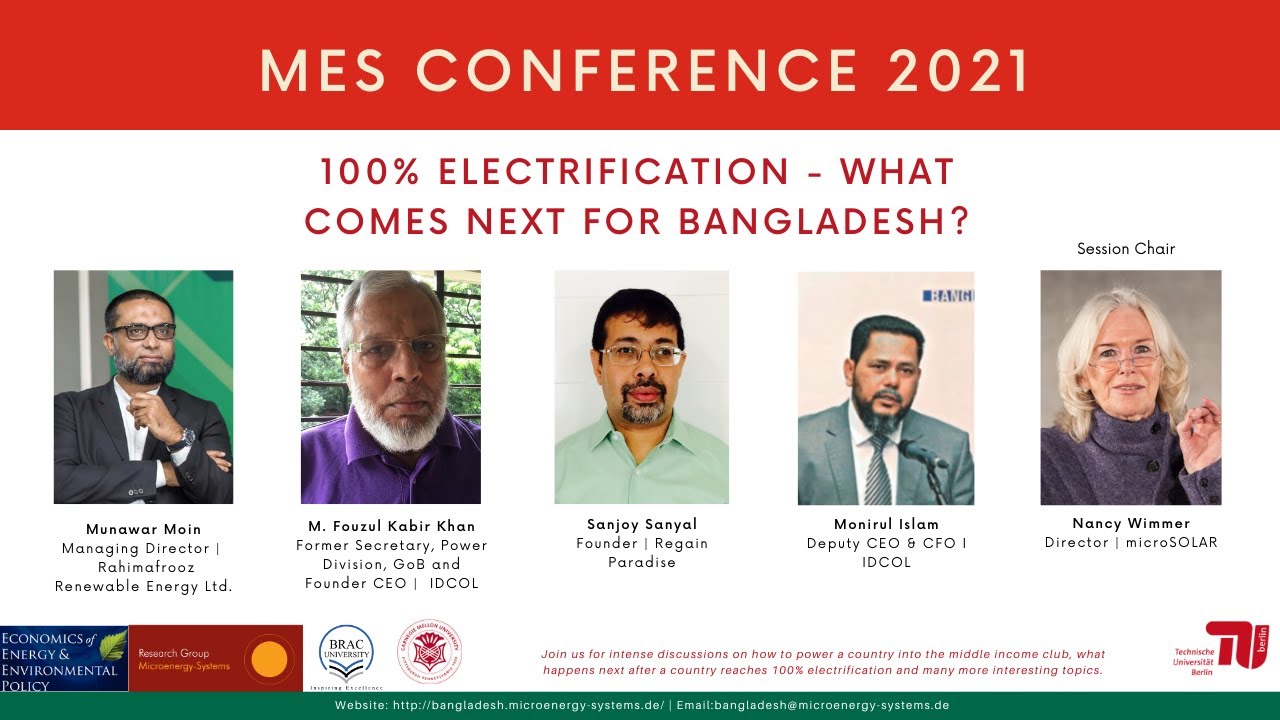
100% Electrification - What Comes Next for Bangladesh? | 2021 MES Conference
Keywords
Summary
140 words
Critical Evaluation
Value of the Information & Strength of the Argument
VALUE: The video provides unique insider perspectives on the design, implementation, and aftermath of one of the world’s most successful off-grid electrification programs. Speakers share concrete data (e.g., 1,514 solar irrigation pumps, 57,000 biogas plants) and candid reflections on mistakes (e.g., abrupt subsidy withdrawal, lack of coordination with grid expansion). The discussion offers actionable insights for other developing countries. ARGUMENTATION: The arguments are well-structured, progressing from historical context to future directions. Panelists support claims with personal experiences and institutional knowledge, though some statements are anecdotal. The debate is balanced, with differing views on market primacy versus regulatory oversight.
Scientific Rigor, Source Quality, Title Accuracy
SCIENTIFIC RIGOR: The content is grounded in practical experience rather than formal scientific literature, but it is internally consistent and credible given the speakers’ roles. SOURCES: The panelists refer to their own published works (Khan’s ‘Win’, Wimmer’s ‘The Market Makers’) and to policy documents (Bangladesh Delta Plan, Mujib Climate Prosperity Plan), but no external peer-reviewed sources are cited. TITLE ADEQUACY: The title’s promise to address ‘What Comes Next?’ is fulfilled through discussion of ongoing projects and future plans.
191 words
Title / Content Match
The title accurately reflects the panel's focus on the status and future of electrification in Bangladesh.
Quality & Reliability
8/10
Panel of highly experienced professionals with first-hand involvement in Bangladesh's electrification programs. They provide specific data and insights, but the discussion is primarily anecdotal and not peer-reviewed.
Key Moments
Markers derived by PSI from the transcript: the creator did not define chapters.
- Introduction by Nancy Wimmer, setting the context of Bangladesh's electrification history and panelist introductions.
- Fouzul Kabir Khan recounts IDCOL's accidental entry into solar home systems, the 'hooker strategy', and early market development.
- Discussion on the blending of microfinance and project finance, and the gradual reduction of subsidies for market sustainability.
- Monirul Islam describes IDCOL's current portfolio: 26 solar mini-grids, 1,514 solar irrigation pumps, and 57,000 biogas plants.
- Focus on solar rooftop potential and the 300 MW target by 2023, along with challenges from grid expansion and COVID-19.
- Panelists discuss policy documents like the Delta Plan and Mujib Climate Prosperity Plan, and the future direction for renewable energy in Bangladesh.
Cited Sources
- MicroEnergy Systems Research Group — Official website of the hosting research group, mentioned in the video description as a resource for more information.
Contribution & Novelties
This panel offers a rare, first-hand account of how a public-private partnership (IDCOL) orchestrated one of the largest off-grid solar markets in the world, with candid lessons on both success factors and pitfalls. The discussion provides original insights into the trade-offs between subsidies, market incentives, and long-term sustainability, as well as the strategic shift from off-grid to grid-connected solutions in a rapidly electrifying nation.
Pour aller plus loin :
- Solar home system (Wikipedia) — Relevant for understanding the technical and financial models discussed.
- Infrastructure Development Company (Wikipedia) — Provides background on the key institution leading Bangladesh’s renewable energy financing.
- Rural electrification (Wikipedia) — Contextualizes the global challenge and the Bangladesh example as a case study.
115 words
Radar Profile
The profile shows high scores in information quantity, quality, and reliability, with a slightly lower but still solid technical level. This indicates a well-rounded, expert-driven discussion that is accessible yet rich in concrete data and insider experience.