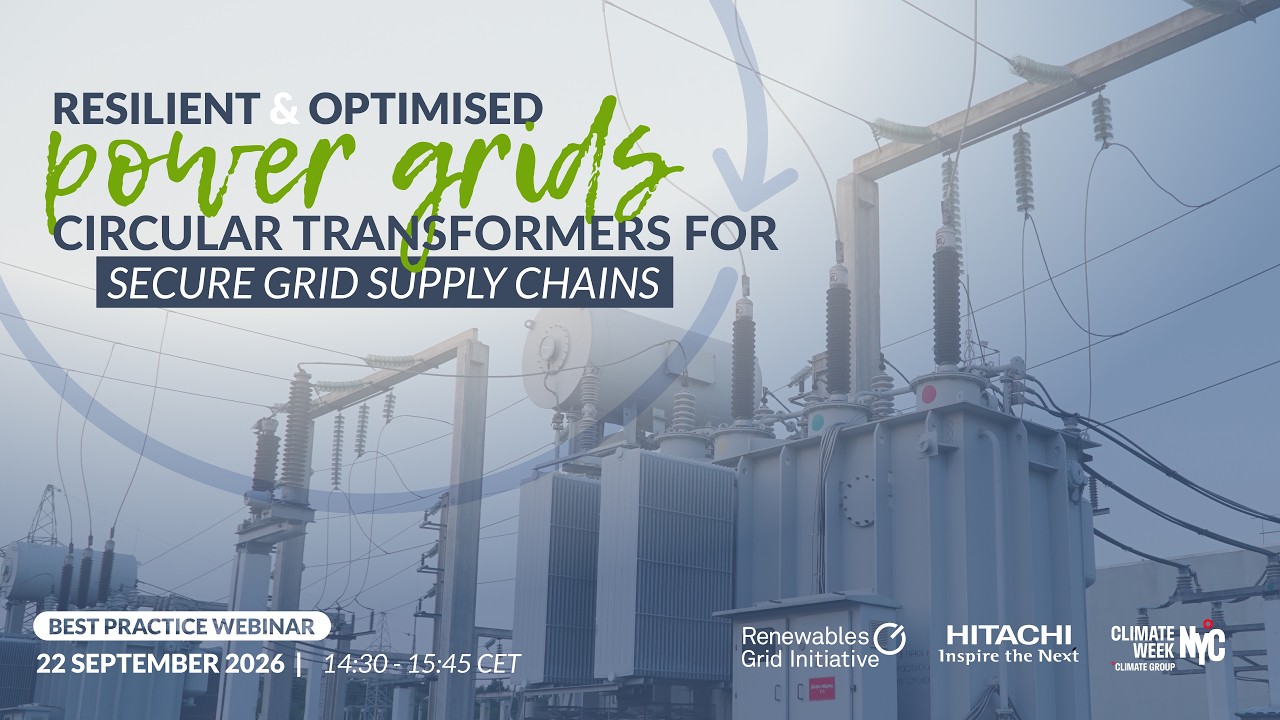
RGI Best Practice Webinar: Circular transformers for secure grid supply chains
Keywords
Summary
275 words
Critical Evaluation
Value of the Information & Strength of the Argument
The webinar offers substantial informational value by combining macro-level context with granular technical detail. It clearly establishes why circularity matters for transformers: the energy transition increases demand for grid equipment, which in turn increases demand for aluminium, steel and copper, materials that are also sought by other sectors such as renewables, energy storage, transport, AI data centres and defence. The argument is structured around three imperatives — security of supply, affordability and sustainability — and shows how these apply to material sourcing as well as to electricity supply. The five Rs framework provides a coherent analytical grid, and the discussion of each lever is grounded in concrete constraints: outdated specifications in the existing fleet, liability and warranty issues for reused components, and the sensitivity of electrical steel to scrap purity. The copper case is particularly well argued, linking mining concentration, declining productivity, long development cycles, refining capacity in China and Europe’s role as a net exporter of copper scrap to the strategic rationale for urban mining. The presentation also acknowledges uncertainties, such as the need for technical and commercial validation of alternative conductor technologies and the limited recyclability of transformer oil due to PCB contamination and cross-border transport constraints. The main weakness is that some quantitative claims are asserted without full methodological context, and the transcript is truncated before the Q&A, so counterarguments and clarifications from Elia Group are not visible. Overall, the argumentation is coherent, evidence-informed and practically oriented, though it remains a stakeholder presentation rather than an independent assessment.
Scientific Rigor, Source Quality, Title Accuracy
The session relies on recognised institutional sources: the Global Resources Outlook, the International Energy Agency, the International Copper Association and the Global Resources Council (referred to as GRC in the transcript). These are credible references, but they are cited in passing and without full bibliographic details, which limits independent verification. The RGI website link provided in the description offers a dedicated resource page on circular transformers, which supports the traceability of the best practice presented. The title is fully aligned with the content: the webinar is explicitly framed as a best-practice session on circular transformers for secure grid supply chains, and the Hitachi Energy–Elia Group pilot is the central case study. No comments were provided, so no audience trend analysis is included.
388 words
Title / Content Match
The title accurately reflects the content: the session focuses on circular transformers and their role in securing grid supply chains, with a pilot between Hitachi Energy and Elia Group as the central case study.
Quality & Reliability
7/10
The webinar is delivered by credible institutional actors (Renewables Grid Initiative, Hitachi Energy, Elia Group) and draws on recognised data sources such as the IEA, the Global Resources Outlook and the International Copper Association. However, it is a best-practice sharing session rather than a peer-reviewed study, and several quantitative claims are presented without full citations or methodological detail. The transcript is truncated, which limits verification of the full argument and the Q&A.
Key Moments
Markers derived by PSI from the transcript: the creator did not define chapters.
- Welcome and introduction by Natalia, moderator from the Renewables Grid Initiative, outlining the agenda and housekeeping rules.
- Presentation of RGI's mission, its three dimensions of work and its best-practice sharing activities, including the RGI Grid Awards.
- Context on why circularity and supply chains matter: the energy transition as a materials transition, with data from the Global Resources Outlook and the IEA.
- Discussion of transformer lead times doubling since 2021 and prices rising 75% since 2019, and the role of critical raw materials.
- Handover to Razi Kablutu from Hitachi Energy, who introduces the five Rs circularity framework and the structure of his presentation.
- Overview of projected demand for grid equipment: three times more transformers and three to five times more switchgear.
- Detailed material composition of a large power transformer: 470 tonnes total, including 135 tonnes of electrical steel, 150 tonnes of steel, 62 tonnes of copper and around 100 tonnes of mineral oil.
- Analysis of recycled content limitations for electrical steel, carbon steel, copper and mineral oil, including scrap purity requirements and Europe's net export of scrap.
- Focus on copper: structural deficits, rising LME prices, mining concentration, refining capacity in China and the concept of urban mining from ageing transformers.
- Introduction of the Hitachi Energy–Elia Group pilot on alternative business models for sourcing and securing materials, and the call for action to scale circular value chains.
Cited Sources
- RGI — Circular transformers resource page — Dedicated RGI webpage on circular transformers, referenced in the video description as further reading on the best practice presented.
Concurring Sources
- International Energy Agency — Electricity Grids and Secure Energy Transitions — IEA report cited in the webinar for data on grid investment needs, transformer lead times and supply chain pressures.
- UNEP International Resource Panel — Global Resources Outlook — Source cited for the claim that material extraction and processing account for over 60% of global climate change impacts.
- International Copper Association — Industry association cited for data on European copper supply and demand, and on copper recycling.
Contribution & Novelties
The webinar’s main contribution is the detailed, material-by-material analysis of circularity constraints for transformers, combined with a concrete pilot between an OEM (Hitachi Energy) and a major European TSO (Elia Group). It moves beyond generic circular economy discourse by quantifying the composition of a large power transformer and explaining why recycled content rates differ so widely across electrical steel (10–15%), carbon steel (10–19%), copper and mineral oil. The concept of urban mining applied to Europe’s ageing transformer fleet, and the emphasis on traceability of material flows after decommissioning, offer a practical framing for supply chain resilience. The call for action to scale circular value chains is also a useful synthesis of the barriers identified.
Pour aller plus loin :
- Circular economy — General overview of the circular economy concept and its principles.
- Transformer — Technical background on power transformers and their components.
- Copper recycling — Context on copper recycling processes and challenges.
- International Energy Agency, ‘Electricity Grids and Secure Energy Transitions’ — Report referenced in the webinar for grid investment and supply chain data.
- Global Resources Outlook (UNEP International Resource Panel) — Source cited for the share of climate change impacts from material extraction and processing.
196 words
Radar Profile
The profile is balanced and moderately strong, with information quantity, quality, technical level and overall reliability all scoring 7/10. This reflects a well-structured, technically detailed stakeholder webinar that draws on credible institutional data but remains a best-practice presentation rather than an independent or peer-reviewed study. The main limitation is the lack of full methodological detail for some quantitative claims and the truncated transcript.