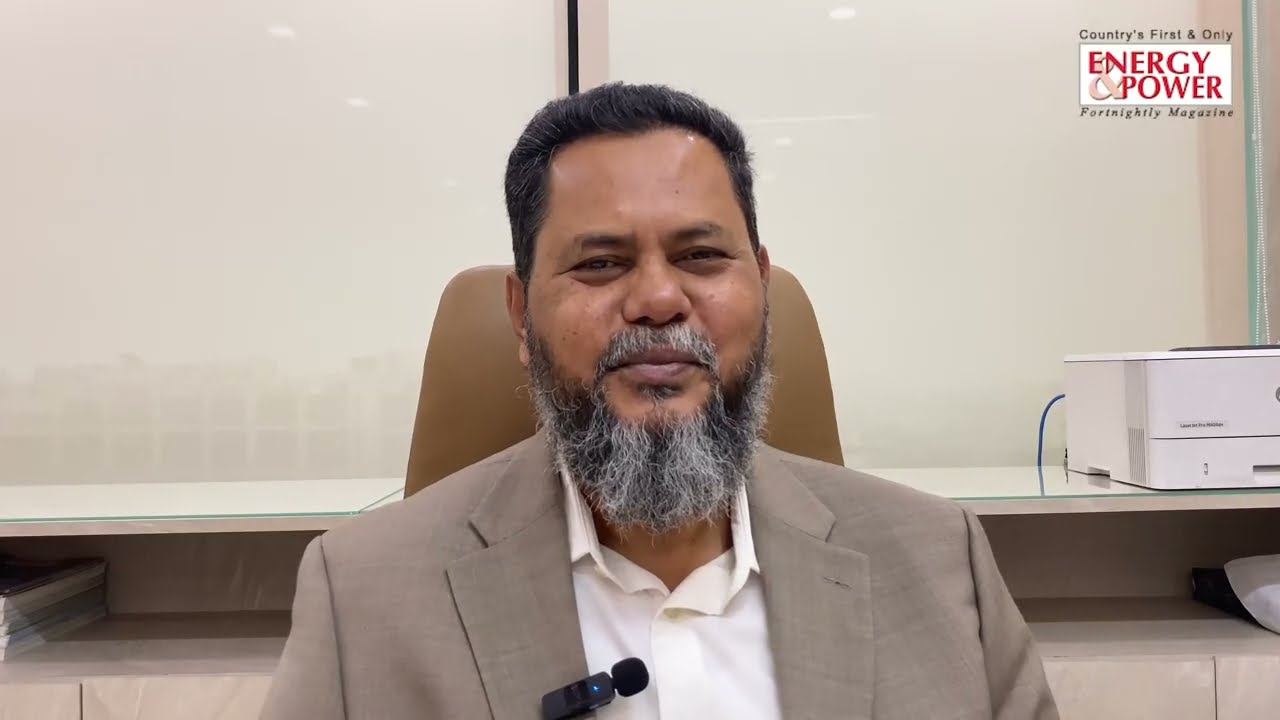
IDCOL Targets 4,800MW Solar Capacity by 2030 | S.M. Monirul Islam | ENERGY & POWER
Keywords
Summary
341 words
Critical Evaluation
Value of the Information & Strength of the Argument
The informational value here is high for anyone tracking Bangladesh’s energy transition, because the speaker is not a commentator but the acting head of the institution that would actually disburse the money. That position yields concrete, checkable operational detail that rarely appears in press coverage: the 2–80 kW system range, the three-hour full-load battery backup as the design reference, the roughly 200,000 taka indicative ceiling for a 3 kW hybrid system including inverter and net-metering energy meter, the 4% refinancing ceiling over seven years, the 10% ceiling for household loans over up to five years, and the 1,523 solar irrigation pumps already installed. The argumentation is strongest where the speaker reasons from mechanism rather than assertion. He explains why the removal of the sanction-load cap matters: under net metering the earlier 70% ceiling, later raised to 100%, is now replaced by an 80 kW installation limit, so a household consuming 500 units a month but able to generate 1,000 can sell the surplus 500 units at 10.50 taka — which in turn opens the door to third-party or opex-style investment, since a household would not self-finance double its own consumption. He is similarly lucid on the demand-aggregator model as a deliberate transposition of the Solar Home System partner structure, and on why the first wave of aggregators will be the already-vetted SHS partners (no loan classification or litigation issues) before an EOI widens the pool. The argumentation is weaker, and the speaker is candid about it, on solar irrigation: replacing diesel pumps requires offering an irrigation tariff below diesel, which requires subsidy, and subsidy-dependent programmes cannot scale indefinitely; he also names the local political economy problem — farmers inside a pump’s command area have no alternative supplier and bargain the tariff down further. On agrivoltaics he explicitly refuses to overclaim, saying two or three crop cycles must be observed before results are published and scale-up considered. The main weakness is that several key numbers are deferred rather than given: the DRS interest rate is ’two more days’ away, and the programme agreements are to be confirmed at the end of the week. The 4,800 MW figure is also a target and an association figure (‘generation-related’), not a committed pipeline, and the speaker himself concedes that the 1,000 MW DRS target is low relative to the assessed potential. Listeners should treat the numbers as institutional intentions with indicative pricing, not as audited outcomes.
Scientific Rigor, Source Quality, Title Accuracy
Scientific rigour is moderate and appropriate to the format. This is an expert interview, not a study: there is no methodology, no dataset, no uncertainty quantification and no peer review. What substitutes for rigour is operational specificity and internal consistency — the net metering ceiling history (70% to 100% to an 80 kW installation limit), the tariff of 10.50 taka over three years, the 4%/7-year refinancing and 10%/5-year on-lending structure, and the 1,523 installed irrigation pumps all hang together as a coherent account of one institution’s programme. The speaker also distinguishes clearly between what is decided, what is indicative and what is pending, which is a mark of epistemic honesty. Source quality, however, is thin in the strict sense: no document, report, policy paper or dataset is cited by name, no third-party study is invoked, and the video description contains only the title, the speaker’s name and affiliation — no links, no references, no chapter markers. The only named external actors are institutional partners (GIZ, KfW, WAVE Foundation, Front Hopper) mentioned in the context of the agrivoltaics pilot, and the government’s 2030 strategy figures (5,500 MW rooftop, 4,500 MW grid-connected solar, 550 MW other renewables), which are attributed to the Prime Minister’s stated intent and a recently determined strategy but not to a citable document. There is no advertising sequence in the video. On title/content adequacy: the title’s 4,800 MW by 2030 claim is genuinely the interview’s headline commitment and is stated explicitly by the speaker, so the title is faithful; it simply omits that most of the conversation concerns the six-month 1,000 MW interim target and the DRS programme mechanics. No viewer comments were supplied, so no audience-trend analysis is offered.
699 words
Title / Content Match
The title accurately reflects the central claim of the interview: IDCOL's stated ambition of 4,800 MW of generation-related capacity by 2030. It is slightly reductive, since the discussion also covers the six-month 1,000 MW interim target, net metering rules, solar irrigation, agrivoltaics and financing constraints.
Quality & Reliability
7/10
The speaker is the acting Managing Director of IDCOL, a state-owned infrastructure financing institution, and speaks from direct operational responsibility. Figures given (1,523 irrigation pumps installed, 3 kW system at just over 200,000 taka, refinancing capped at 4% for 7 years, 10% ceiling for households, 4,800 MW target by 2030, 1,000 MW initial six-month target) are specific and internally consistent. However, no document, dataset or independent source is cited on screen or in the description, several numbers are explicitly provisional ('I would need two more days', 'to be confirmed at the end of this week'), and the interview format gives no adversarial verification. Reliability is therefore that of a well-informed institutional insider, not of a verified study.
Key Moments
Markers derived by PSI from the transcript: the creator did not define chapters.
- Opening question on the government's first incentive package for rooftop solar with storage, the six-month deadline to February, and the 10.50 taka preferential tariff for surplus power over three years.
- Monirul Islam responds that the timeframe is short but the target is not impossible, and introduces the Domestic Rooftop Solar programme with battery backup for uninterrupted supply during load shedding.
- Explanation of net metering: the sanction-load ceiling history (70% raised to 100%), the current 80 kW installation limit, and the worked example of a household consuming 500 units but generating 1,000 and selling the surplus at 10.50 taka.
- Introduction of the 'demand aggregator' model, modelled on the Solar Home System partner structure, aggregating local demand and accessing IDCOL refinancing.
- System specifications: 2 kW to 80 kW range, three-hour full-load battery backup as the reference package, extensible to five or six hours through load rationing, with 3–5 kW expected to be the most popular size.
- Indicative pricing: a 3 kW system with three-hour backup, hybrid inverter and net-metering energy meter at just over 200,000 taka, described as a ceiling price that competition among aggregators and vendors should push down.
- Aggregator onboarding strategy: first wave from already-vetted Solar Home System partner organisations, second wave through an EOI open to EPC firms, private businesses, NGOs and MFIs.
- The six-month interim target: 1,000 MW total, split between 500 MW of new industrial rooftop and 500 MW from the new DRS programme, with the DRS portion potentially exceeding its share.
- The 2030 strategy breakdown (5,500 MW rooftop, 4,500 MW grid-connected solar, 550 MW other renewables) and IDCOL's 4,800 MW association target across solar IPP, EPP, industrial rooftop and DRS.
- Solar irrigation: 1,523 pumps installed, the 50% subsidy, the difficulty of matching diesel tariffs, and the proposal for a preferential tariff for grid-exported surplus from irrigation pumps.
- Agrivoltaics pilot in Chuadanga with WAVE Foundation, GIZ technical support via Front Hopper, and KfW financing; two to three crop cycles needed before results are published and scale-up decided.
- Closing topics: shrinking concessional development finance and IDCOL's blended-finance basket, indicative terms of 4% refinancing over seven years and up to 10% household lending over five years, and cautious interest in battery rickshaws, lithium-ion assembly and solar-plus-grid charging stations.
Contribution & Novelties
The original contribution of this interview is the level of operational granularity it provides on a programme that, at the time of recording, had not yet been publicly documented in detail. Most coverage of Bangladesh’s rooftop solar incentive would report the headline tariff and the six-month deadline; here the acting head of the implementing institution supplies the design parameters behind them — the 2–80 kW system envelope, the three-hour full-load battery backup as the reference specification, the roughly 200,000 taka indicative ceiling for a 3 kW hybrid system including net-metering meter, the 4% seven-year refinancing ceiling for aggregators against a 10% five-year ceiling for households, and the explicit statement that the demand-aggregator model is a deliberate transposition of the Solar Home System partner structure. It also surfaces two things rarely stated on the record by an implementing agency: that the 1,000 MW DRS target is acknowledged to be low relative to assessed potential, and that the solar irrigation programme’s commercial viability is blocked by a structural subsidy requirement rather than by technology. The candid admission that agrivoltaics results will not be published until two or three crop cycles have been observed is a useful counterweight to the promotional tone such pilots often receive.
Pour aller plus loin :
- Net metering — Background on the billing mechanism whose sanction-load ceiling and export tariff are central to the DRS programme design.
- Agrivoltaics — Context for the Chuadanga pilot and the crop-cycle observation period the speaker insists on before scale-up.
- Infrastructure Development Company Limited (IDCOL) — Institutional background on the state-owned financing entity whose 2030 targets are the subject of the interview.
- Solar Home System programme in Bangladesh — The predecessor programme whose vetted partner organisations form the first wave of demand aggregators.
- Blended finance and concessional development finance — Relevant to the speaker’s account of shrinking low-cost funding and IDCOL’s weighted-average-cost basket; cited by name only, as no single canonical reference is reliably identifiable.
322 words
Radar Profile
The profile is that of a high-information, moderate-technicality institutional interview: information quantity and reliability are the strong axes, reflecting a speaker with direct operational authority and consistent internal figures, while technical depth sits mid-range because the discussion stays at programme-design and financing level rather than engineering detail. The relatively lower technical score is not a weakness of the source but a consequence of the format — a policy and financing conversation rather than a technical exposition.