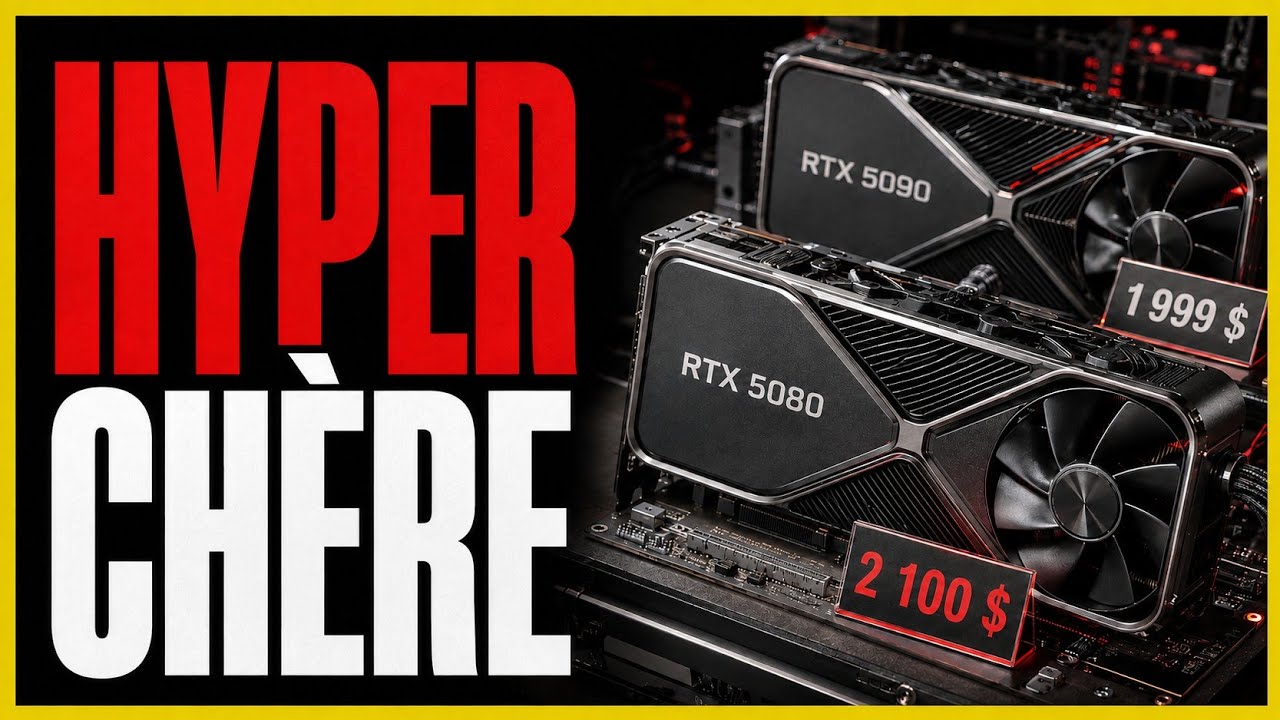
ABUSÉ: les RTX augmentent ENCORE !
OUTRAGEOUS: RTX cards are getting EVEN MORE expensive!
Title history
- ABUSÉ: les RTX augmentent ENCORE ! — observed on 20261101-0059 UTC (YouTube)
Keywords
Summary
166 words
Critical Evaluation
Value of the Information & Strength of the Argument
The video provides a clear and coherent argument about the causes of GPU price increases, linking them to AI demand and manufacturing constraints. The speaker uses concrete price examples and a TSMC document to support his claims. However, the argumentation is partly speculative, and the evidence is not fully cited (the TSMC document is not shown with a source link). The identification of market segmentation and the rise of APUs is insightful, but it remains a personal prediction. The reasoning is accessible and logically structured, though it lacks quantitative data beyond the mentioned price points and TSMC investment figures. Overall, the video offers a valuable perspective but relies heavily on the presenter’s interpretation.
Scientific Rigor, Source Quality, Title Accuracy
The video mentions an internal TSMC document but does not provide a link or reference, making it impossible to verify. The speaker uses MSRP and street prices to support his points, but these are not sourced. The title is somewhat sensational but accurately reflects the content. The video does not present any formal sources or citations, so its scientific rigor is limited. However, the author’s analysis is internally consistent and aligns with known trends in the GPU market.
206 words
Title / Content Match
The title accurately reflects the video's focus on rising RTX prices, though it uses an informal tone.
Quality & Reliability
5/10
The video is an opinion-driven analysis based on current market data and a TSMC document, but lacks specific source citations and relies on speculative projections. The reasoning is coherent but not backed by formal research.
Key Moments
Markers derived by PSI from the transcript: the creator did not define chapters.
- Introduction of current RTX 5090 and 5080 prices, showing a 5080 at $2000 and 5090 at nearly $5000.
- Historical comparison of GPU MSRPs: GTX 980 at $549, GTX 1080 at $599, RTX 3080 at $699, RTX 4080 at $1199, and RTX 5080 at $999.
- Explanation of the memory-centric market, where VRAM capacity becomes crucial for local AI, and the competition between gamers, creators, and AI users.
- Presentation of TSMC investment documents: $52-56 billion for 2026, with 70% for advanced processes, indicating production constraints.
- Discussion of market segmentation: premium cards as luxury items and the rise of 'halo' products, with mid-range cards being squeezed.
- Prediction that entry-level will shift to APUs (e.g., AMD's Ryzen with 128GB support), and mid-range discrete GPUs may disappear, leading to integrated non-upgradable PCs.
Contribution & Novelties
The video offers a synthesized analysis of the GPU market, connecting AI-driven demand, TSMC manufacturing bottlenecks, and memory-centric needs to explain price inflation. Its originality lies in the explicit forecast of a market split into ultra-premium AI-capable cards and integrated APU-based systems, with a squeezed middle segment. While not based on original research, it presents a coherent explanatory framework that goes beyond simple price reporting.
Pour aller plus loin :
- TSMC — Key foundry company whose investment plans are central to the video’s argument.
- High-performance computing — The HPC sector accounts for a majority of TSMC’s revenue, as mentioned.
- Accelerated Processing Unit — APUs are predicted to replace entry-level discrete GPUs.
111 words
Radar Profile
The radar profile shows a balanced but moderate performance across all dimensions. Quantity and technical level of information are adequate, while quality and reliability are slightly lower, reflecting the lack of verifiable sources and the speculative nature of the predictions.