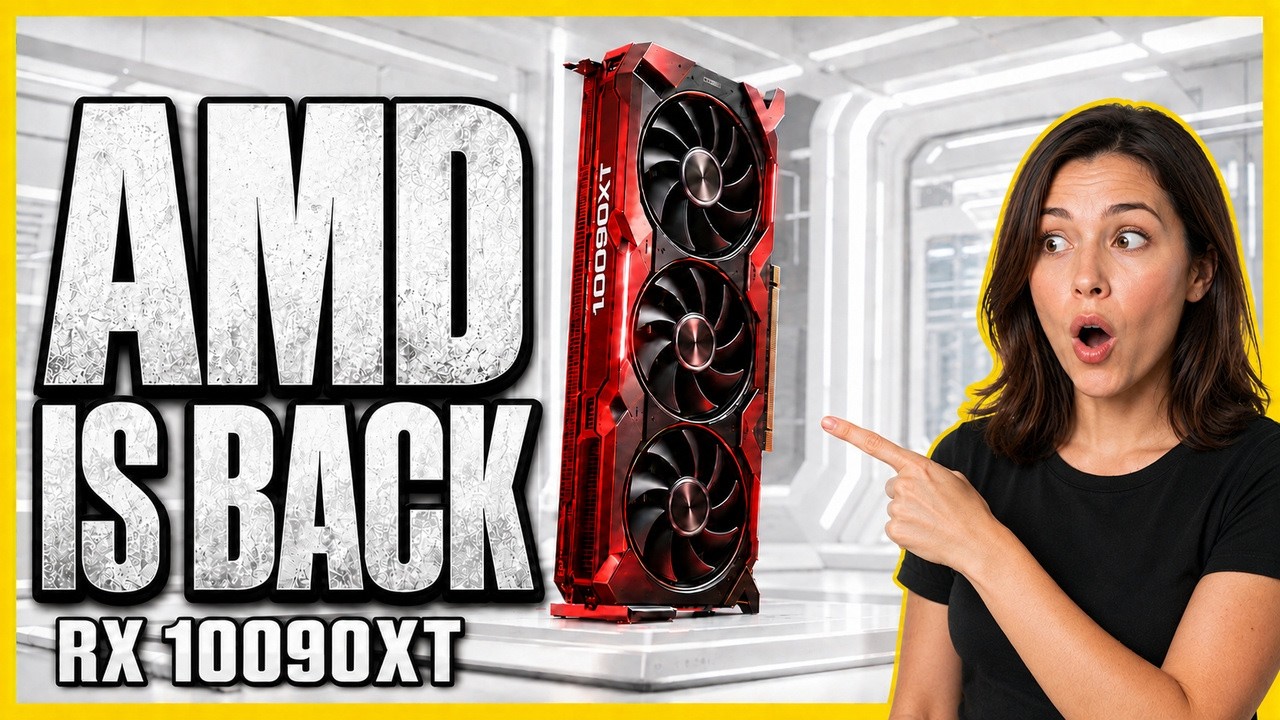
AMD va HUMILIER la RTX 5090… et pour 40 % moins cher !
AMD is going to HUMILIATE the RTX 5090… and for 40% less!
Title history
- AMD va HUMILIER la RTX 5090… et pour 40 % moins cher ! — observed on 20261101-0050 UTC (YouTube)
Keywords
Summary
193 words
Critical Evaluation
Value of the Information & Strength of the Argument
The video provides a fairly detailed technical analysis of the alleged architecture, including specific numbers for compute units, shader processors, process node, and expected performance. The presenter argues that AMD’s shift to a unified architecture is a strategic move to regain competitiveness, particularly in ray tracing and AI features where NVIDIA has held an advantage. The argumentation is structured around the premise that TSMC’s N3P node and the increased execution density will close the gap with NVIDIA’s newer GPUs. However, the reasoning relies heavily on leaks and unverified estimates, and the presenter occasionally acknowledges uncertainty (e.g., ‘probably’, ‘maybe’). The value of the information lies in its synthesis of many rumors into a coherent picture, but the lack of official confirmation limits its reliability.
Scientific Rigor, Source Quality, Title Accuracy
The video cites a single blog post from the creator’s site as a reference for more details. The information is largely based on leaks and speculation, with no direct quotes from official sources. The title is sensationalist, claiming AMD will ‘humiliate’ the RTX 5090, but the content is more moderate, suggesting only that AMD might compete closely. This overstates the case, though the video does caution that these are estimates. Regarding public comments, the 30 analyzed reveal skepticism about AMD’s ability to truly beat NVIDIA, concerns about driver quality, and a mix of hope and cynicism about the potential price and performance.
240 words
Title / Content Match
The title is sensationalist and claims AMD will 'humiliate' the RTX 5090, but the video itself is more nuanced, presenting it as a potential competitor. The content does discuss the possibility of performance parity at a lower price, but the title overstates certainty.
Quality & Reliability
5/10
The video is based on unconfirmed leaks and speculation, with the presenter acknowledging uncertainty. While the technical details are presented with some expertise, the reliability is limited by the lack of official sources.
Key Moments
Markers derived by PSI from the transcript: the creator did not define chapters.
- Introduction: AMD's next-gen GPU leaks and strategic pivot
- Merging RDNA and CDNA into unified UDNA architecture
- Technical details: TSMC N3P node and doubled execution units
- Spec comparison with RTX 5090 (compute units, shaders, clock, power)
- Price expectations ($1000-$1200) and launch window (late 2027)
- Conclusion: AMD's return to high-end and potential impact on market
Cited Sources
- Radeon RX 10800 XT vs NVIDIA RTX 5090 — Blog post cited in the video description for more details on the comparison.
Contribution & Novelties
The video’s original contribution is to compile and analyze the latest rumors about AMD’s next-generation high-end GPU, placing them in the context of AMD’s strategic shift to a unified UDNA architecture. It offers a comparative table against the RTX 5090 and discusses practical implications for gamers and AI users. The presentation is straightforward, though it lacks in-depth evidence.
Pour aller plus loin :
- AMD RDNA microarchitecture — Overview of AMD’s gaming GPU architecture, explaining its evolution towards UDNA.
- ROCm — AMD’s software stack for computation and AI, which UDNA aims to unify across all products.
- TSMC — The semiconductor foundry’s process nodes, including N3P, which are critical to the performance and efficiency gains discussed.
114 words
Radar Profile
The radar shows high scores for information quantity and technical level, but lower for reliability and quality, reflecting a video that is dense with speculative but technically detailed content. The overall profile is typical of tech YouTube channels covering leaks and rumors.
💬 Among the 30 comments analyzed, the tone is overall skeptical, with many doubting AMD's ability to truly compete with the RTX 5090, but some express hope for increased competition. Main concerns involve drivers and the reliability of rumors.