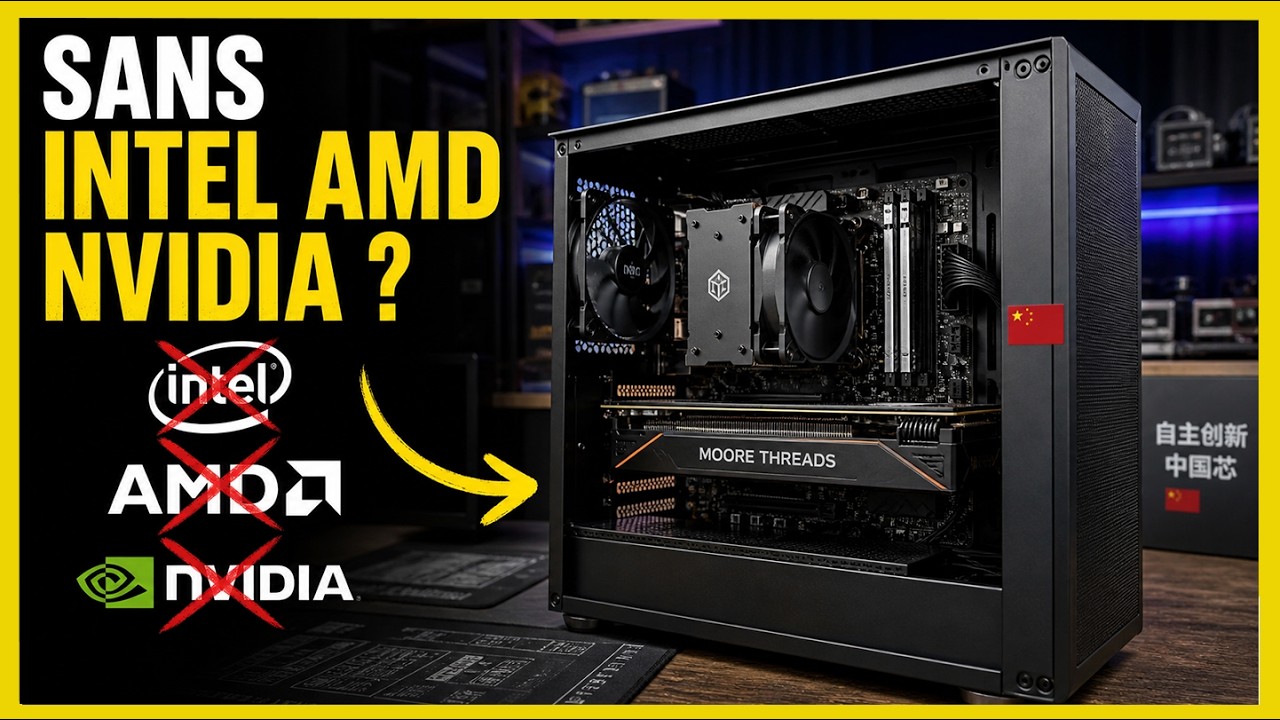
Construire un PC SANS Intel, SANS AMD, SANS NVIDIA… et le résultat est fou !
Building a PC WITHOUT Intel, WITHOUT AMD, WITHOUT NVIDIA… and the result is insane!
Title history
- Construire un PC SANS Intel, SANS AMD, SANS NVIDIA… et le résultat est fou ! — observed on 20261101-0121 UTC (YouTube)
Keywords
Summary
160 words
Critical Evaluation
Value of the Information & Strength of the Argument
The video provides valuable context on the emergence of non-US PC components and the concept of technological sovereignty. The argument is coherent: it acknowledges current performance shortcomings while highlighting industrial progress and ecosystem development. The reasoning avoids overhype by clearly separating theoretical specs from real-world use, and it correctly identifies software maturation as the critical factor. However, the argument relies heavily on qualitative impressions and unverified third-party tests, with no concrete benchmark numbers or references. The analogy to BYD and the claim of government subsidies are asserted without data. The conclusion about future viability is speculative but reasonably grounded in observed trends.
Scientific Rigor, Source Quality, Title Accuracy
The video presents itself as an expert opinion and demonstration rather than a rigorous scientific study. No specific sources are cited in the description beyond a general Amazon affiliate link and the channel’s own previous videos. The presenter mentions the YouTube channel ‘Moore’s Law Is Dead’ for future improvements, but that is not a formal citation. The title accurately reflects the content, and the adéquation is good. The description offers no additional references or datasheets. Overall, the scientific rigor is moderate: the factual claims about hardware specifications are plausible, but the evaluation of performance lacks verifiable data. The absence of independent benchmarks weakens the reliability.
222 words
Title / Content Match
The title accurately reflects the content: a PC built without US components, with the 'crazy' result being the performance gap. Adequate.
Quality & Reliability
6/10
The video provides a hands-on assessment of a Chinese-sourced PC build (Zhaoxin CPU + Moore Threads GPU), mixing technical observations with geopolitical commentary. Claims are plausible but lack precise benchmarks or verifiable data, and the presenter explicitly relies on personal impressions and third-party tests without naming them precisely. Industrial trajectory claims are speculative.
Key Moments
Markers derived by PSI from the transcript: the creator did not define chapters.
- Introduction: the premise of building a PC without US components and its geopolitical importance.
- Presentation of the Zhaoxin KX-7000 CPU: x86 compatibility, history from Cyrix/VIA, current specs, and performance level (equivalent to 2017 Intel).
- Discussion of motherboards: Asus support signals a real ecosystem forming.
- Introduction of the Moore Threads MTT S80 GPU: theoretical specs, but immature drivers and poor DirectX compatibility.
- Explanation of the bottleneck: CPU cannot feed GPU effectively, leading to low performance.
- Gaming test results: Forza Horizon 5 playable but poor, Cyberpunk 2077 almost unplayable, Black Myth Wukong catastrophic.
- Future outlook: improvements expected, subsidies, and the possibility of fully Chinese PCs in the near future.
Cited Sources
- Amazon affiliate shop - MAKERTRONIC — Link in description to the host's recommended products, not a scientific source.
- Moore's Law Is Dead (YouTube channel) — Mentioned as a source for future improvements in GPU drivers and hardware, but no specific video or URL given.
Concurring Sources
- Moore's Law Is Dead (YouTube channel) — The host references this channel as reporting breakthroughs in next-gen GPUs and ray tracing, supporting the optimistic trajectory.
Dissenting Sources
- No specific discordant sources provided — The video does not mention any contradicting sources. The presenter's own observations are somewhat negative about current performance, which is in tension with the overall optimistic outlook, but this is not a formal disagreement.
Contribution & Novelties
The video offers a practical, hands-on perspective on building a PC with Chinese components, highlighting the real-world gap between theoretical specs and software maturity. It contributes to the discourse on technological sovereignty by showcasing a concrete example rather than abstract arguments. The analysis correctly identifies the software ecosystem as the critical bottleneck and notes the trajectory of improvements, which is often overlooked in mainstream coverage.
Pour aller plus loin :
- Zhaoxin KX-7000 — Overview of the CPU architecture and market positioning.
- Moore Threads MTT S80 — Technical specifications and performance context (note: this URL is plausible but not verified; the exact page may change).
- DirectX 12 — API compatibility issues outlined in the video.
- x86 — Why x86 compatibility is crucial for PC ecosystem.
- Technological sovereignty — Concept central to the video’s argument.
133 words
Radar Profile
The radar profile shows balanced but moderate scores across dimensions, with slightly higher quantitative information and technical level relative to reliability. This reflects a video that is informative but lacks rigorous verification, making it suitable for enthusiasts but not for academic reference.