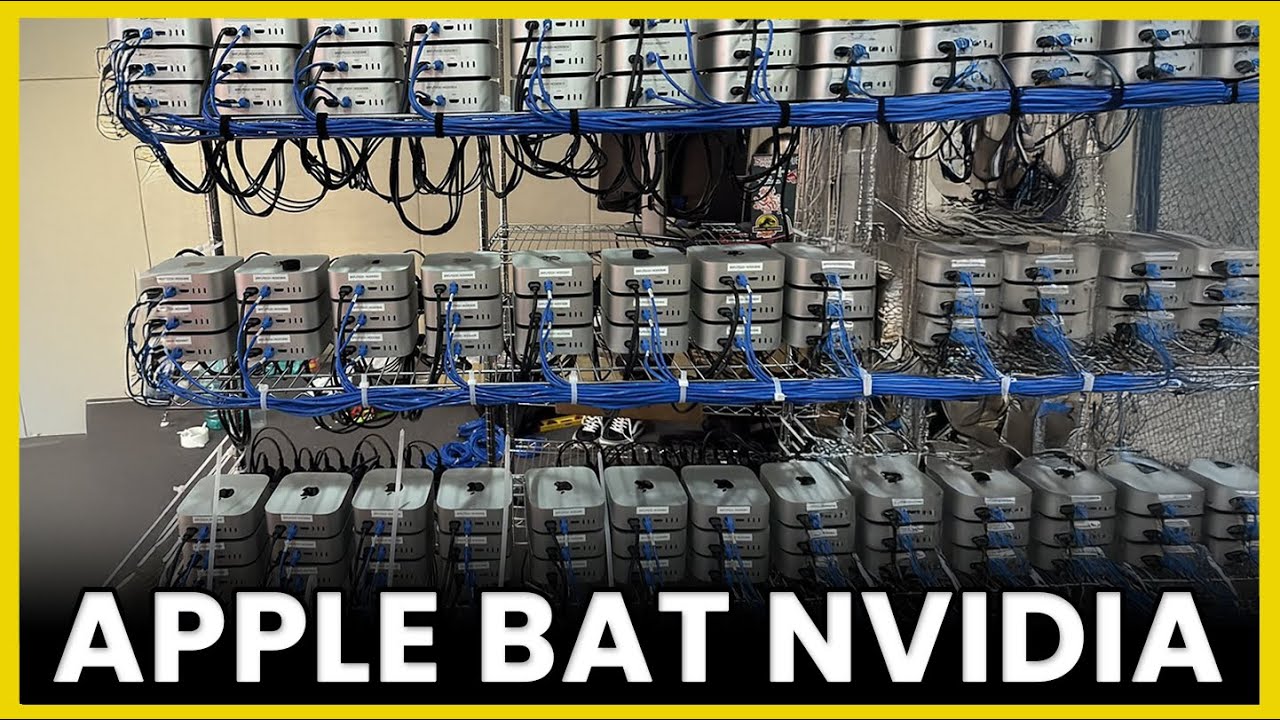
Oubliez NVIDIA : Voici le Cluster Mac le Moins Cher, nvidia en panique !
Forget NVIDIA: Here's the Cheapest Mac Cluster, NVIDIA is panicking!
Title history
- Oubliez NVIDIA : Voici le Cluster Mac le Moins Cher, nvidia en panique ! — observed on 20261101-0152 UTC (YouTube)
Keywords
Summary
164 words
Critical Evaluation
Value of the Information & Strength of the Argument
The video provides a clear, engaging overview of a novel technology, demonstrating its practical value for hobbyists and small businesses. The presenter argues convincingly that RDMA over Thunderbolt 5 offers a significant cost-performance advantage for AI inference, using concrete price comparisons and performance estimates. However, the argumentation relies on personal assertions rather than empirical data or benchmarks, and some numbers (e.g., token rates, memory capacity) are stated without verification. The comparison with NVIDIA is generally fair, but the conclusion overstates the potential by extrapolating to trillion-parameter models, which may not be reproducible in practice.
Scientific Rigor, Source Quality, Title Accuracy
The video is a tutorial-style presentation with no external sources cited; the only link in the description is an affiliate Amazon link. The scientific rigor is low because the claims about RDMA and Exo are not backed by official documentation or independent tests. The title uses hyperbolic language (’nvidia en panique’) that does not match the measured tone of the content, creating a mild mismatch. The presenter does not mention any sources for the performance figures, which reduces trust. The adequacy between title and content is partial: the video indeed focuses on a cheap Mac cluster, but the ‘panic’ element is fictional.
211 words
Title / Content Match
The title is somewhat clickbait and exaggerates the 'panic' but accurately reflects the content about building a cheap Mac cluster as an alternative to NVIDIA.
Quality & Reliability
5/10
The video presents plausible but unverified claims about RDMA over Thunderbolt 5, lacks citations, and includes promotional content. The technical explanation is accessible but oversimplified, and performance figures are not sourced from official benchmarks.
Key Moments
Markers derived by PSI from the transcript: the creator did not define chapters.
- Introduction and channel pitch
- Explanation of what a cluster is and the context of expensive memory
- Introduction of RDMA over Thunderbolt 5 and its benefits
- Discussion of Exo software and tensor parallelism
- Cost comparison between Mac Mini cluster and NVIDIA H100
- Limitations: Apple ecosystem, old hardware, chain topology
- Advantages, use cases, and conclusion
Contribution & Novelties
The video introduces a recent development in consumer hardware—the use of RDMA over Thunderbolt 5 to create distributed AI inference systems with Apple silicon. This is an emerging topic likely unknown to many viewers, making the information novel. The presenter also highlights the Exo software, which facilitates model sharding across multiple Macs, and points to a cost-effective alternative to cloud-based AI services.
Pour aller plus loin :
- Thunderbolt 5 — Relevant to the connector technology that enables high-speed data transfer
- Remote direct memory access — Core concept behind accessing remote memory without CPU involvement
- Exo GitHub repository — The software mentioned for clustering devices, though not directly linked in the video, is key to reproducing the setup
117 words
Radar Profile
The radar profile shows a high score in quantity of information (8) but moderate in quality (6) and reliability (5), indicating a good volume of content with somewhat weaker factual support. The technical level is solid (7), suggesting the video is informative but not deeply rigorous.