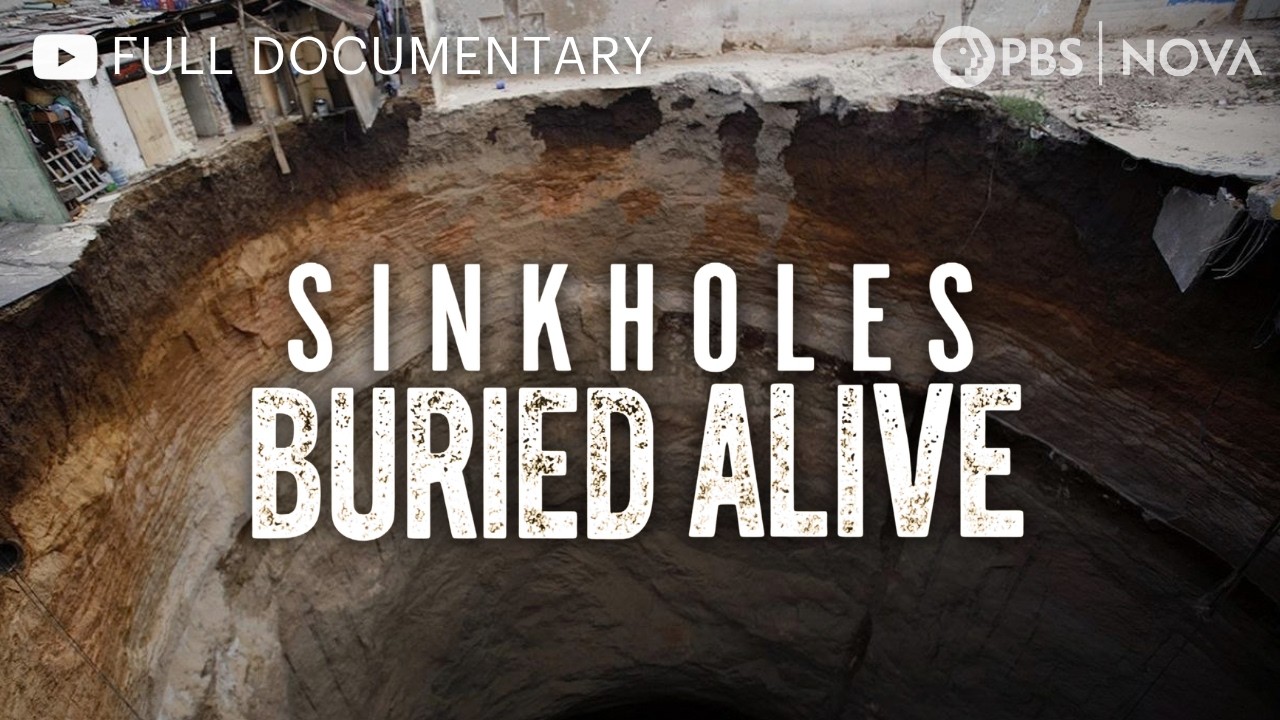
Sinkholes - Buried Alive | Full Documentary | NOVA | PBS
Keywords
Summary
161 words
Critical Evaluation
Value of the Information & Strength of the Argument
The documentary provides a comprehensive overview of sinkhole science, combining dramatic case studies with clear explanations of geological processes. It effectively demonstrates the global distribution of sinkholes and the interplay of natural and human factors. The argument is well-structured, moving from specific incidents to broader scientific principles and mitigation strategies. The inclusion of a controlled sandbox model experiment adds experimental evidence to support the role of water-level changes in triggering collapses. The narrative is compelling and informative, though it occasionally prioritizes spectacle over depth. Overall, the value lies in its accessible synthesis of expert knowledge and real-world consequences.
Scientific Rigor, Source Quality, Title Accuracy
The documentary maintains high scientific rigor by featuring experts from the Florida Geological Survey, Florida State University, and the University of Zaragoza, who explain karst processes and sinkhole mechanics. It uses field observations, cave diving, and ground-penetrating radar, though it does not cite specific peer-reviewed studies. The title accurately reflects the content, focusing on sinkholes and their deadly impacts. The program is transparent about its sources through on-screen identification of experts and institutions. No comments were provided for analysis.
192 words
Title / Content Match
The title accurately reflects the content: the documentary focuses on sinkholes, their causes, impacts, and human responses, including the dramatic story of a fatal sinkhole in Florida.
Quality & Reliability
9/10
The documentary is produced by NOVA/PBS, a highly reputable science broadcaster, and features credentialed experts including geologists from the Florida Geological Survey, Florida State University, and the University of Zaragoza. It relies on field observations, expert interviews, and a controlled laboratory model, with clear explanations of geological processes. The main limitation is the lack of explicit citations to peer-reviewed literature within the video, though the scientific consensus presented is well-established.
Chapters
Cited Sources
- NOVA PBS Official Website — Official website for the documentary, providing additional resources and information.
- PBS Donate — Support page for PBS, mentioned in the description.
- PBS App — Link to the PBS app for streaming full episodes.
- NOVA Newsletter — Sign-up for NOVA's newsletter for science discoveries.
Concurring Sources
- USGS Water Science School: Sinkholes — USGS provides authoritative information on sinkhole formation and distribution, consistent with the documentary's explanations.
- Florida Department of Environmental Protection: Sinkholes — State agency resources on sinkholes in Florida, corroborating the state's vulnerability and management approaches.
External References
Contribution & Novelties
The documentary offers a global perspective on sinkholes, weaving together case studies from Florida, Spain, and Louisiana to illustrate the universality of karst hazards. It highlights the role of human activities, such as groundwater overpumping and salt cavern collapse, in triggering sinkholes. The sandbox model experiment provides a tangible demonstration of how water-level changes can induce collapse, bridging field observations and controlled simulation. The film also underscores the challenges of living with sinkholes in historic towns and the need for adaptive strategies.
Pour aller plus loin :
- Karst — Wikipedia article on karst topography and its formation.
- Sinkhole — Wikipedia article on sinkholes, including causes and notable examples.
- Bayou Corne sinkhole — Wikipedia article on the 2012 Louisiana sinkhole disaster.
120 words
Radar Profile
The radar profile shows high scores in information quantity, quality, and reliability, reflecting the documentary's thorough and accurate coverage. The technical level is moderately high, suitable for a general audience with some scientific interest. The overall profile indicates a well-balanced, authoritative production.