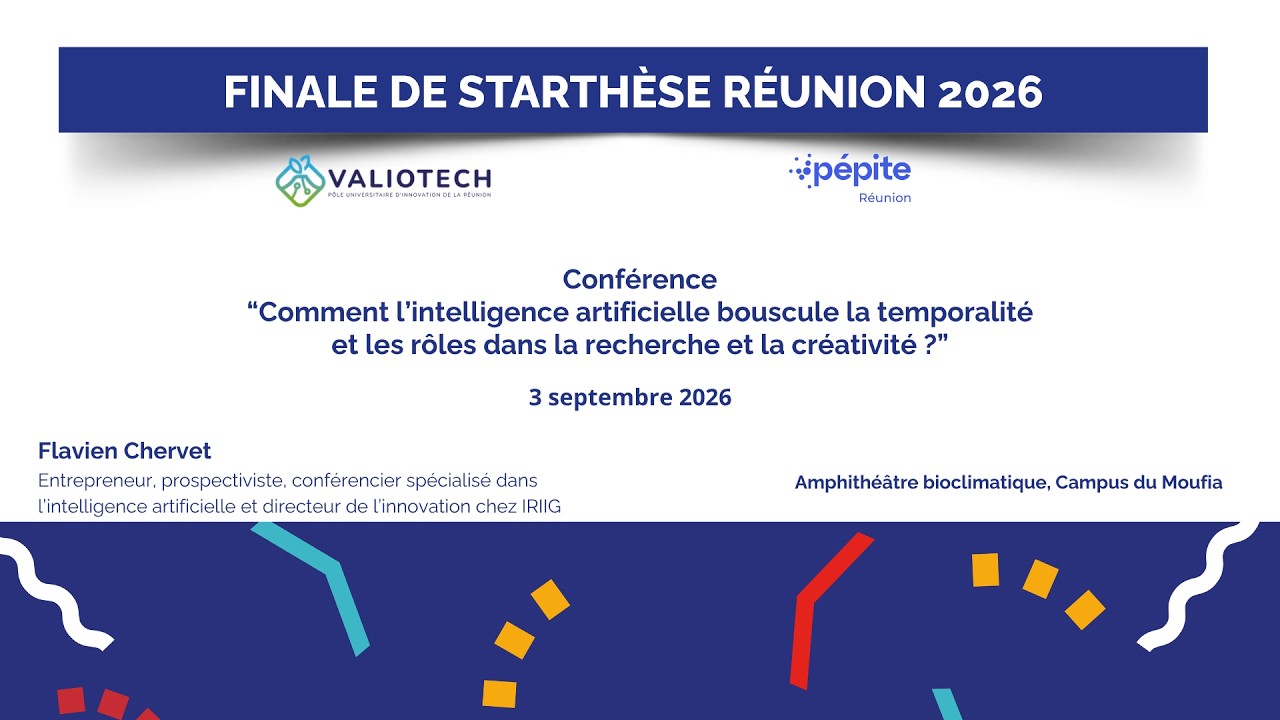
Starthèse Réunion 2026 : conférence de Flavien Chervet
Starthèse Meeting 2026: conference by Flavien Chervet
Keywords
Summary
214 words
Critical Evaluation
Value of the Information & Strength of the Argument
The value of the information lies in offering a convincingly optimistic and accessible narrative linking the historical progression of neural networks to concrete breakthroughs like AlphaFold and AI-driven drug design. The speaker’s use of live demos with Claude Code effectively illustrates the democratization of AI tools for scientific collaboration, adding practical relevance. The argumentation is persuasive in its appeal to human curiosity, notably by framing creativity as a process that can be simulated since it originates in the brain. However, the core argument for AI’s transformative power often leans on futurist rhetoric and sweeping claims, such as AlphaFold 3 having ‘solved’ all living molecule processes or that AI is entirely ‘underhyped’. While he encourages rational examination (asking whether the Lila.ai ambition is serious), he openly aims to augment both fascination and anxiety rather than providing a detached analysis. Thus, the talk excels at engaging and motivating but falls short of offering a carefully hedged or fully evidence-backed scientific thesis.
Scientific Rigor, Source Quality, Title Accuracy
The conference demonstrates a solid understanding of major AI milestones, with accurate mentions of neural networks, backpropagation, Transformers, and the FDA approval of IDx-DR. Chronologically, the narrative aligns with the general timeline (deep learning in the 2000s, Transformers in 2017, large-scale generative AI in 2022). However, scientific rigor is limited by the absence of on-screen citations, precise dates, or links to specific publications during the talk. The speaker occasionally overreaches, such as implying IDx-DR was very recent or that all living molecule functions have been clarified by AlphaFold 3. While the title perfectly matches the content of the conference, the lack of rigorous source referencing and the presence of futurist overstatements temper the overall reliability rating.
290 words
Title / Content Match
The title is a straightforward, accurate description of the video content: a recording of Flavien Chervet's conference given at Starthèse Réunion 2026. It matches perfectly.
Quality & Reliability
6/10
The speaker, an entrepreneur and futurist, provides a broad and passionate perpective on AI's impact on science and creativity. He accurately references well-known historical milestones (deep learning, Transformers, AlphaFold) and uses live demos to illustrate accessibility. However, the talk simplifies complex topics, overstates certain findings (e.g., AlphaFold 3 'solving' all living processes), and relies heavily on personal futurist opinions rather than rigorous peer-reviewed citations. The authority lies more in industry experience than formal academic research, which limits the score.
Key Moments
Markers derived by PSI from the transcript: the creator did not define chapters.
- The host introduces Flavien Chervet, recounting her surprise at his conference and presenting him as a futurist and AI specialist.
- Flavien Chervet takes the stage, thanks the audience, and shares his background as a 'geek' whose interest in AI started through philosophy.
- He states that AI is 'underhyped' and introduces a live demonstration using Claude Code to build a collaborative science platform called 'Réunion récif'.
- He explains the fundamentals of neural networks, including the learning loop, backpropagation of error, and why data is the 'invisible oil' of our era.
- He presents early applications of deep learning, notably medical diagnosis (FDA-approved IDx-DR for diabetic retinopathy) and agricultural drones.
- He asks whether AI can be creative and highlights AlphaFold, which predicted 200 million protein structures in contrast to the 170,000 known before.
- He discusses AlphaFold 3, AI-driven drug design, and the first AI-created drug in 2020, noting the ambition of Lila.ai to build a scientific superintelligence.
- He transitions to the 'Middle Ages' of AI with ChatGPT and foundation models, mentioning Transformers (the 'T' in GPT) and the philosophical implications for science.
Concurring Sources
- AlphaFold — Supports the claim about the dramatic leap in protein structure prediction from human research to AI-based methods.
- Transformer (deep learning architecture) — Provides factual background for the 2017 Transformer algorithm that the speaker says underpins modern generative AI like ChatGPT.
Contribution & Novelties
The original contribution of this talk lies in explicitly framing AI’s impact on science through the lens of ’temporality and roles’, urging the audience to consider the acceleration of research cycles and the redefinition of the researcher’s identity. Unlike purely technical talks, it blends philosophical questions (e.g., what it means to do science when an algorithm can propose hypotheses) with live practical demonstrations, making the abstract concept of AI superintelligence tangible. The speaker successfully bridges the gap between geek culture and academic audiences by using accessible metaphors (the airplane vs. bird, data as oil). However, a significant portion of the content revisits widely known AI milestones, and the futurist speculations (like Lila.ai’s race) are presented without reference to ongoing academic debates on AI alignment or reproducibility.
Pour aller plus loin :
- AlphaFold — Directly relevant to the ‘creativity’ and rapid protein structure prediction discussion.
- Transformer (deep learning architecture) — Explains the foundational model mentioned as the ‘T’ in GPT, central to the ‘Middle Ages’ of AI.
- Deep learning — Provides a broader academic overview of the deep neural networks that underpin the speaker’s explanation.
- Backpropagation — The specific mathematical technique the speaker references for learning in neural networks.
198 words
Radar Profile
The radar profile shows a high score in 'quantite_information' (8), indicating a dense and content-rich presentation, while 'qualite_information', 'niveau_technique', and 'fiabilite_globale' cluster around the 6 range. This suggests the talk is engaging and broad but requires the listener to separate solid facts from speculative opinions, and it is not highly technical or rigorously cited.