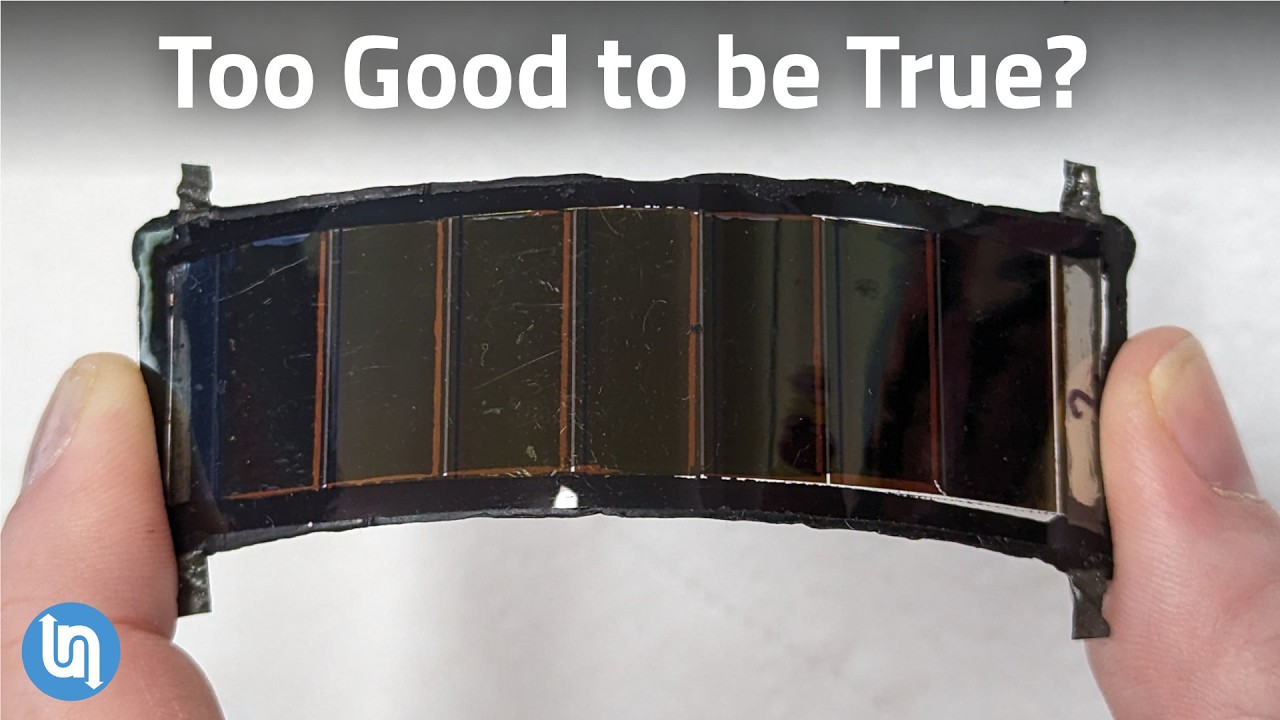
How This Perovskite Breakthrough Could Change Solar Forever
Title history
- How This Perovskite Breakthrough Could Change Solar Forever — observed on 20261101-0158 UTC (YouTube)
Keywords
Summary
125 words
Critical Evaluation
Value of the Information & Strength of the Argument
The video provides substantial value by synthesizing recent research and commercial initiatives in graphene-perovskite solar cells, offering a balanced view that counters hype with practical reality checks. The argumentation is solid: it presents concrete data (efficiency, cost reduction, lifespan tests) and contextualizes them within industry standards. The presenter effectively breaks down complex technical aspects into accessible explanations, while also acknowledging uncertainties such as proprietary methods and limited pilot trial details. The inclusion of financial forecasts and TRL levels strengthens the analytical depth. Overall, the content is informative, well-structured, and critically evaluated.
Scientific Rigor, Source Quality, Title Accuracy
The video demonstrates scientific rigor by citing specific institutions, studies, and industry claims, with links to a detailed script and references. The presenter openly questions the reproducibility of proprietary processes and notes gaps in information (e.g., Chinese pilot trials). The title ‘How This Perovskite Breakthrough Could Change Solar Forever’ accurately encapsulates the video’s theme, though the content extends beyond a single breakthrough to broader developments. No major deviations from title to content occur. The inclusion of a reality check section effectively tempers expectations, aligning with the channel’s reputation for critical analysis.
197 words
Title / Content Match
The title accurately reflects the video's focus on a perovskite-graphene breakthrough and its potential impact.
Quality & Reliability
8/10
Well-researched with citations, balanced reality check, transparent about uncertainties.
Chapters
Cited Sources
- Video script and citations on Undecided.tech — Detailed script with references for the video's claims.
- How Record Breaking Perovskites Are Here NOW — Previous video on perovskite advances.
- Perovskite Solar Cells Could Be the Future of Energy — Earlier discussion on perovskite solar cells.
- Why Coastal Cities Are Betting on Osmotic Power — Related video on alternative energy, referenced for context.
Concurring Sources
- Video script and citations on Undecided.tech — Primary source with detailed references.
- How Record Breaking Perovskites Are Here NOW — Prior related video from same channel.
External References
Contribution & Novelties
The video offers a unique synthesis of the latest graphene-perovskite solar cell developments, including recent collaborations and pilot trials, and critically evaluates their readiness for market deployment. It provides a balanced perspective on both the potential and the challenges, backed by specific data and citations. The ‘reality check’ section adds a valuable skeptical lens often missing in tech news.
Pour aller plus loin :
- Perovskite solar cell — Background on perovskite technology.
- Graphene — Properties and applications.
- Roll-to-roll processing — Manufacturing technique relevant to scalability.
- Technology readiness level — Framework used to assess maturity of technologies.
96 words
Radar Profile
The radar profile indicates high quality and quantity of information, with moderate technical depth, reflecting a well-researched video that balances accessibility and detail.
💬 Positif; on 30 comments analyzed, viewers appreciate the balanced reality check and detailed explanation, though some express skepticism about commercialization and the age of the technology.