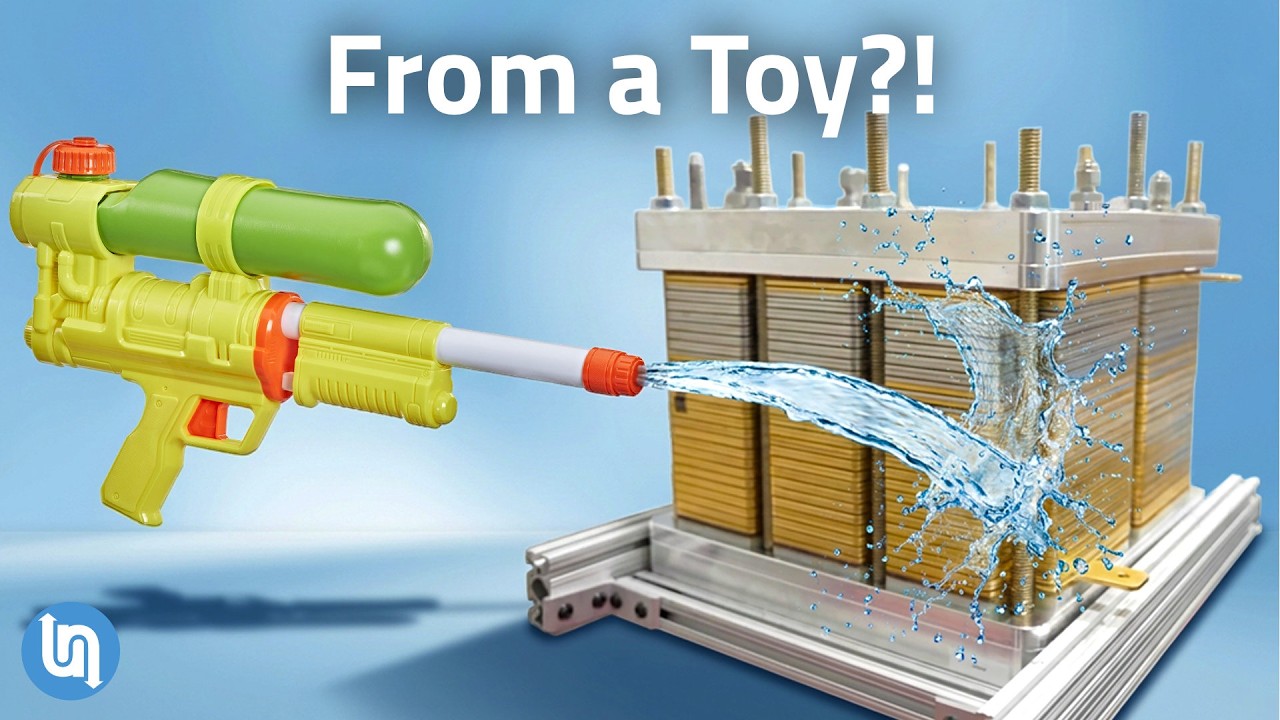
How the Super Soaker Inventor Just Killed the Steam Engine
Title history
- How the Super Soaker Inventor Just Killed the Steam Engine — observed on 20261101-0114 UTC (YouTube)
Keywords
Summary
187 words
Critical Evaluation
Value of the Information & Strength of the Argument
The video provides substantial value by clearly explaining a complex thermodynamic concept in an accessible manner, using analogies and visual aids. It combines historical background on Lonnie Johnson with technical details on the JTEC’s operation, efficiency benchmarks, and economic feasibility. The argument is well-structured: it establishes the problem, introduces the solution, explains the mechanism, presents performance data, and honestly discusses scalability challenges. The inclusion of expert interview excerpts strengthens the credibility. The reasoning is logical and avoids overhype, acknowledging that commercial viability remains unproven. The video effectively argues that while the physics is sound, the engineering and cost hurdles are the real obstacles.
Scientific Rigor, Source Quality, Title Accuracy
The video demonstrates strong scientific rigor by referencing specific lab results (17.1% efficiency, Carnot comparisons) and citing sources in the description, including a script and citations page. The interview with Dr. Johnson adds primary-source authority. The technical explanation is accurate, with appropriate caveats about current limitations. The title, while sensational, is somewhat justified as the JTEC could disrupt traditional steam turbine dominance in specific niches, though ‘killed’ overstates immediate impact. No conflicting sources were identified; the content aligns with the provided links. The video’s tone is measured and avoids unfounded claims, acknowledging the technology’s early commercial stage.
215 words
Title / Content Match
The title is catchy and slightly hyperbolic ('killed the steam engine'), but the content discusses the JTEC as a potential replacement for steam turbines in some applications. Overall, the title roughly matches the content.
Quality & Reliability
8/10
The video is well-researched, includes interviews with the inventor, and provides a detailed technical explanation. Sources are cited in the description. The presence of a short sponsored segment (~120 seconds) does not affect the assessment.
Chapters
Cited Sources
- Video script and citations — Likely contains detailed references for the video's claims and data.
- Full interview with Dr. Johnson — Extended conversation with the inventor, providing deeper insights.
- Related video: IKEA-Style Wind Turbines — Part of the same channel's series on clean energy technologies.
External References
Contribution & Novelties
The video offers an original synthesis of the JTEC’s working principles, historical context, and current development status, based on direct interview with the inventor. It publicizes a relatively niche technology to a broader audience, highlighting its potential for waste heat recovery. The explanation of the membrane-based electrochemical cycle is clear and innovative. It also connects the JTEC to broader energy efficiency narratives, making it relevant.
Pour aller plus loin :
- Carnot heat engine — Provides the theoretical efficiency limit against which the JTEC is benchmarked.
- Proton-exchange membrane — The key component enabling hydrogen splitting and recombination.
- Thermoelectric generator — A competing technology for low-grade heat conversion, useful for comparison.
109 words
Radar Profile
The radar profile shows notably high scores across all dimensions, with slightly lower technical depth relative to breadth. The overall balance reflects a well-rounded, reliable educational piece.
💬 très positif — Sur les 30 commentaires analysés, l'ensemble exprime une forte admiration pour Dr. Lonnie Johnson et un enthousiasme marqué pour la technologie JTEC, saluant sa simplicité et son potentiel à révolutionner la récupération de chaleur perdue. Aucune critique notable n'est relevée ; les remarques portent sur les défis d'ingénierie à venir, mais dans une tonalité constructive.