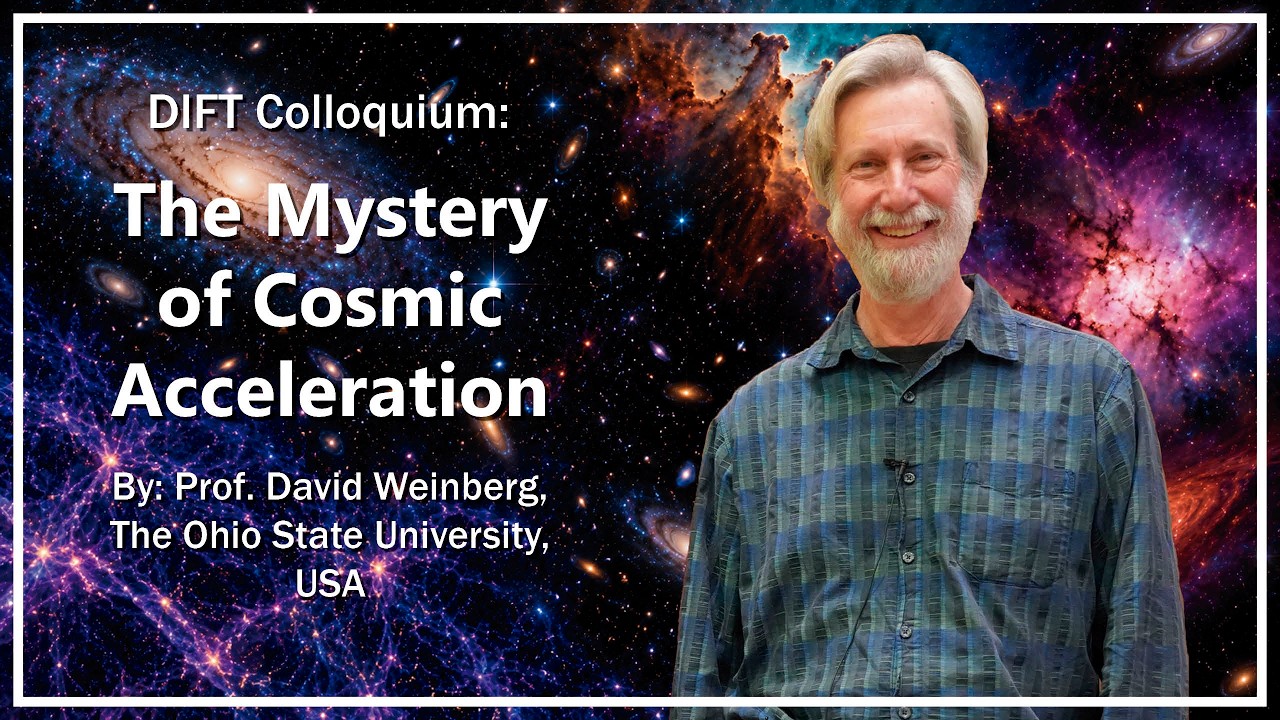
DIFT Colloquium "The Mystery of Cosmic Acceleration" - David Weinberg
Keywords
Summary
224 words
Critical Evaluation
Value of the Information & Strength of the Argument
The lecture provides a high-value synthesis of the field, effectively combining historical context, key physical concepts, and the latest observational results. The argumentation is logically structured: it first establishes the empirical puzzle, then explains why the acceleration implies new physics, and finally outlines how current and future measurements can distinguish between competing theories. Weinberg is careful to distinguish well-established facts from speculative scenarios, and he clearly states when a particular explanation is ‘bad’ (i.e., ad hoc) versus when it emerges naturally from particle physics. He also highlights the significance of independent verification (e.g., two groups measuring supernovae) and the complementary role of CMB and large-scale structure data. The discussion of DESI’s recent hints of evolving dark energy is presented with appropriate scientific caution, noting the need for further confirmation. Overall, the argumentation is rigorous and accessible, suitable for an informed scientific audience.
Scientific Rigor, Source Quality, Title Accuracy
The scientific rigor is high. Weinberg cites specific experiments (DESI, Euclid, Vera Rubin, Roman) and mentions a comprehensive review article co-authored with a ‘cast of great co-authors’ (likely the Dark Energy Task Force report), as well as the Particle Data Group dark energy review. He grounds his claims in well-established cosmological data and does not overstate findings. The title ‘The Mystery of Cosmic Acceleration’ accurately reflects the content; the talk indeed focuses on the mystery, its history, and the path to solving it. There are no obvious inconsistencies or unfounded assertions. The speaker also includes a touch of humor and personal anecdotes, which do not detract from the scientific substance.
267 words
Title / Content Match
The title precisely matches the content: the talk is entirely devoted to cosmic acceleration, its evidence, explanations, and ongoing observational programs.
Quality & Reliability
9/10
Talk delivered by a renowned cosmologist, covering both historical milestones and contemporary state-of-the-art results (including DESI). Presentation is balanced, references well-known missions and methods, and avoids speculative overreach.
Key Moments
Markers derived by PSI from the transcript: the creator did not define chapters.
- Introduction to the talk and framing of cosmic acceleration as a mystery: gravity repels on cosmic scales.
- Historical milestones: Mercury's precession, Hubble's expanding universe, dark matter, and the cosmic microwave background.
- Discovery of cosmic acceleration through Type Ia supernovae and the need for a negative-pressure component.
- Explanation of the Lambda-CDM model and the many 'bad ideas' to explain dark energy, including the cosmological constant and anthropic selection.
- Observational techniques: supernovae, baryon acoustic oscillations, weak lensing, and redshift-space distortions.
- DESI's recent results suggesting possible evolution of dark energy, and upcoming experiments (Euclid, Rubin, Roman) that will sharpen measurements.
Cited Sources
- DESI - Dark Energy Spectroscopic Instrument — Mentioned as the main current experiment providing new data on dark energy.
- Euclid mission (ESA) — Cited as a space mission currently producing data to probe cosmic acceleration.
- Vera C. Rubin Observatory — Mentioned as a ground-based observatory beginning operations to map the sky and measure weak lensing.
- Nancy Grace Roman Space Telescope — Cited as a future NASA mission expected to launch in September and improve cosmological measurements.
- Particle Data Group dark energy review — Weinberg mentions his periodic review of dark energy for the PDG, a concise summary of current knowledge.
Concurring Sources
- DESI official site — Provides independent information about the experiment and its recent results, consistent with the talk.
- Euclid mission page — Confirms the mission's status and objectives, aligning with the lecturer's description.
Contribution & Novelties
The talk provides an up-to-date overview of cosmic acceleration, focusing on the latest DESI results that hint at a possible time-varying dark energy. It synthesizes a wide body of literature and highlights the transition to next-generation experiments that could decisively test Lambda-CDM. The speaker’s personal perspective and historical framing add depth, while clearly delineating what is established versus speculative.
Pour aller plus loin :
- Dark energy (Wikipedia) — Comprehensive background on the concept and its role in cosmology.
- Baryon acoustic oscillations (Wikipedia) — Explanation of the standard ruler technique used by DESI.
- Dark Energy Spectroscopic Instrument (DESI) — Official site with current results and project details.
- [The Physics of Dark Energy (arXiv)] (no stable URL) — If accessible, a deep review of theoretical models; but the exact URL is not verified.
131 words
Radar Profile
The radar profile shows high scores across all dimensions, with a slight dip in 'niveau technique' (8) reflecting the use of advanced physics, but overall the talk is highly informative, reliable, and well-argued.