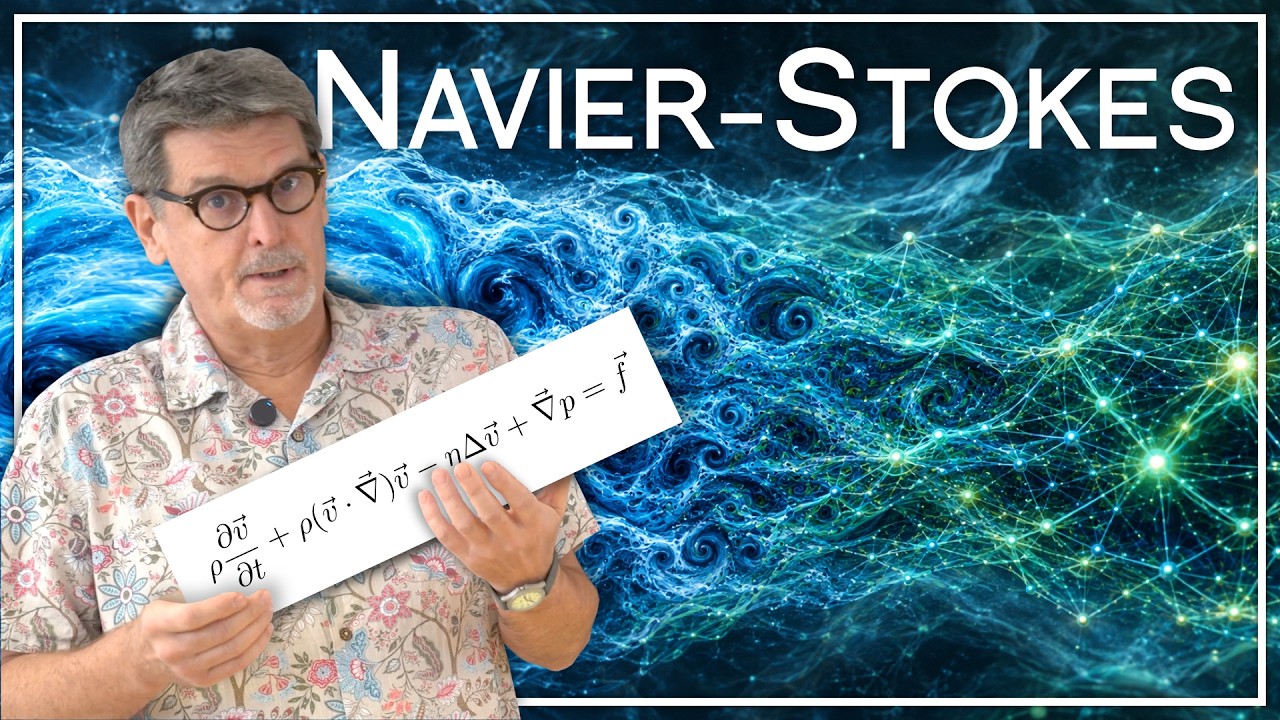
Navier-Stokes: la Física del problema del milenio que ha resuelto la IA
Navier-Stokes: The Physics of the Millennium Problem that AI has solved
Keywords
Summary
250 words
Critical Evaluation
Value of the Information & Strength of the Argument
The video’s value lies in its clear and pedagogical explanation of a notoriously complex topic. Landsteiner successfully translates the abstract Navier-Stokes equation into intuitive physical concepts (inertia, friction, pressure) without oversimplifying to the point of inaccuracy. The argumentation is logically structured: from the observed phenomena, to the mathematical formulation, to the specific aspect of the Millennium problem, and finally the discussion of physical relevance and limitations. The introduction of the Reynolds number and its consequences (microorganisms, turbulence) is particularly well done. However, the segment on the OpenAI result is descriptive and does not provide a deep analysis of the mathematical proof itself, nor does it discuss the robustenss or the scientific community’s reception in detail. The video does not mention any caveats about the validity of the AI proof beyond the fact that it needs to be digested by humans. The intellectual honesty in distinguishing between the mathematical result and its physical interpretation is commendable and adds value.
Scientific Rigor, Source Quality, Title Accuracy
The scientific rigor is acceptable for a science communication video. The derivation of the Navier-Stokes equation is standard and correct. The explanation of the Reynolds number and turbulence is accurate. The presentation of the Clay Millennium problem is precise. Regarding sources, the video description provides links to the Clay Institute page, the OpenAI article and PDF, and the ICMAT article on Diego Córdoba’s work, which are relevant and legitimate. However, the video does not critically assess the peer-review status of the OpenAI proof, nor does it contextualize it within the broader history of efforts on this problem beyond mentioning Córdoba’s group. The title is slightly sensationalist (“ha resuelto la IA”) but acceptable as a hook, and the content does indeed discuss this result. No public comments were provided for analysis.
303 words
Title / Content Match
The title emphasizes the AI solution, which is the hook of the video, and the content effectively addresses both the physics of the Navier-Stokes equations and the recent AI result. The framing is slightly sensationalist but overall consistent with the content.
Quality & Reliability
7/10
Video by a physicist researcher from a recognized institute (IFT), presents the Navier-Stokes equations and the context of the recent OpenAI result with scientific clarity. The explanation is simplified but accurate. However, the claim about the AI 'proof' is presented without critical caveats (e.g., the proof is not yet peer-reviewed, and the video relies on OpenAI's announcement). The video is a popular science explainer, not an original peer-reviewed contribution.
Chapters
Cited Sources
- Clay Mathematics Institute – Navier-Stokes Equation — Referenced in the video description as the source of the official Millennium Prize problem description.
- OpenAI article – Navier-Stokes solution — The video discusses the recent OpenAI result on singularities in Navier-Stokes; the link is provided in the description.
- OpenAI paper – Navier-Stokes (PDF) — Direct link to the technical paper (166 pages) about the AI proof mentioned at the end of the video.
- ICMAT article on Diego Córdoba and Luiz Martínez-Zoroa — Referenced in the description in relation to the work of the Institute of Mathematical Sciences in Madrid on the Navier-Stokes problem.
Concurring Sources
- Clay Mathematics Institute – Navier-Stokes Equation — The official problem statement aligns with the video's description of the Millennium Problem.
Dissenting Sources
- No discordant sources identified — The video does not present any controversial or debated claims that would require counter-sourcing. The OpenAI result is recent and the video aligns with the announcements, without alternative perspectives.
External References
Contribution & Novelties
The video’s original contribution is its pedagogical framing of the recent OpenAI mathematical result within the physical intuition of fluid dynamics. It successfully connects a highly abstract mathematical proof (finite-time singularity) to the physical question of turbulence and the necessity of relativistic corrections, which is a perspective often missing in general media coverage. The explanation of why singularities cannot occur in the real world (speed of light limit) and the link to relativistic hydrodynamics and quark-gluon plasma is subtle and relevant.
Pour aller plus loin :
- Navier-Stokes equations — Foundational mathematical background.
- Reynolds number — Key dimensionless number governing flow regimes.
- Turbulence — The physical phenomenon central to the problem.
- Millennium Prize Problems — The context of the Clay Institute prize.
- Quark-gluon plasma — Mentioned in relation to relativistic hydrodynamics; the Wikipedia article at https://en.wikipedia.org/wiki/Quark%E2%80%93gluon_plasma provides additional detail.
138 words
Radar Profile
The profile is fairly balanced across all four axes, with slightly lower scores on reliability (6/10) and information quality (7/10) compared to technical level (7/10). This reflects a video that is visually and conceptually rich but offers limited critical depth on the AI proof, mitigating the overall reliability score.