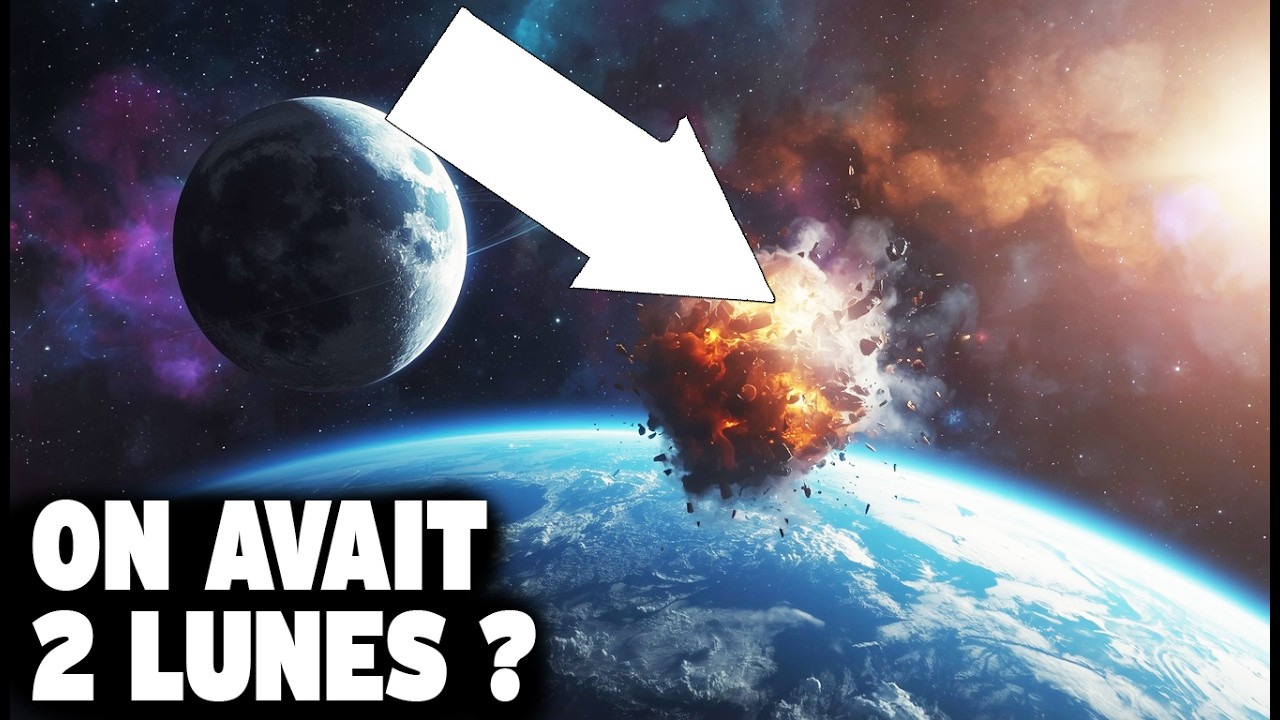
La Terre a déjà eu deux lunes, et l'une d'elles a disparu - DOCUMENTAIRE ESPACE
The Earth has already had two moons, and one of them has disappeared - SPACE DOCUMENTARY
Keywords
Summary
93 words
Critical Evaluation
Value of the Information & Strength of the Argument
The video provides a coherent summary of the two-moon hypothesis, presenting the arguments and some supporting evidence. It effectively explains the logical deductions and the role of simulations. However, the argumentation is one-sided, with limited presentation of counterarguments. The lack of direct citations to sources weakens the ability to verify claims. The addition of unrelated content reduces the overall value.
Scientific Rigor, Source Quality, Title Accuracy
The video mentions several specific studies (e.g., Asphaug & Jutzi 2011 in Nature, GRAIL mission, Chang’e 6) and discusses their findings. However, it does not provide direct URLs or full references, making it difficult to trace the sources. The title accurately describes the main topic, but the video’s content diverges significantly later, which may mislead viewers expecting a focused documentary on the two moons. The scientific rigor is moderate, with some simplifications and a few transcription errors in names.
154 words
Title / Content Match
The title focuses on the two-moon hypothesis, but the video expands to multiple unrelated space topics (Sirius, exoplanets, cold stars), which dilutes the focus. The actual content on the two moons is only a portion of the video.
Quality & Reliability
7/10
The video presents a well-known scientific hypothesis (the two-moon theory) and references several actual studies (Asphaug & Jutzi 2011, GRAIL mission, Chang'e 6, Laskar's obliquity calculations). However, it also includes extraneous content on other stars and exoplanets, and some names are slightly mispronounced. The scientific content is generally accurate but simplified for a general audience. The sources are not systematically cited with URLs, and the video does not provide a critical discussion of all competing hypotheses in depth.
Key Moments
Markers derived by PSI from the transcript: the creator did not define chapters.
- Introduction to the Moon's uniqueness and the two-moon hypothesis.
- Overview of the giant impact hypothesis and formation of the Moon.
- Presentation of Asphaug & Jutzi model of a second moon at Lagrange points.
- GRAIL mission evidence for thick farside crust.
- Chang'e 6 samples and potential isotopic evidence.
- Transition to other space topics (Sirius, exoplanets).
Cited Sources
- Asphaug and Jutzi (2011) - Nature paper on the two-moon hypothesis — Proposed that a second moon formed from debris and collided with the Moon, explaining farside asymmetry.
- GRAIL mission (NASA) — High-resolution gravity mapping of the Moon, confirming farside crustal thickness differences.
- Chang'e 6 mission (CNSA) — Returned samples from the lunar farside, analyzed for composition differences.
- Laskar et al. (1993) - Obliquity stability study — Demonstrated that the Moon stabilizes Earth's obliquity, essential for climate stability.
Contribution & Novelties
The video contributes by synthesizing a scientific hypothesis and making it accessible to a general audience. It connects multiple strands of evidence (simulations, gravity data, sample return) to support the two-moon model. However, it does not present original research. The ‘Pour aller plus loin’ section offers further exploration:
- Giant-impact hypothesis — The leading theory for the Moon’s formation, which this video builds upon.
- Lagrange point — Gravitational equilibrium points where a second moon could have formed.
- GRAIL mission — NASA mission that provided gravity data supporting the farside crustal thickness difference.
- Chang’e 6 — Recent sample-return mission from the lunar farside, relevant to testing the hypothesis.
106 words
Radar Profile
The radar profile shows a balanced pattern with high 'quantity of information' and moderate 'technical level', but 'fiabilité' is slightly lower due to lack of direct sources. The overall shape indicates a general-interest documentary with substantial content.