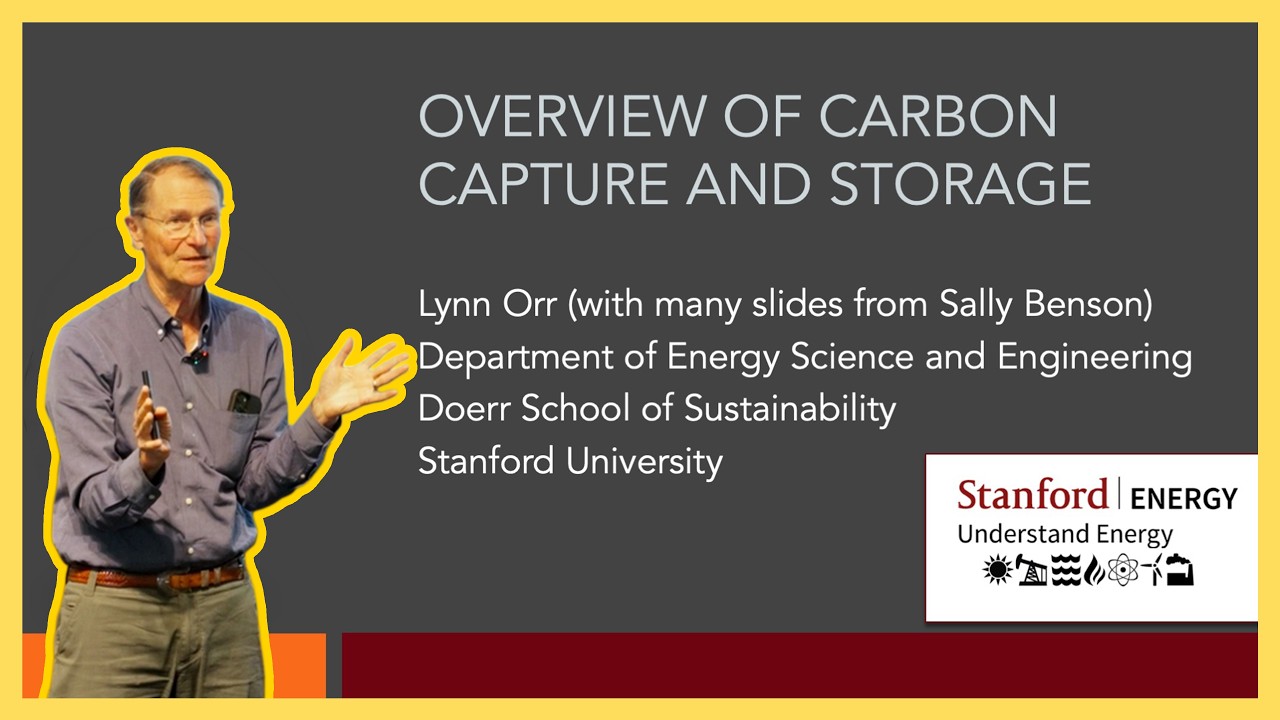
Carbon Capture and Storage (CCS) Lecture | Lynn Orr | Stanford Understand Energy
Keywords
Summary
251 words
Critical Evaluation
Value of the Information & Strength of the Argument
The primary value of this lecture lies in its rigorous systems thinking. Orr convincingly argues that CCS is not a silver bullet but a necessary ‘bridge’ technology for decarbonizing sectors where alternatives are currently impractical (like aviation), and as a flexible dispatchable resource to complement intermittent renewables. His argumentation is solidly grounded in thermodynamics, giving a physical foundation to cost estimates, and is enriched with real-world operational case studies. The explicit discussion of the scale mismatch (60 million tons current vs. billions needed) and the honest framing of CCS’s goal to eventually become obsolete demonstrates a balanced, scientifically honest perspective. The inclusion of an economic model (California grid savings) strengthens the practical value of the argument.
Scientific Rigor, Source Quality, Title Accuracy
The scientific rigor is excellent. The lecture is anchored by reference to established international scenarios (IEA), thermodynamics principles, and named operational projects with verified data (Sleipner, Decatur, Boundary Dam). The speaker, Lynn Orr, is a recognized authority, holding a named professorship in Petroleum Engineering at Stanford, which lends direct expertise to both the chemical and geological aspects of the talk. The title is an exact and unambiguous match to the content delivered. Sources provided in the description are traceable and authoritative: they link directly to the professor’s Stanford profile and the university’s dedicated carbon management learning hub.
228 words
Title / Content Match
The title perfectly and directly describes the content. The video is a structured university lecture covering the technological, economic, and geological aspects of Carbon Capture and Storage, without deviation.
Quality & Reliability
9/10
The lecture is delivered by Lynn Orr, a Stanford professor with deep expertise in petroleum engineering and energy science. It is grounded in quantitative data (costs per ton, IEA scenarios, project capacities), references specific operational projects (Sleipner, Decatur, Boundary Dam), and clearly explains thermodynamic limits. The speaker transparently addresses risks and scale challenges, demonstrating a high level of scientific objectivity and reliability.
Chapters
Cited Sources
- Lynn Orr - Stanford Profile — Official Stanford University profile of the lecturer, confirming his expertise and academic standing.
- Carbon Management - Understand Energy Learning Hub — Stanford's educational hub providing further resources on carbon management, complementing the lecture content.
- Understand Energy Newsletter — Free newsletter offering periodic updates on energy topics from Stanford University.
Concurring Sources
- International Energy Agency (IEA) — The lecture explicitly references IEA scenarios for the potential global contribution of CCS (approximately 9% of reductions by 2050).
- Intergovernmental Panel on Climate Change (IPCC) — Supports the lecture's rationale that negative emissions and CCS are integral in most climate pathways aiming for well-below 2°C warming.
Contribution & Novelties
The lecture excels at synthesizing technical, economic, and systemic aspects of CCS into a unified narrative. Its original contribution is the clarity with which it frames CCS as an economic and physical necessity for specific niches (hard-to-abate industries and grid flexibility), rather than a general solution. The discussion of the density anomaly of CO2-saturated water adding to storage security, and the thermodynamic floor for separation costs, adds depth not typical of standard overviews.
Pour aller plus loin :
- Carbon capture and storage — Wikipedia’s extensive overview of the technologies, history, and global projects discussed in the lecture.
- Direct air capture — Detailed technical explanation of the DAC methods highlighted as promising but costly in the talk.
- Sleipner gas field — Background on Norway’s pioneering CCS project (operational since 1996) which serves as a key model for the lecture’s assertions on long-term storage.
- Oxy-fuel combustion process — Explains the combustion method demonstrated at pilot scale for generating a concentrated CO2 stream for storage.
162 words
Radar Profile
The radar profile is highly balanced, with scores clustering around 8-9. Fiabilité and qualité are at the top, reflecting the expertise of the speaker and the depth of data. The niveau technique score is slightly lower, acknowledging the lecture's accessibility for an educated general audience rather than deep specialist jargon.