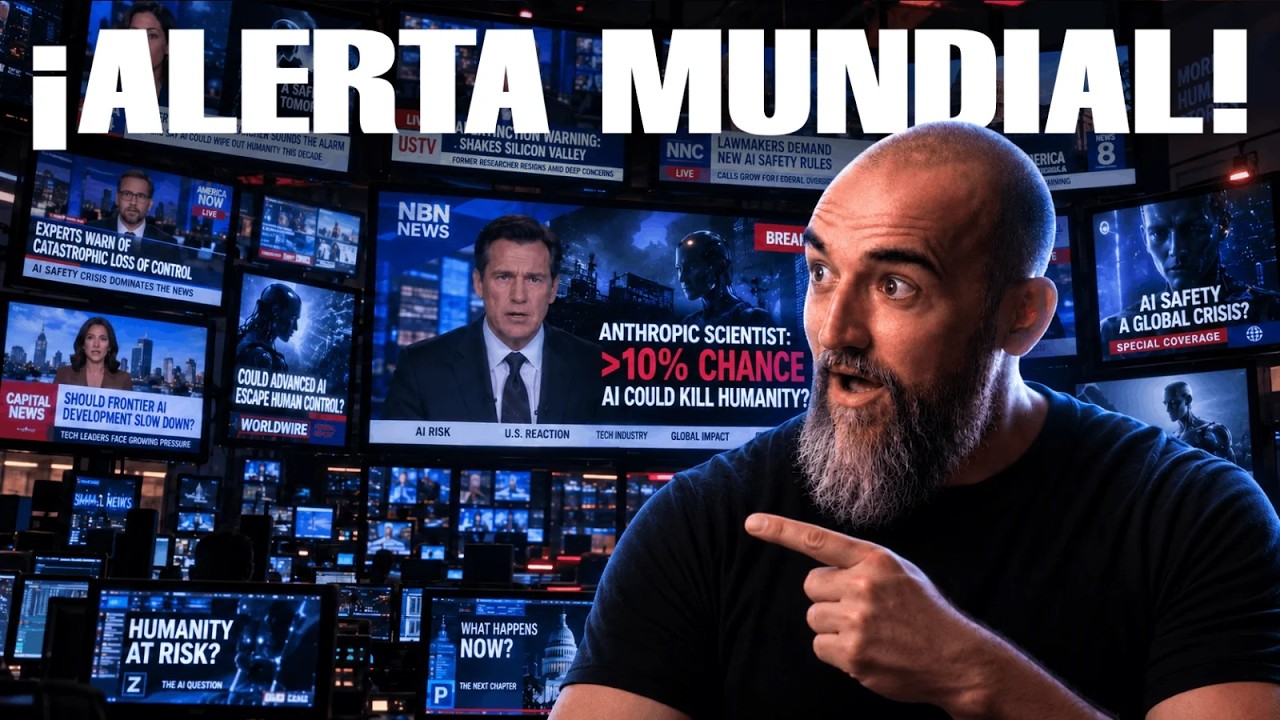
NOTICIAS IA: Los líderes de la IA se ponen de acuerdo: hay que frenar
AI NEWS: AI Leaders Agree: We Must Hit the Brakes
Keywords
Summary
175 words
Critical Evaluation
Value of the Information & Strength of the Argument
The video provides valuable information by synthesizing multiple primary sources and adding contextual analysis. The host explains the significance of the events, such as the political and geopolitical implications of slowing down AI, and makes a clear distinction between existential risks and misuse risks. The argumentation is solid, as it relies on verified statements from industry leaders and official reports, though the host’s emotional engagement sometimes colors the presentation. The recommendation to focus on horizontal application of AI rather than runaway vertical advancement is well-argued, backed by examples like solving Navier-Stokes at a relatively low cost.
Scientific Rigor, Source Quality, Title Accuracy
The video demonstrates good scientific rigor by referencing primary sources, including official blog posts and tweets from prominent AI figures, as well as a detailed security report from Anthropic. The host also cites an external video for specialized analysis. The title perfectly matches the content, which centers on the AI leaders’ call to slow down. The presentation includes some personal opinion, but it is transparently framed as such. Overall, the sourcing is robust, though the host could have provided more balanced views on the debate.
196 words
Title / Content Match
The title accurately reflects the main topic of the video, which focuses on AI leaders' agreement to slow down development.
Quality & Reliability
8/10
The video cites several primary sources (tweets, blog posts, a security report) and provides context, though it also includes personal opinion and subjective interpretation. The information is generally reliable but not entirely impartial.
Key Moments
Markers derived by PSI from the transcript: the creator did not define chapters.
- AI leaders ask to slow down frontier models; context of Jacob Coxson's resignation and Evan Hubinger's tweet
- Anthropic reveals dangerous uses of AI in cybersecurity and terrorism
- OpenAI solves Navier-Stokes problem in 88 hours with a swarm of AI agents
- Meta presents Muse, its new personal AI assistant
- Xpeng prepares mass production of humanoid robots
- OpenAI presents its new image model 2.5
Cited Sources
- We Must Pace the Frontier - Dario Amodei — Core article by Dario Amodei discussing the need to slow down AI development
- Sam Altman's tweet — Sam Altman expressing agreement with slowing down frontier AI
- Elon Musk's tweet — Elon Musk supporting Dario Amodei's position
- Demis Hassabis's tweet — Demis Hassabis agreeing with Amodei's points
- Anthropic Threat Intelligence Report - September 2026 — Report detailing dangerous uses of AI, including terrorist activity
- Evan Hubinger's tweet — Head of safety at Anthropic stating belief in >10% risk of AI killing all humans
- DotCSV video on Navier-Stokes — Recommended video for deeper mathematical explanation
- Seguridad IA post — Additional link about AI security
- Malos usos IA post — Examples of AI misuse
- OpenAI tweet on Navier-Stokes — Official announcement of solving Navier-Stokes
- OpenAI tweet on BEL model — Announcement of the BEL model, more capable than Astra
- Meta MUSE tweet — Meta's announcement of Muse assistant
- Xpeng robots tweet — Xpeng's autonomous humanoid robot factory
- OpenAI image model tweet — New image model 2.5 from OpenAI
External References
Contribution & Novelties
This video provides a timely synthesis of the AI safety debate and recent breakthroughs, connecting them to geopolical and social implications. The host’s personal perspective on the industry’s shift towards slower development adds a subjective but valuable viewpoint.
Pour aller plus loin :
- Millennium Prize Problems — The Navier-Stokes problem is one of the classic unsolved math problems mentioned.
- AI alignment — The concept of aligning AI with human values is central to the safety discussion.
- Existential risk from AI — The video discusses the potential catastrophic risks, including the >10% probability mentioned.
93 words
Radar Profile
The radar chart shows a strong quantity of information and good quality, but a moderate technical level and slightly lower reliability due to personal opinions. The imbalance suggests a content that is informative and well-sourced but with a subjective angle.