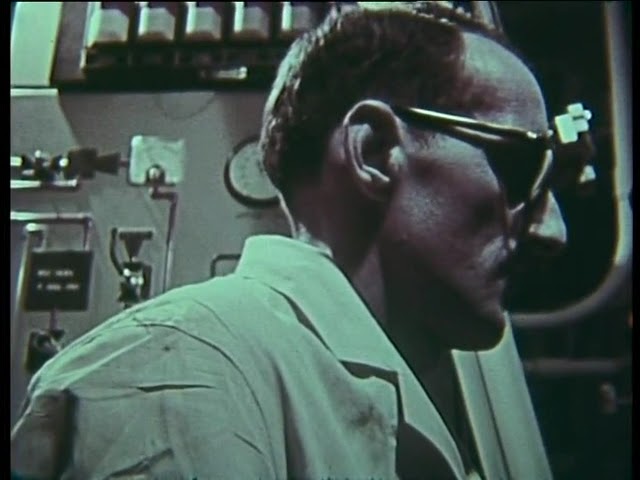
Fabrication of SNAP-7D Fuel Sources
Keywords
Summary
168 words
Critical Evaluation
Value of the Information & Strength of the Argument
The video’s value lies in its rare, firsthand visual documentation of nuclear fuel fabrication processes from the 1960s. It provides detailed technical steps—precipitation, filtration, calcination, pellet pressing, sintering, welding, and leak testing—each shown with actual equipment. The argumentation is implicit but clear: the process is safe, precise, and applicable for peaceful remote power generation. The step-by-step presentation is logical and thorough, with no assertion unexplained. However, it lacks comparative analysis or broader context; it is purely a process demonstration.
Scientific Rigor, Source Quality, Title Accuracy
The source is an institutional archival film from the IAEA and US DOE, making it authoritative for historical accuracy. The technical details align with known nuclear engineering practices of that era. The title is perfectly matched to the content; it delivers precisely the promised fabrication walkthrough. No external sources are cited beyond the provenance note; the film itself is a primary source. Comments are not available for analysis, so no public reception is assessed.
168 words
Title / Content Match
The title accurately describes the content, as it specifically showcases the step-by-step fabrication of SNAP-7D fuel sources.
Quality & Reliability
8/10
The video is a historical archival film from the IAEA and US DOE, showing actual fabrication processes. The technical detail is high and the provenance is authoritative, though the footage is dated and not peer-reviewed.
Key Moments
Markers derived by PSI from the transcript: the creator did not define chapters.
- Introduction: strontium-90 fuel capsules for SNAP-7D generator, showing the generator and location
- Shipment of strontium-90 carbonate from Hanford to ORNL, up to 350,000 curies
- Filtration of slurry using stainless steel shells and ceramic thimbles
- Calcination in furnace at 1100°C for 4 hours
- Pulverizing and blending powder, weighing 40g portions on lab balances
- Pressing pellets at 5,000 psi then 11,000 psi using die body inversion
- Sintering pellets at 1400°C for 8 hours, showing shrinkage
- Loading pellets into inner capsules using vacuum tool with spacers
- Welding inner and outer capsules using pressure dome welder with argon purging
- Leak testing with krypton-85 in vacuum chamber and cleaning capsules
- Loading sources into generator channels, cooling bath and fitting checks
- Generator assembly and mention of other SNAP projects using strontium-90 at ORNL
Cited Sources
- IAEA Lise Meitner Library Archive — The video is digitized and published by the IAEA with permission, referencing the US DOE; the description mentions this provenance.
Contribution & Novelties
This film offers a unique visual record of nuclear fuel fabrication in the 1960s, providing explicit operational details that are often only described textually. It contributes to the historical understanding of radioisotope thermoelectric generator (RTG) production and the SNAP program. The novelty is its direct demonstration of remote handling and welding procedures under radiation shielding.
Pour aller plus loin :
- Radioisotope thermoelectric generator — Context on RTG operation and applications.
- Strontium-90 — Properties of the isotope used.
- Systems for Nuclear Auxiliary Power (SNAP) — Overview of the SNAP program, including 7D.
- Oak Ridge National Laboratory — History and role in nuclear research.
102 words
Radar Profile
The radar shows high scores in information quantity, quality, and reliability, with a slightly lower technical level due to the film's age and some unclear details. The profile is consistent for a well-documented historical engineering process.