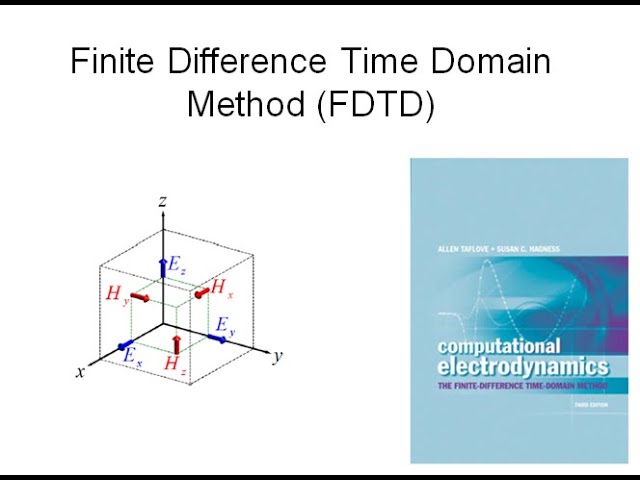
Lecture 10 (Part 1) Introduction to FDTD method
Keywords
Summary
152 words
Critical Evaluation
Value of the Information & Strength of the Argument
The lecture provides a solid conceptual foundation for FDTD, explaining the rationale behind the method and its derivations clearly. The argumentation is logical, moving from Maxwell’s equations to discrete approximations, and finally to the update equations. It highlights both advantages (broadband simulation, time-domain insights) and disadvantages (staircasing error, computational cost) of FDTD, offering a balanced view. The use of visual aids and examples, such as wave propagation animations, enhances understanding. However, the lecture does not critically examine alternative methods or compare FDTD with other numerical techniques in depth, limiting its analytical depth.
Scientific Rigor, Source Quality, Title Accuracy
The lecture cites a single academic source (empossible.net) as the basis for the presentation, which is reputable in the field of photonics. The Google Drive link likely contains the presentation slides. The content aligns with established FDTD theory, and the derivations are standard. The title matches the content precisely. No contradictory sources or major inaccuracies were identified. The public comments are not provided, so no insight into community reception is available.
178 words
Title / Content Match
The title accurately describes the content: an introductory lecture on the FDTD method, consistent with the material presented.
Quality & Reliability
7/10
The lecture is well-structured and based on a known academic course (empossible.net). It provides a clear step-by-step derivation of the FDTD update equations, but lacks in-depth validation or referencing of sources within the video itself.
Key Moments
Markers derived by PSI from the transcript: the creator did not define chapters.
- Introduction and review of Maxwell's equations, focusing on the curl equations
- Advantages of FDTD over frequency-domain methods, including broadband simulation
- Introduction to finite difference approximations and the importance of consistent evaluation points
- Derivation of the FDTD update equations and the Yee lattice arrangement
- Discussion on grid discretization, computational cost, and stability considerations
Cited Sources
- EMP5304 Electromagnetic Simulation - Course Materials — The presentation is based on this course, which provides slides and materials on FDTD.
- Lecture slides on Google Drive — The full presentation slides used in the lecture.
Contribution & Novelties
The video offers an educational contribution by explaining FDTD in Arabic, making this computational technique accessible to Arabic-speaking students and researchers. It provides a step-by-step derivation of the update equations, which is valuable for learners. While not presenting new research, it serves as a didactic resource.
Pour aller plus loin :
- Finite-difference time-domain method — Background and applications.
- Yee grid — Explanation of the spatial discretization used in FDTD.
- Courant–Friedrichs–Lewy condition — Stability criterion for FDTD simulations.
- Maxwell’s equations — Foundational equations solved by FDTD.
85 words
Radar Profile
The radar profile shows balanced scores across information quantity, quality, and technical level, with slightly lower global reliability due to the absence of in-video source citations and the lecture's introductory nature. The method is well-explained but not deeply critical.