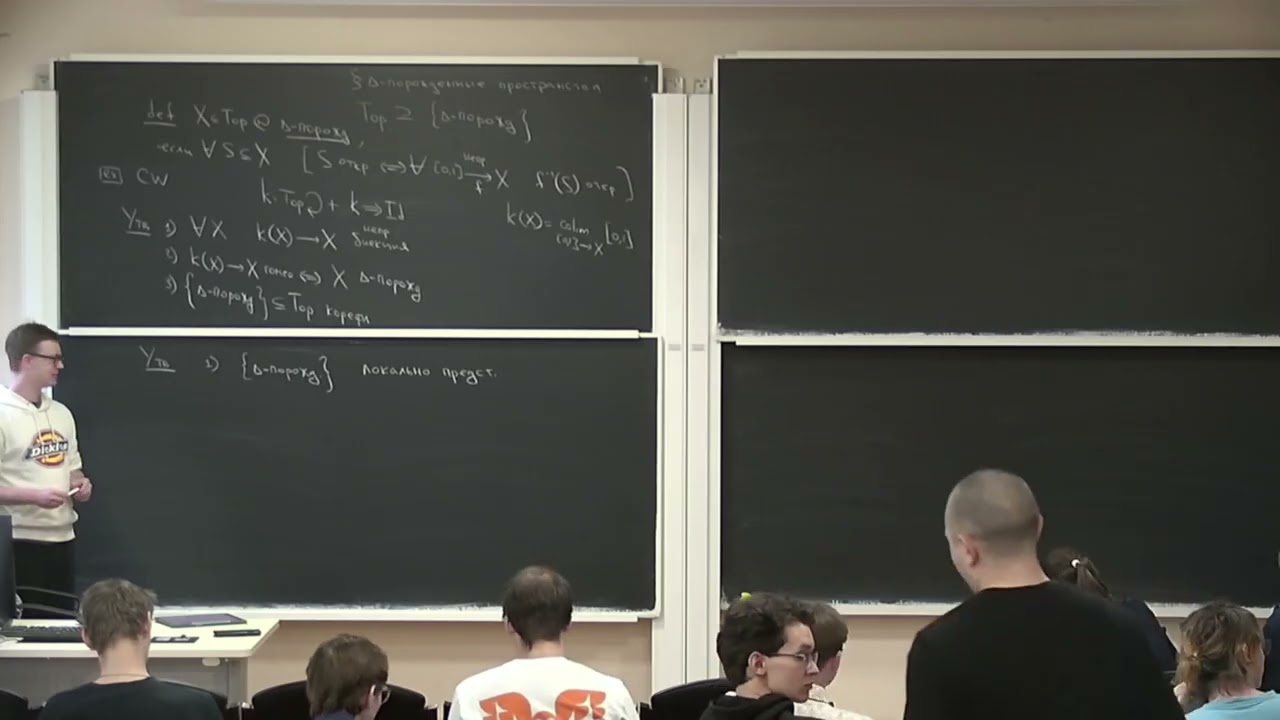
Лекция 1 | Рациональная теория гомотопий | Вася Ионин
Keywords
Summary
164 words
Critical Evaluation
Value of the Information & Strength of the Argument
The lecture provides substantial mathematical value by carefully motivating the choice of delta-generated spaces and presenting categorical tools (localisation, weak equivalences) essential for homotopy theory. The argumentation is rigorous: definitions are explicit, properties are stated as theorems and proved or intuitively justified, and the dialogue with students clarifies subtle points regarding universal properties and the 2-of-6 rule. The treatment of the localisation functor, including the detailed exchange on the distinction between isomorphism and equivalence, demonstrates the depth and liveliness of the presentation.
Scientific Rigor, Source Quality, Title Accuracy
No external sources are explicitly cited in the video, which is typical for an advanced lecture series; the instructor draws on standard mathematical results and concepts (delta-generated spaces, locally presentable categories) whose correctness is assumed from the literature. The title accurately outlines the content: it is indeed the first lecture on rational homotopy theory, introducing the categorical foundations. The internal rigour is high, as every notion is formally defined and the reasoning is logical, even though the scope is intentionally limited to those aspects needed for the course.
185 words
Title / Content Match
The title faithfully reflects the content: a lecture on rational homotopy theory, first in a series, covering foundational categorical frameworks.
Quality & Reliability
9/10
Rigorous mathematical lecture delivered by a specialist, with precise definitions, proofs, and interactive dialogue with students. The content is inherently logical and verifiable, and the discussion is consistent with standard literature on homotopy theory.
Key Moments
Markers derived by PSI from the transcript: the creator did not define chapters.
- Introduction of δ-generated spaces and the motivation for working with them.
- Properties of the functor K and its role as a coreflector.
- Local presentability of δ-generated spaces and comparison with compactly generated spaces.
- Definition of categories with weak equivalences and the 2-of-6 property.
- Construction of the homotopy category via zig-zags and universal property.
- Detailed discussion on localisation and the role of the universal property in defining the homotopy category.
Contribution & Novelties
The lecture offers a clear pedagogical exposition of the categorical foundations of rational homotopy theory, with a particular emphasis on the advantages of δ-generated spaces over the usual topological category. It clarifies the universal property of localisation and the role of the 2-of-6 axiom, which is often underemphasised in standard treatments. This foundational material prepares the listener for the subsequent constructions in the field.
Pour aller plus loin :
- Model category — Key structure underlying homotopy theory, closely related to the categorical setup discussed.
- Homotopy category — The universal construction inverting weak equivalences, described in the lecture.
- Rational homotopy theory — The subject of the lecture series; provides further context for the goal of the course.
116 words
Radar Profile
The radar profile is extremely high on technical level and information quality, indicating a dense, expert-level lecture. The relatively lower scores on breadth or accessibility are expected for an advanced specialised course, but the presentation excels in rigour and depth.