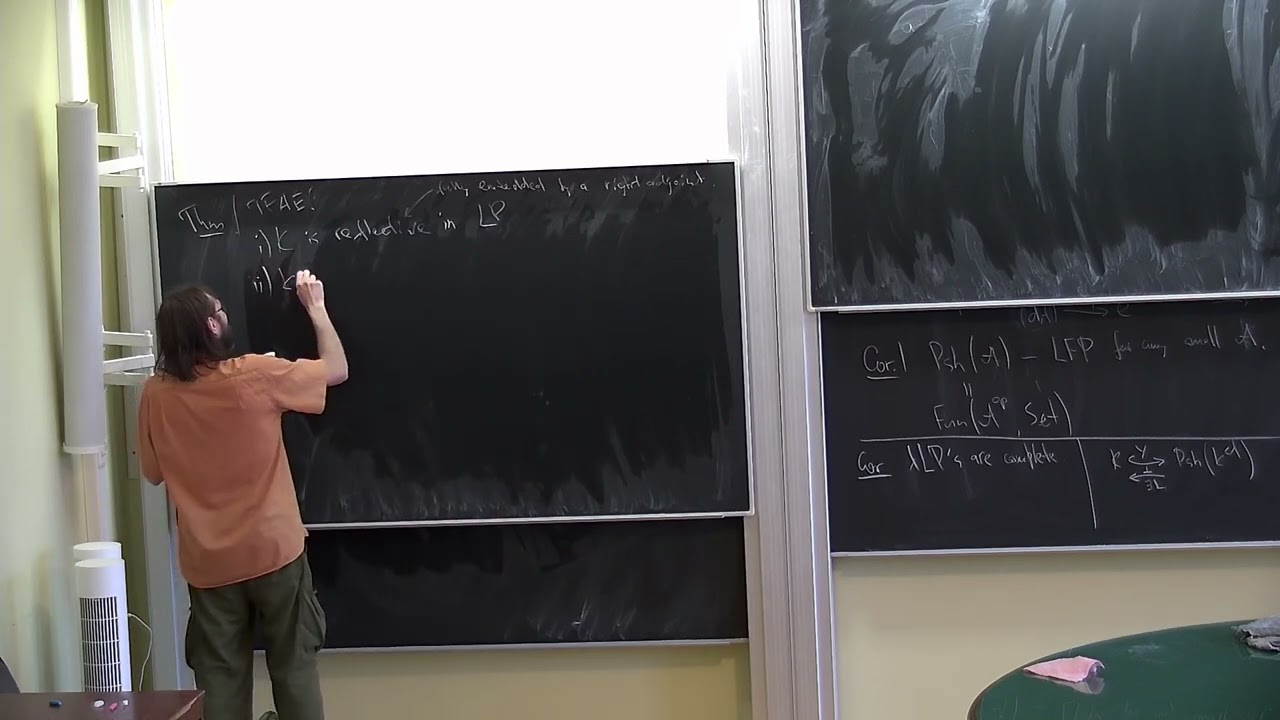
Лекция 2.2 | Локально представимые категории | Денис Терёшкин
Keywords
Summary
202 words
Critical Evaluation
Value of the Information & Strength of the Argument
The lecture provides valuable insight into the structure theory of locally presentable categories. It carefully proves lemmas and theorems, emphasizing the logical coherence of the arguments. The reasoning is solid, building on known results about presheaf categories, adjoint functors, and reflective subcategories. The lecturer also acknowledges subtleties and potential pitfalls, such as the non-equivalence of some conditions without additional hypotheses. The discussion about notation discrepancies among different authors (e.g., Adamek, Rosický, Makkai) adds to the intellectual rigor. Overall, the information is highly technical and precise, and the argumentation is convincing.
Scientific Rigor, Source Quality, Title Accuracy
The lecture demonstrates high scientific rigor. The proofs are detailed and rely on established categorical concepts. References are made to the literature: the works of Adamek and Rosický (likely ‘Locally Presentable and Accessible Categories’), Makkai, and Pare. The lecturer mentions that errors in original proofs by some authors were later corrected, showing attention to accuracy. The title exactly reflects the content, as it is a lecture on locally presentable categories. The presentation is well-organized, though the handwriting on the board is noted as somewhat messy, but the verbal explanation is clear.
196 words
Title / Content Match
The title accurately matches the content: it is a lecture on locally presentable categories, continuing a series. The lecture presents key structural theorems and their proofs.
Quality & Reliability
8/10
Advanced lecture on category theory by a knowledgeable instructor. Content is rigorous and well-structured, but is not peer-reviewed and relies on the lecturer's expertise.
Key Moments
Markers derived by PSI from the transcript: the creator did not define chapters.
- Recap of previous lemma and discussion of adjoint functor theorem conditions.
- Corollary: locally presentable categories are complete, using dense embeddings into presheaves.
- Statement of preliminary theorem characterizing reflective subcategories of locally presentable categories.
- Proof of implications: from complete+generator to reflective, etc.
- Discussion of dense generators and the role of reflector preserving colimits.
- Preview of future equivalences: λ-locally presentable, reflective in presheaves closed under filtered colimits, and sketches.
- Mention of notation issues and errors in literature, and motivation for developing techniques.
Cited Sources
- Locally Presentable and Accessible Categories (book) — Referenced as the source for the theory and where corrected proofs are found.
- Makkai's work on locally presentable categories — Mentioned in context of early proofs containing errors.
- Pare's work — Mentioned in conjunction with corrected expositions in Makkai-Pare.
Concurring Sources
- Locally Presentable and Accessible Categories — Standard reference confirming the theory presented.
Contribution & Novelties
The lecture’s original contribution lies in its pedagogical clear presentation of classical results in locally presentable category theory. It provides a careful walk-through of fundamental theorems and their proofs, highlighting logical connections and subtle points. The lecturer also adds personal remarks about notation and technical difficulties, which can be useful for learners.
Pour aller plus loin :
- Locally presentable category — Basic definition and properties.
- Adjoint functor theorem — General theorem used in the lecture.
- Reflective subcategory — Concept central to the discussion.
83 words
Radar Profile
The radar profile shows extremely high technical level (10) and qualitative information (9), with moderate quantity (8) and reliability (8). This indicates a dense, advanced lecture that is highly informative but may be too technical for general audiences.