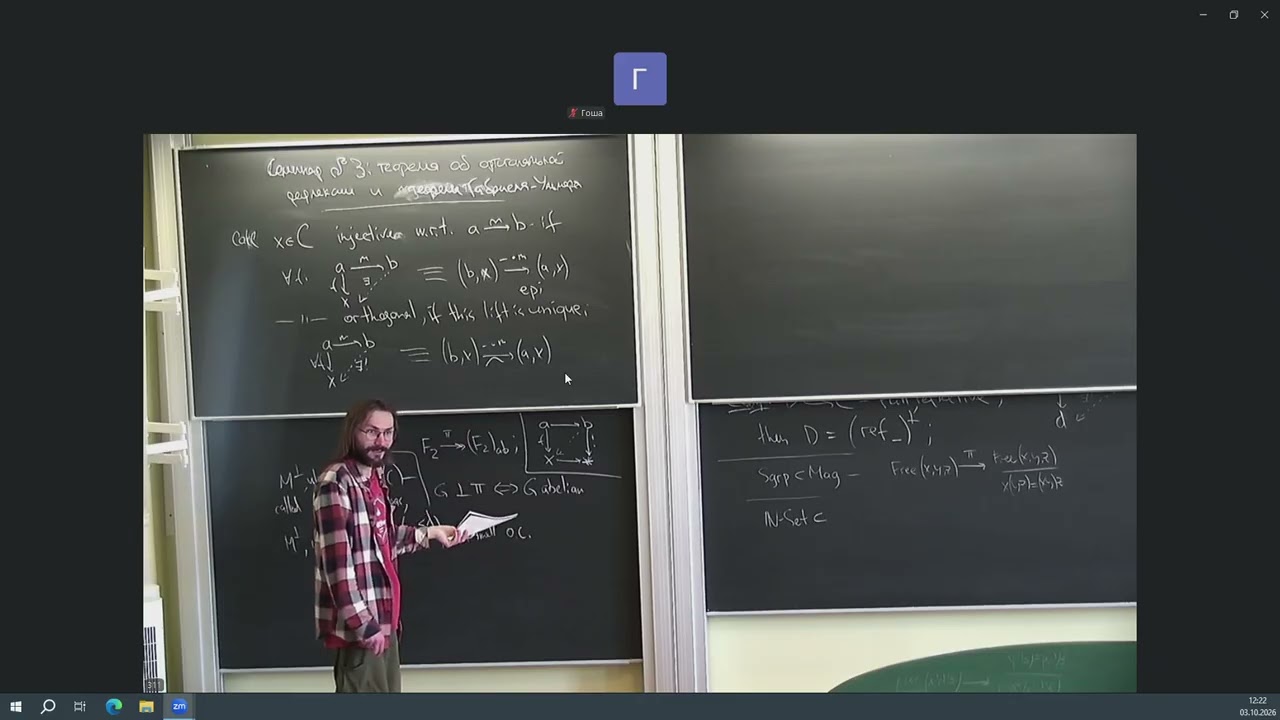
Лекция 3.1 | Локально представимые категории | Денис Терёшкин
Keywords
Summary
196 words
Critical Evaluation
Value of the Information & Strength of the Argument
The lecture provides a solid and detailed argumentation, with a step-by-step proof of a nontrivial theorem. The speaker carefully defines all objects and morphisms, and he verifies naturality and universal properties. The value lies in its didactic clarity: it breaks down a complex theorem into manageable computational and diagrammatic steps. The argumentation is rigorous, though it demands a strong background in category theory. The use of an AI tool to restructure the proof is an interesting methodological addition, but it does not affect the mathematical content.
Scientific Rigor, Source Quality, Title Accuracy
The speaker mentions Kelly’s theorem and the book by Adámek and Rosický as references, but provides no formal citations within the video. The mathematical content appears accurate and coherent. The title matches the content, which indeed focuses on locally presentable categories. No external sources are linked in the description, and the lecture is self-contained. The audience’s comments are not provided, so no trend analysis is possible.
167 words
Title / Content Match
The title accurately describes the lecture's focus on locally presentable categories; content matches.
Quality & Reliability
8/10
The lecture is a rigorous, detailed mathematical exposition, but relies on oral references and the speaker's own derivations; external verification is limited.
Key Moments
Markers derived by PSI from the transcript: the creator did not define chapters.
- Introduction to orthogonal classes and Galois correspondence.
- Examples of orthogonal classes: monoids, sets with operations, relations.
- Proof that orthogonal classes are closed under lambda-filtered colimits.
- Statement of Kelly's theorem and necessity of hypotheses.
- Construction of pointed endofunctor S and iterative reflection.
- Detailed verification of the proof and conclusion.
Cited Sources
- Kelly's theorem on reflective subcategories — Referenced as the key theorem proved in the lecture.
- Adámek and Rosický, Locally Presentable and Accessible Categories — Mentioned as the standard reference for the techniques.
Concurring Sources
- Locally presentable category - Wikipedia — This page confirms the definitions and general framework that the lecture assumes.
Contribution & Novelties
The lecture offers an unusually detailed and pedagogical walkthrough of Kelly’s theorem on reflective subcategories, a result that is often treated abstractly. It provides explicit constructions and emphasizes the necessity of each hypothesis. The use of an AI to reorganize a proof from the literature is a novel, though ancillary, contribution. The lecture is valuable for graduate students and researchers in category theory.
Pour aller plus loin :
- Locally presentable category — Direct relevance to the subject.
- Reflective subcategory — Core concept used throughout.
- Adjoint functor theorem — Underpins the existence of reflectors.
- Filtered colimit — Central to the proof’s technical details.
102 words
Radar Profile
The radar profile is strongly skewed towards technical depth, with minimal emphasis on broad applicability or accessibility. This reflects a specialized lecture aimed at advanced students, where mathematical rigor dominates over general audience engagement.